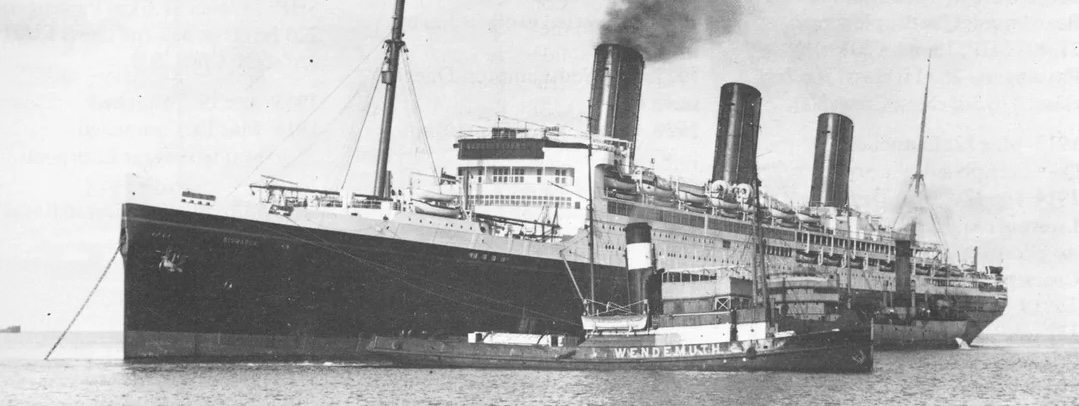
SS Bismarck (1914)
Hamburg America Line · launched 1914 · completed 1922 as RMS Majestic
Overview
SS Bismarck was the third vessel of Hamburg America Line's immense Imperator class, following Imperator and Vaterland. Blohm & Voss built her at Hamburg as yard no. 214. She was launched on 20 June 1914 in a major public ceremony attended by Kaiser Wilhelm II and named by Countess Anna Bismarck, a granddaughter of Otto von Bismarck.
Only weeks later, the First World War halted the peacetime program for which she had been created. The ship remained incomplete at Hamburg throughout the war and never made a commercial voyage for HAPAG. After the war she was ceded under reparations arrangements, completed in Germany under British supervision, and entered White Star Line service in 1922 as RMS Majestic.
The change from Bismarck to Majestic is not a minor rename. It marks one of the clearest examples of the First World War redistributing the physical infrastructure of the Atlantic liner trade: a German prestige flagship, conceived as part of HAPAG's challenge to British dominance, became the largest and most conspicuous ship in White Star's postwar fleet.
Key Facts
A few retrospective web references incorrectly give the launch as 20 July 1914. Contemporary reporting in The Times dated 22 June described the launch as having taken place on 20 June, and specialist liner histories use the same date.
The Largest Expression of HAPAG's Prewar Program
The Imperator-class ships were conceived less as pure speed machines than as floating demonstrations of scale, comfort, and national industrial prestige. Bismarck was slightly longer than Vaterland and was intended to culminate Albert Ballin's strategy of competing through enormous passenger capacity and monumental public spaces.
Her planned interiors followed the same broad architectural language seen in her sisters: great dining and social rooms, extensive first-class accommodation, and decorative schemes intended to give passengers the impression of a grand hotel rather than a machine at sea. The French architect Charles Mewès contributed to the prewar interior conception, although he died in 1914 and never saw the finished ship.
Launch and Wartime Suspension
The launch on 20 June 1914 occurred only days before the assassination of Archduke Franz Ferdinand and little more than a month before Europe entered general war. Contemporary reports described one of the largest crowds ever assembled at the Hamburg yard, with about 15,000 invited guests inside Blohm & Voss alone.
When war began in August, fitting-out slowed and then stopped. Machinery and interiors remained incomplete, and the hull spent the war years at Hamburg rather than in Atlantic service. This is why authentic HAPAG-era Bismarck material consists mainly of launch souvenirs, yard photographs, promotional images, plans, and press coverage rather than tickets, menus, passenger lists, or voyage documents.
Postwar Transfer
After Germany's defeat, the unfinished ship became part of the reparations settlement. By 1919 she had been assigned to Britain, and work resumed in Hamburg. Ownership arrangements around the ex-German giants were somewhat more complicated than a simple one-step “handover”: Cunard and White Star interests were involved jointly in the disposition of Imperator and Bismarck, with Bismarck ultimately allocated to White Star.
Completion remained politically charged. A suspicious fire damaged the unfinished vessel on 5 October 1920. Work nevertheless continued, with Blohm & Voss finishing the ship under British oversight and adapting parts of the prewar design for White Star requirements.
Completion as Majestic
On 28 March 1922 the completed ship left for trials. When White Star representatives formally took possession, specialist accounts note that Blohm & Voss had retained the original name Bismarck on the bow and painted the funnels in Hamburg America colors—a final visual assertion of the vessel's German origin.
She became RMS Majestic in April and departed Southampton on 10 May 1922 for Cherbourg and New York. At 56,551 gross tons and roughly 956 feet long, she was then the world's largest passenger liner and remained White Star's largest ship ever operated. Royal Museums Greenwich preserves a circa-1922 White Star brochure explicitly marketed as Majestic: the world's largest ship.
The later career as Majestic belongs to the same hull but a different operational identity. She spent her White Star career on the Southampton–Cherbourg–New York service, was withdrawn in 1936, then sold for conversion into the Royal Navy training ship HMS Caledonia. A fire destroyed the ship at Rosyth in September 1939; the wreck was later raised and scrapped.
The Bismarck–Majestic Identity Boundary
Bismarck never entered commercial HAPAG service. Her German identity therefore belongs to construction, launch, and the suspended prewar program; the completed passenger career belongs to the same hull under the White Star name Majestic.
This makes date and naming especially important in cataloging. Material labeled Bismarck should normally relate to the 1914 launch or construction period, while service-era passenger material from 1922 onward belongs to Majestic.
War as a Fleet-Redistribution Event
The ship's transfer after the First World War illustrates how the peace settlement redistributed not only finished vessels but also unfinished capital projects. A liner conceived as the culmination of Hamburg America Line's prewar prestige program became the flagship-sized replacement tonnage of a British competitor.
That transformation is historically more significant than a simple rename. It moved technology, investment, and symbolic prestige across national and corporate boundaries without changing the underlying hull.
Interpretive Notes
There were no HAPAG passenger voyages: any purported 1914–21 menu, passenger list, or ticket claiming to document a commercial voyage by Bismarck requires exceptional scrutiny, because the ship never entered HAPAG service.
Identity follows date and context: launch photographs and German promotional pieces properly belong to Bismarck; White Star operational material from 1922 onward belongs to Majestic; naval material from the late 1930s belongs to HMS Caledonia.
The ship's completion is part of the history, not an interruption to it: the nearly eight-year gap between launch and maiden voyage is precisely what makes the vessel historically significant. Her physical survival through the war allowed a prewar German prestige project to become a central component of British postwar liner service.
Evidence-first ship guideSources (Selected)
- Ocean Liner Curator — Sources (master bibliography)
- Atlantic Liners — SS Bismarck / RMS Majestic
- MaritimeQuest — Bismarck / Majestic builder's data and timeline
- Royal Museums Greenwich — White Star Line Majestic brochure, c. 1922
- Encyclopedia Titanica — transcription of The Times, 22 June 1914, launch report