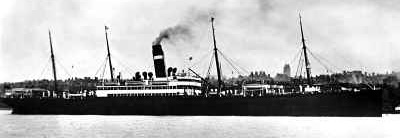
SS Brasilia
Hamburg America Line · 1898 · Ship Guide
Overview
SS Brasilia was a large Hamburg America Line emigrant and cargo steamer built by Harland & Wolff at Belfast. Launched on 27 November 1897 and completed in March 1898, she was designed primarily for the mass movement of emigrants between continental Europe and the United States rather than for the prestige express service occupied by HAPAG’s fastest liners.
Her career under the name Brasilia was brief. After service on the Hamburg–Baltimore route, she returned to Belfast for rebuilding and was sold in 1900 to the Dominion Line, which renamed her Norseman. Under that name she served as a Boer War transport, an emigrant and cargo liner, an Aberdeen Line chartered vessel, and finally a First World War transport.
Evidence-first note: published specifications differ because the ship was substantially altered before entering Dominion Line service. Her tonnage, accommodation, and external appearance as Norseman should not automatically be applied to her original Hamburg America Line configuration as Brasilia.
Key Facts
Design & Construction (Context)
Brasilia was conceived as a high-capacity emigrant and cargo vessel. Her accommodation was weighted heavily toward steerage traffic, reflecting the scale of late nineteenth-century migration from Central and Eastern Europe to the United States. She was not designed to compete directly with HAPAG’s luxury express steamers; her commercial purpose depended on volume, dependable schedules, and substantial cargo capacity.
Harland & Wolff constructed her with a steel hull, twin screws, and two quadruple-expansion engines. Her moderate speed was appropriate for an emigrant and freight service in which capacity and operating economy mattered more than record passages. In her original HAPAG form she carried one funnel and two masts. Her later four-masted appearance belonged to the altered vessel after her conversion for British ownership.
Service History (Summary)
1898: Entry into service. Brasilia departed Belfast for New York on 21 March 1898. She was then assigned to Hamburg America Line service between Hamburg and Baltimore, one of the principal routes used by emigrants traveling from continental Europe to the United States.
1898–1899: Hamburg–Baltimore voyages. Fleet records credit the ship with thirteen round voyages on the route between May 1898 and October 1899. Her unusually large steerage capacity made her representative of the migration system that joined European railways and embarkation ports with American immigration facilities and inland transportation networks.
1899–1900: Rebuilding and transfer. The ship returned to Harland & Wolff in 1899 for substantial alteration. In February 1900 she passed to the Dominion Line and was renamed Norseman. Her passenger arrangements were changed, her tonnage was reduced, and she emerged with a four-masted profile.
1900: Second Boer War transport. Before beginning regular Dominion Line employment, Norseman sailed from Liverpool for South Africa on 10 February 1900 as a transport. This marked the beginning of a British career quite distinct from her short period under the German flag.
Dominion Line and Aberdeen Line service. After her transport duties, Norseman worked as an emigrant and cargo liner. In 1910 she was chartered to the Aberdeen Line and employed on service linking Britain with Cape Town and Australia.
22 January 1916: Torpedoing. During First World War service in the eastern Mediterranean, Norseman was torpedoed by the German submarine U-39 in the Gulf of Salonika. The damaged ship settled in shallow water rather than disappearing completely. Her remains were later refloated and broken up in 1920.
Rebuilding as Norseman
The 1899–1900 rebuilding marked a genuine change in the ship's commercial identity rather than a simple change of name. Harland & Wolff reduced her measured tonnage, altered her accommodation, and changed the rig from two masts to four before she entered Dominion Line service as Norseman. The conversion shifted emphasis away from the enormous emigrant capacity of the original HAPAG arrangement toward cargo and steerage work.
Her transfer is therefore especially useful for interpreting photographs and technical descriptions. Images of the four-masted Norseman should not be silently backdated to Brasilia's original 1898 appearance, and later Dominion specifications should not automatically be treated as the ship's as-built HAPAG particulars.
1916 Torpedoing and Survival of the Hull
On 22 January 1916, while serving as Norseman and carrying military cargo toward Salonika, the ship was attacked by the German submarine U-39. She was torpedoed after earlier attempts missed, badly damaged, and ultimately beached rather than sinking in deep water. Contemporary and later records indicate that there were no human fatalities in the attack, although many of the animals aboard were lost.
The wreck remained accessible and salvageable. Sources commonly record the vessel as a constructive total loss and as being scrapped in situ or refloated for demolition in 1920. The distinction matters: the 1916 attack ended her service career, while physical dismantling of the hull continued later.
Interpretive Notes
Brasilia is historically important because her design makes the scale and economics of mass migration visible. Accommodation for roughly 2,400 steerage passengers placed her among the specialized emigrant carriers whose viability depended upon carrying large numbers of people at comparatively low fares together with commercially valuable cargo.
Her transfer also demonstrates how one hull could move through several national and corporate systems. As Brasilia, she belonged to HAPAG’s German-American migration network. As Norseman, she became part of British military transport, Dominion Line operations, and Aberdeen Line service to South Africa and Australia.
Image attribution requires particular care. A photograph showing the vessel with two masts is more likely to represent Brasilia during her Hamburg America Line career. Images showing four masts generally depict the rebuilt ship as Norseman. Captions that ignore the alteration can easily misdate the vessel.
Evidence-first ship guideSources (Selected)
Use these as a starting index and corroborate publish-ready details with contemporary German and British registers, HAPAG schedules, Dominion Line records, passenger manifests, and wartime shipping records where possible.
- Ocean Liner Curator — Sources (master bibliography)
- Harland & Wolff Shipbuilding Database — Brasilia, Yard No. 318
- Norway Heritage — SS Brasilia
- Norway Heritage — SS Norseman
- Great Ships — SS Norseman
- TheShipsList — Dominion Line fleet history
- Wikipedia — SS Norseman (1897) (starting index; corroborate key facts)
- Norway Heritage — SS Brasilia chronology
- Uboat.net — Norseman attack record, 22 January 1916