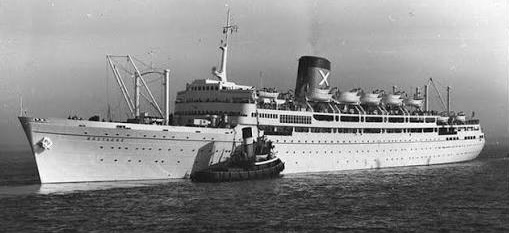
SS Bretagne
SGTM · 1951 · Ship Guide
Overview
SS Bretagne was a postwar French passenger liner built for the Société Générale de Transports Maritimes (SGTM), entering service in the early 1950s during the final substantial phase of French long-distance passenger shipping outside the very top prestige transatlantic express-liner category. She belonged to a world of Mediterranean, colonial, and long-haul passenger service that remained commercially important even as aviation increasingly reshaped global travel.
In collecting and interpretation, Bretagne is valuable because she represents a less frequently documented but historically important branch of French passenger-liner history. She should not be casually conflated with earlier CGT ships bearing the Bretagne name, nor with unbuilt “superliner” projects that circulated in French maritime discussion before the Second World War.
Key Facts
Published figures for tonnage, route emphasis, and accommodation wording can vary a little across fleet summaries and quick-reference sources. For stricter catalog work, preserve the exact terminology used by the cited source or by the artifact itself.
Design & Construction Context
Bretagne was built in the early postwar period when France was rebuilding its passenger fleet under materially and commercially constrained circumstances. She was not conceived as a headline prestige ship on the scale of the grandest French transatlantic liners, but rather as a practical and still dignified vessel suited to sustained passenger work in routes that remained strategically and commercially meaningful for France.
This matters interpretively. Ships like Bretagne show that the postwar liner story was not only about famous flagships such as Liberté or later France, but also about the medium-sized and regionally important vessels that kept broader passenger networks functioning. She belongs to the late but still serious operational world of passenger service before aviation fully displaced it.
Service History (Summary)
1951–1952: Built at Saint-Nazaire for SGTM and entered service in 1952. Her arrival formed part of postwar French fleet renewal at a time when passenger shipping still played a major role in imperial, emigrant, and regional mobility.
Early to mid-1950s: Operated in long-distance passenger service associated with Marseille and French Mediterranean or colonial-route networks. This is the principal early collecting phase, reflected in menus, brochures, passenger lists, baggage labels, company stationery, and cabin ephemera.
Late colonial and postwar transition era: Bretagne served during a historically transitional period in which passenger traffic patterns were shaped both by ordinary civilian travel and by the political realities of a changing French imperial world. This can affect how voyages and artifacts should be interpreted.
Late 1950s–1960s: Like many medium-sized passenger liners, she faced mounting competition from aviation and changing travel expectations. Ships built for respectable but not ultra-fast passenger service became increasingly vulnerable as air travel expanded.
End of career: She was eventually withdrawn and scrapped in the 1960s. Her relatively modest fame compared with larger French liners has made her less visible in popular memory, even though she represents an important operational category in postwar maritime history.
SGTM and the Marseille Long-Distance Trade
Bretagne was built for Société Générale de Transports Maritimes rather than the better-known Compagnie Générale Transatlantique. Her service world was centered on Marseille and long-distance Mediterranean-linked routes rather than the Le Havre–New York express trade.
That distinction is important for French liner history. Postwar France supported several different passenger-shipping systems, and Bretagne belongs to the southern and colonial-route tradition rather than the North Atlantic flagship lineage.
Late-Liner Economics
Entering service in 1952, Bretagne arrived just as long-distance aviation was beginning to erode the market for conventional passenger liners. Her relatively short SGTM career illustrates how quickly a ship designed for postwar route restoration could confront a changing transport economy.
Brittany and the Chandris Phase
Sold to Chandris Lines in 1960, the ship entered a new operating phase and was later renamed Brittany. The change shifted the same hull from French long-distance liner service toward the emerging Mediterranean cruise and migrant-ship market.
Her career ended abruptly after a serious fire at Skaramangas in April 1963. For attribution, the Bretagne and Brittany identities should be kept distinct even though they belong to the same vessel.
Interpretive Notes
Name duplication matters: “Bretagne” was used by more than one French passenger ship across different eras. Catalog records should preserve full identification, including line, date, and service context, rather than relying on ship name alone.
She is not best understood as a North Atlantic prestige liner: her importance lies in postwar French passenger networks beyond the most famous transatlantic headline ships. That makes her especially useful for a broader, less prestige-centered view of liner history.
Route context can change interpretation: a piece linked to Mediterranean passenger service, North African travel, or wider colonial-route service may carry a different historical meaning than a generic “French liner” description suggests.
This is a strong study ship for the late practical liner era: Bretagne helps illustrate how substantial passenger ships continued to matter after the age of the great interwar superliners, even when they attracted far less romantic attention.
Evidence-first ship guideSources (Selected)
- Ocean Liner Curator — Sources (master bibliography)
- SS Bretagne (1951) — overview chronology and basic specifications
- Clydeships / shipbuilding reference — construction and yard context
- Miramar Ship Index — registry and career reference context
- SS Maritime — general passenger-liner historical reference context