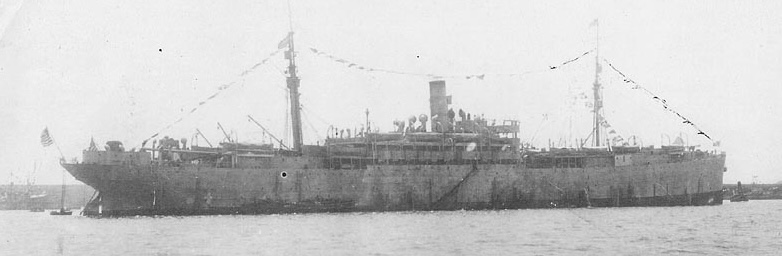
SS Bulgaria
Hamburg America Line · 1898 · Ship Guide
Overview
SS Bulgaria was a large Hamburg America Line passenger-cargo steamer built by Blohm & Voss at Hamburg. Launched on 5 February 1898 and completed in April, she belonged to HAPAG’s high-capacity “B” steamers and was intended principally for emigrant and freight traffic between continental Europe and North America.
Although not an express liner, Bulgaria became notable almost immediately. In February 1899 she was disabled in a severe Atlantic storm after losing steering control and remained overdue for weeks before reaching the Azores. Her survival became one of the best-known episodes of her career. She later served under the names Canada, Hercules, and Philippines, ending her life as an American transport and cargo vessel.
Evidence-first note: published tonnage and passenger figures vary because the ship was remeasured and altered during her career. This guide distinguishes her original 1898 particulars from later figures and avoids treating all recorded capacities as simultaneous.
Key Facts
Design & Construction (Context)
Bulgaria was built for capacity and economy rather than speed. Her long steel hull contained extensive cargo space together with accommodation heavily weighted toward steerage passengers. This made her particularly suited to the great migration flows moving through Hamburg at the end of the nineteenth century.
Two quadruple-expansion engines drove twin screws, providing both moderate speed and a degree of mechanical redundancy. The ship carried one funnel and two masts, producing the restrained profile typical of HAPAG’s large emigrant and cargo steamers. Ten watertight bulkheads and four principal decks were recorded in contemporary technical descriptions.
Service History (Summary)
1898: Entry into HAPAG service. Bulgaria began her maiden voyage from Hamburg through Halifax to New York on 10 April 1898. She entered service as a mixed passenger and cargo vessel with a very large emigrant capacity.
February 1899: Atlantic hurricane ordeal. During a westbound Atlantic passage, Bulgaria encountered a violent storm and suffered serious damage, including the loss or failure of steering control. For weeks she was overdue and feared lost. After improvised repairs and prolonged difficulty, she reached the Azores. The conduct of her captain and officers was later publicly recognized.
Regular North Atlantic service. After repairs, Bulgaria resumed HAPAG employment between Hamburg and North American ports. In May 1907 she arrived at New York carrying 2,724 steerage passengers during a record-setting day in which more than 20,000 immigrants entered the port aboard fourteen ships.
1910–1913: Boston and Baltimore route. The ship was assigned to Hamburg–Boston–Baltimore service. In early 1913 she was sold to Unione Austriaca and renamed Canada for a Trieste–Quebec–Montreal service. The experiment lasted only two round voyages because the vessel proved too large for the available traffic.
1913–1914: Return to HAPAG. Returned to her former owners, she again became Bulgaria and resumed service from Hamburg to Boston and Baltimore. Her final HAPAG arrival at Baltimore came in July 1914 as the European crisis was becoming war.
1914–1917: Internment at Baltimore. With German merchant services suspended, Bulgaria remained laid up in the neutral United States. American authorities later disabled and sealed her wireless equipment amid concern over transmissions from interned German vessels.
1917–1919: U.S. Army service. After the United States entered the war, the ship was seized and employed by the U.S. Army as an animal and general cargo transport. She served first as Hercules and later as Philippines.
1919: USS Philippines. Transferred to the United States Navy, she was commissioned as a troop transport and used to return American servicemen from France. Her troopship arrangement could carry nearly 4,000 enlisted personnel in addition to officers and crew.
1920–1924: Final commercial career. After naval decommissioning, Philippines was converted for cargo service. Her commercial revival was brief, and she was laid up by 1921 before being dismantled at Perth Amboy, New Jersey, in 1924.
The 1899 Atlantic Ordeal
Bulgaria's best-known early episode came less than a year after she entered service. In February 1899, while westbound across the North Atlantic, she encountered exceptionally severe weather and suffered serious steering damage. The disabled liner remained overdue long enough for fears of loss to spread ashore before she eventually reached the Azores after improvised repairs and prolonged work by her crew.
The episode is important not merely as a survival story but as evidence of the operating conditions faced by high-capacity emigrant steamers before modern forecasting, radio networks, and oceanic rescue coordination. Contemporary accounts emphasized the endurance of the ship's company, and later summaries note that the captain and officers were formally recognized for their conduct.
From Emigrant Liner to American Transport
The First World War radically altered Bulgaria's identity. Laid up at Baltimore after the suspension of German transatlantic service, she was seized after the United States entered the war in 1917 and employed by the U.S. Army under the names Hercules and later Philippines. In 1919 she entered U.S. Navy service as USS Philippines (ID-1677) and helped return American troops from Europe.
That sequence gives the ship unusual documentary range: HAPAG emigrant material, wartime seizure records, Army transport records, and Navy troop-return material all belong to the same hull. Her postwar cargo career was short, and she was ultimately broken up at Perth Amboy in 1924.
Interpretive Notes
Bulgaria belonged to a class of liners whose historical importance lies less in luxury than in scale. Ships such as this carried the overwhelming majority of transatlantic migrants, linking European departure systems with American ports and railways.
Her 1899 survival is also instructive. The episode illustrates both the vulnerability of large steamships before modern weather forecasting and the ability of crews to improvise when steering, machinery, and communications failed far from land.
Her later identities reveal how the First World War reassigned merchant ships across national boundaries. A German emigrant liner became an American animal transport, naval troopship, and merchant freighter—all without changing the underlying hull built at Hamburg in 1898.
Evidence-first ship guideSources (Selected)
Use these as a starting index and corroborate publish-ready details with German registers, HAPAG schedules, passenger manifests, United States Army and Navy records, and contemporary newspaper reporting.
- Ocean Liner Curator — Sources (master bibliography)
- Norway Heritage — SS Bulgaria
- GG Archives — SS Bulgaria Archival Collection
- Naval History and Heritage Command — USS Philippines
- Titanic Inquiry Project — Bulgaria technical particulars
- Wikipedia — SS Bulgaria (1898) (starting index; corroborate key facts)