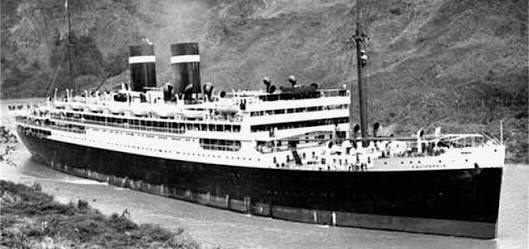
SS California
Panama Pacific Line · entered service 1928 · Ship Guide
Overview
SS California was the first of Panama Pacific Line’s three large American-built intercoastal liners, followed by Virginia and Pennsylvania. Built at Newport News and entering service in January 1928, she connected New York with the Pacific Coast by way of Havana and the Panama Canal. Her route, machinery, and commercial purpose placed her in a distinctly American branch of liner history: long-distance domestic and intercoastal passenger travel rather than the familiar North Atlantic express trade.
The ship is especially important technologically. California was a major early commercial application of turbo-electric propulsion, using steam turbines to generate electricity for large propulsion motors driving twin screws. At launch she was widely presented as the largest American-built passenger liner then completed and as a conspicuous demonstration of modern American marine engineering.
Her historical significance extends well beyond machinery. In March 1936, while at San Pedro, California became the scene of a three-day crew strike led by Joseph Curran. The dispute over wages and overtime became an important episode in the transformation of American maritime labor and the emergence of the National Maritime Union.
In 1938 the ship’s original career ended. She was acquired by the United States Maritime Commission, extensively rebuilt, renamed Uruguay, and placed in South American service. During the Second World War she became a large troop transport, survived a severe 1943 collision with the tanker Salamonie, and later returned to civilian service before withdrawal in 1954 and scrapping in 1964.
Evidence-first note: sources disagree on the shipyard hull number. Some later compilations list yard no. 315, while a contemporary Newport News construction notice has been cited for hull no. 325. Because that discrepancy has not been independently resolved here, this guide does not present a yard number as settled fact.
Key Facts
Design & Construction
California was conceived for a route made practical by the Panama Canal. Panama Pacific Line could offer a through passenger service between the American East and West Coasts without requiring travelers to cross the continent by rail. The ship therefore belongs to a hybrid world of ocean liner, coastal passenger ship, mail carrier, and long-distance domestic transport.
At Newport News she was given a modern machinery installation centered on turbo-electric drive. Oil-fired boilers supplied steam to turbines connected to electrical generators; those generators in turn supplied the propulsion motors. The arrangement allowed the turbines to operate efficiently at high rotational speed while the propellers turned at the lower speeds appropriate for marine propulsion. Contemporary technical reporting treated the installation as an important demonstration of electric drive at liner scale.
The ship’s public identity was equally modern. First-class accommodation included air conditioning, and some cabins had private bathrooms. Direction-finding equipment and other contemporary navigational systems reinforced the image of a technically advanced American liner. Her two-funnel Panama Pacific appearance also gave her a strong visual identity distinct from the one-funnel profile she would later carry as Uruguay.
The Panama Pacific Sister Trio
California was the lead ship of a three-vessel program completed by Virginia and Pennsylvania. The sisters were built at Newport News for the same intercoastal service and shared the broad technological concept of large American-built turbo-electric passenger liners. Together they formed the modern core of Panama Pacific Line’s late-1920s fleet.
Their relationship is particularly useful for interpretation because the three ships later followed parallel second careers. After Panama Pacific withdrew from the route, the vessels were rebuilt and renamed Uruguay, Brazil, and Argentina respectively for South American service. The three names therefore describe not only sister ships but two successive fleet identities built around the same hulls.
Intercoastal Service Through the Panama Canal
California left New York on 28 January 1928 to begin service toward the Pacific Coast. The route linked New York with Havana, the Panama Canal, Los Angeles-area ports, and San Francisco. It offered passengers a long sea passage between the two American coasts and used the canal not merely as a transit shortcut but as the central geographic fact of the service.
Panama Pacific’s liners also represented a different social and commercial environment from the great immigrant routes of the Atlantic. The company marketed comfortable through travel, mail carriage, and an increasingly automobile-conscious form of tourism. The sisters became associated with a period when the canal supported a distinctive American passenger corridor between two oceans.
The 1936 California Strike
On 1 March 1936, while California lay at San Pedro, crew members led by seaman Joseph Curran refused to sail unless disputes involving wages and overtime were addressed. The action was not authorized by the International Seamen’s Union. It lasted three days and attracted federal attention before a settlement allowed the ship to sail.
The significance of the episode lies in what followed. Curran became a central figure in the new National Maritime Union, organized in 1937 during a broader upheaval in American maritime labor. The California strike was therefore not simply an isolated onboard dispute; it became part of the origin story of a major American seafaring union and of changing labor relations aboard U.S.-flag merchant ships.
Interpretive caution: it is reasonable to describe the strike as an important precursor to the National Maritime Union. Claims that the three-day action alone “created” the union compress a larger sequence of labor conflict and organization.
End of Panama Pacific Service
By the late 1930s Panama Pacific’s economics had deteriorated. Federal mail subsidies were withdrawn in 1937, canal toll changes increased operating costs, and labor problems added further pressure. The company ended the New York–California liner service in 1938. California was the last of the three sisters to leave active Panama Pacific operation, joining Virginia and Pennsylvania in New York in early May.
Rebuilt as SS Uruguay
The United States Maritime Commission acquired the ship in June 1938. Newport News then carried out a substantial rebuilding. Her two-funnel silhouette became a single-funnel profile, passenger spaces were altered, air conditioning was extended, a swimming pool was added, and fire-safety work reflected the stricter federal standards of the later 1930s.
Renamed Uruguay, she entered the New York–South America trade under American Republics Line and Moore-McCormack management. Her route connected New York with Caribbean and Brazilian ports, Montevideo, and Buenos Aires. This was not simply a continuation of the Panama Pacific service under another name; it was a new route system, new commercial identity, and materially altered ship.
Second World War Troopship Service
Following American entry into the Second World War, Uruguay was converted for troop transport. Her wartime capacity was increased to roughly 4,473 troops, and a hospital was installed. She operated under War Shipping Administration arrangements in support of U.S. Army movement requirements.
Her voyages became global. She carried troops and personnel through the Panama Canal to the South Pacific, across the Atlantic to Britain and North Africa, and later toward India and the western Pacific. These movements place the former intercoastal liner within the much larger wartime story of civilian passenger ships adapted for military logistics.
The 1943 Collision with Salamonie
On 12 February 1943, while Uruguay was carrying thousands of troops across the North Atlantic, the U.S. Navy tanker Salamonie suffered a steering failure and struck the transport amidships. The tanker’s bow tore deeply into Uruguay and penetrated the hospital area. Thirteen soldiers were killed and dozens were injured.
The ship survived. Her crew controlled the flooding, constructed temporary internal protection, and brought the damaged transport safely to Bermuda. Captain Albert Spaulding later received the Merchant Marine Distinguished Service Medal in recognition of his actions during the emergency. The episode is one of the clearest demonstrations that California/Uruguay had a historically substantial second life far removed from her peacetime Panama Pacific image.
Postwar Return and Final Years
After wartime service, Uruguay was restored for civilian operation and returned to the South American passenger trade. She resumed service in the late 1940s and continued under Moore-McCormack until withdrawal on 29 March 1954.
She then remained out of active passenger service for a decade before being scrapped in 1964. Her lifespan therefore stretched from the optimism of late-1920s American liner construction through Depression-era labor conflict, wartime transport, and the postwar decline of traditional long-distance passenger shipping.
Interpretive Notes
California is not primarily a North Atlantic liner story: her original historical frame is the New York–California intercoastal trade through the Panama Canal.
Her machinery is central to her importance: turbo-electric propulsion was not incidental equipment; it was one of the features that made the ship notable when new.
The 1936 strike deserves independent attention: the ship occupies an unusual place at the intersection of liner history and American labor history.
California and Uruguay should be cataloged as two operating identities of one hull: photographs, menus, passenger lists, and ephemera should be dated to the correct route and configuration.
The sister relationship is unusually strong: California, Virginia, and Pennsylvania were not merely contemporaries; they formed a purpose-built three-ship program and later became Uruguay, Brazil, and Argentina.
Precision requires caution: published dimensions, tonnage figures, and the Newport News hull number can differ across sources. Preserve the measurement context and source wording rather than forcing incompatible figures into a false single value.
Evidence-first ship guideSources (Selected)
- Ocean Liner Curator — Sources (master bibliography)
- Pacific Marine Review — “Largest American-Built Passenger Liner” (1928), contemporary construction and design description
- Pacific Marine Review — electrical equipment of SS California, contemporary technical account
- Smithsonian National Museum of American History — model and historical description of California/Uruguay
- Online Archive of California / San Francisco Maritime National Historical Park — SS Uruguay survey report and historical note
- U.S. Maritime Administration — Vessel History Database and agency vessel-history resources
- U.S. Army Center of Military History — World War II historical resources, including troopship documentation
- SS California (1927) — consolidated chronology with references to Lloyd’s Register, Pacific Marine Review, MARAD, and wartime transport sources