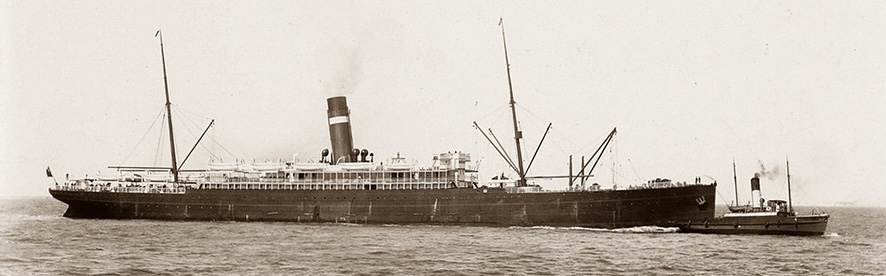
SS Canada (1896)
Dominion Line · entered service 1896 · Ship Guide
Overview
SS Canada was a Dominion Line liner built by Harland & Wolff at Belfast for the practical Britain–Canada trade. Launched on 14 May 1896 and entering service that October, she belonged to the migration-centered world of late nineteenth-century Atlantic travel: regular schedules, seasonal Canadian navigation, mail and cargo work, and large numbers of ordinary passengers moving between Britain and North America.
Her significance lies precisely in that everyday infrastructure. Canada was not a record-breaking prestige ship, but a durable liner whose career connected Liverpool with Quebec and Montreal, shifted seasonally toward Boston and Halifax, and later expanded into government transport work during both the South African War and the First World War.
Key Facts
Built for the Canadian Migration Trade
Canada's design reflected a market in which migration and practical transport mattered at least as much as saloon prestige. Large third-class accommodation allowed the ship to carry substantial numbers of emigrants, while first- and second-class spaces served travelers with different budgets and expectations.
That mixed passenger profile is historically important. The ship's paper trail—passenger lists, tickets, sailing notices, baggage labels, immigration records, and company advertisements—documents the ordinary mechanics of Atlantic movement far more directly than luxury-focused material alone could do.
Seasonal Route Logic
The Liverpool–Quebec–Montreal route depended on the navigability of the St. Lawrence. Winter ice forced changes in port usage, and Canada consequently appeared on Boston and Halifax-linked services as the company kept the ship commercially active through the colder months.
This seasonal flexibility should be preserved in cataloging. A Boston passenger list and a Montreal passenger list do not contradict one another; they can represent different times of year within the same operating system. Dated route material is therefore especially valuable evidence.
Dominion Line and Corporate Context
Canada's principal identity is Dominion Line, but later material may appear under White Star-Dominion wording or related corporate arrangements. That does not necessarily indicate an error. Shipping-company identity could shift through ownership, management, ticketing, and branding before the physical ship changed at all.
For objects, the safest method is date-sensitive: record the line name printed on the item, then explain broader corporate context separately. A catalog should not overwrite contemporary wording merely to impose a later corporate label.
Passenger Service as Infrastructure
Ships like Canada are a corrective to a glamour-only history of ocean liners. Their significance lies in repetition: voyage after voyage carrying migrants, families, mail, cargo, and travelers moving onward through rail networks in Canada and the United States.
That routine work built the transatlantic system. The absence of a spectacular disaster or famous speed record does not make the ship historically minor; it makes the surviving operational evidence especially valuable.
Boer War Service
During the South African War, Canada was used as a transport. This placed the ship in a different administrative and human context from ordinary passenger service. Troop movements, official orders, and government use produced records unlike the familiar commercial ephemera of the Dominion Line period.
Photographs or documents from this phase should therefore be identified as military transport material rather than simply “Dominion Line” objects.
First World War
The ship again served transport functions during the First World War, including troop carriage. By then she was already an older vessel, but her size and reliability still made her useful to wartime logistics.
This later service adds another provenance layer. A 1916 military reference and an 1898 passenger list may concern the same hull, yet they belong to completely different operational worlds.
Postwar Years and Retirement
After the war, Canada returned to commercial use, with passenger arrangements altered as market needs changed. She remained in service into the 1920s before finally being sold for breaking at Genoa in 1926.
The long career means specifications and class arrangements should be tied to dates. “As built” figures are not automatically valid for every later period.
Collecting Profile
Because Canada was a working migration liner, historically meaningful material often appears in genealogical, military, immigration, or regional Canadian collections rather than in high-end liner memorabilia markets. Passenger lists, landing papers, postcards, route brochures, and wartime references can all be important.
Strong attribution anchors include the ship name printed in the original design, a Dominion Line imprint, a dated sailing, or a route such as Liverpool–Quebec–Montreal. A generic image labeled only “Canada” is much weaker evidence because the name was widely reused.
Passenger Experience Across Classes
The original accommodation arrangement—roughly 200 first class, 200 second class, and 800 third class in commonly cited summaries—shows how deliberately the ship balanced several markets. Saloon passengers encountered a conventional late-Victorian liner environment, while the much larger third-class complement reflected migration and family travel on a very different economic basis.
Those differences matter when interpreting surviving objects. A first-class menu, an emigrant passenger list, and a wartime transport photograph all belong to the same ship but document different social worlds. Preserving those distinctions makes the guide more useful than a single undifferentiated service summary.
Why Ordinary Ephemera Matters
Because Canada was a working liner rather than a celebrity ship, her most revealing artifacts are often ordinary. A baggage label can identify route and company; a passenger list can link a family to a specific crossing; a sailing notice can show seasonal port changes. These modest documents can carry stronger evidence than an attractive but weakly attributed souvenir.
Interpretive Notes
The safest shorthand is “SS Canada (Dominion Line, 1896).” The year and operator help distinguish her from numerous other ships carrying the national name.
Her historical value is social and infrastructural: migration, Canadian service, seasonal route adaptation, and wartime transport. Those themes should remain central rather than being compressed into a few specifications.
Evidence-first ship guide