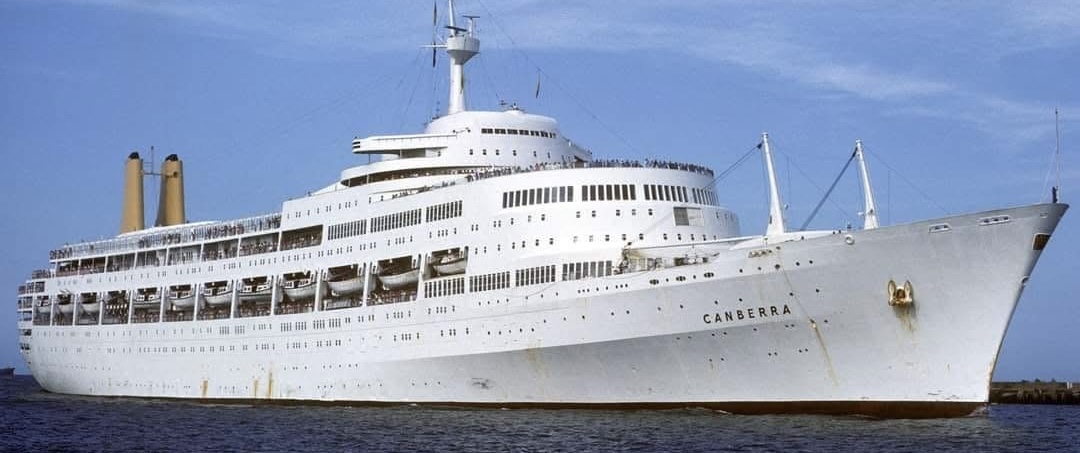
SS Canberra
P&O · entered service 1961 · Ship Guide
Overview
SS Canberra was P&O's great postwar liner for the Britain–Australia trade, built by Harland & Wolff at Belfast and completed in 1961. She arrived at the end of the scheduled long-distance liner era, when assisted migration and sea travel still mattered but commercial aviation was rapidly changing the economics of passenger shipping.
Her unusually long second life as a cruise ship and her 1982 Falklands service made her far more than a short-lived late liner. The same ship moved from migrant transport to one-class cruising, then to military troop transport, before returning again to commercial service.
Key Facts
Built for the Australia Route
P&O Heritage describes Canberra as the last P&O liner built specifically for the UK–Australia run. Her maiden voyage began at Southampton on 2 June 1961. During the 1960s she carried conventional passengers as well as thousands of assisted migrants, including the travelers popularly remembered as “Ten Pound Poms.”
Her engineering was distinctive. Steam turbines drove alternators, which supplied electric propulsion motors connected to the two propeller shafts. This turbo-electric arrangement allowed machinery to be concentrated aft and contributed to the ship's unmistakable external form.
Late-Liner Design Context
Canberra was conceived for a market that was already changing beneath her. Assisted migration, long-haul sea travel, and the social prestige of the Australia route still justified a very large purpose-built liner, yet jet aviation was rapidly eroding the economics of weeks-long passenger voyages. Her scale and modernist interiors therefore belong to the final generation of ships designed before cruising became the dominant survival strategy for many passenger liners.
For interpreting surviving material, the clearest division is between route-era P&O documents, one-class cruise material after the 1974 conversion, and the separate documentary world created by the Falklands campaign. Each phase reflects a different operating purpose even though the ship's identity remained continuous.
From Liner to Cruise Ship
By the early 1970s, declining migrant traffic and the dominance of jet aviation made the original liner role increasingly uneconomic. P&O briefly announced in 1973 that Canberra would be withdrawn, then reversed the decision as cruise demand improved. In 1974 she was converted to one-class cruising and continued from Southampton for more than two decades.
That transition is central to her significance: Canberra did not merely survive the end of the liner market. She was deliberately reconfigured for the leisure economy that replaced it.
Falklands Service, 1982
On 5 April 1982, near the end of a world cruise, the British government requisitioned Canberra for the Falklands campaign. P&O records that she was converted at Southampton in only a few days, including the construction of helicopter flight decks, and sailed south on 9 April carrying more than 2,000 troops.
The ship served as a troop carrier during the San Carlos landings and remained with the task force through the campaign. She returned to Southampton on 11 July after 94 days and more than 25,000 nautical miles of wartime service. Imperial War Museums identifies her directly with the San Carlos landings as a troopship.
The distinction between authentic shipboard material and later Falklands commemorative material is important for collectors. Association with the campaign is not the same as documented onboard issue.
Final Years
After reconversion, Canberra returned to cruising in September 1982. P&O announced her retirement in 1996, and she completed her final season in 1997. On 10 October she left Southampton for Pakistan and was beached at Gadani on 31 October for dismantling. National Museums NI preserves a substantial Canberra collection ranging from menus and cruise ephemera to engineering plans and Falklands material.
Evidence-first ship guide