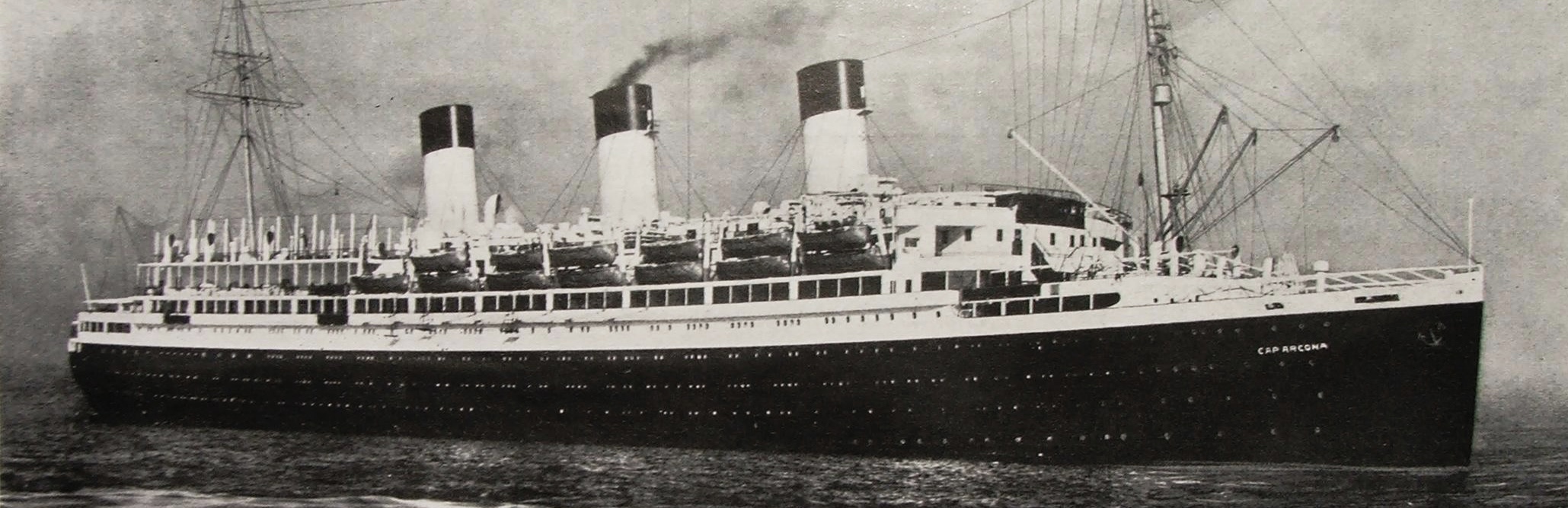
SS Cap Arcona
Hamburg Süd · 1927 · Ship Guide
Overview
SS Cap Arcona was Hamburg Süd’s late-1920s flagship for the South America trade—an ocean liner designed to project “floating palace” prestige on long-haul passenger routes linking Hamburg with ports along the Atlantic coast of South America. In interwar service she became known for high comfort and a resort-like onboard experience rather than Atlantic speed records.
Her historical gravity, however, lies in her wartime transformation and end. Requisitioned by the Kriegsmarine in 1940 and used as an accommodation ship at Gotenhafen (Gdynia), she later became entangled in the final weeks of the Nazi camp system: prisoners from Neuengamme were forced aboard in late April 1945. On 3 May 1945 she was attacked in the Bay of Lübeck and burned/sank—one of the worst maritime catastrophes of the war, with enormous loss of life among prisoners.
Evidence-first note: “Cap Arcona” is often framed online as “the Nazi Titanic.” Treat that as a headline, not a source. For collecting and cataloging, separate: (1) Hamburg Süd luxury-liner era (1927–1940) vs (2) Kriegsmarine accommodation ship era (1940–1945) vs (3) Bay of Lübeck prisoner-ship catastrophe (April–May 1945).
Key Facts
Design & Construction (Context)
Built at Blohm & Voss during the high-confidence late Weimar / early interwar passenger era, Cap Arcona was optimized for long, comfortable passages rather than short Atlantic dashes. That shows up in the “cruise-liner” feel of many photos and descriptions: generous public rooms, deck leisure spaces, and a branding emphasis on elegance and destination travel.
For collectors, that matters because Hamburg Süd printed identity is often clean and coherent—company name, ship name, and route language can appear across passenger lists, menus, deck plans, agency brochures, and onboard stationery. As always, the strongest attribution is ship name + date + route printed on the item itself.
Service History (Summary)
1927–1940: Hamburg Süd flagship, South America service. Entering service in late 1927, Cap Arcona served the Hamburg–South America run and became a prestige symbol for the line. This is the primary era for classic “liner ephemera”: menus, passenger lists, sailing cards, cabin labels, onboard programmes, and travel-agent brochures.
1940–1945: Requisition and Baltic accommodation ship. Requisitioned by the Kriegsmarine in November 1940, the ship spent years as an accommodation ship at Gotenhafen (Gdynia). This era can produce materially different artifacts (official forms, military-context photographs, administrative paper), but it is also where misinformation spreads fastest online—be strict about documentation.
1942: Film stand-in for “Titanic.” In 1942, Cap Arcona was used as an exterior stand-in during production of the Nazi propaganda film Titanic. Collectibles tied to this are uncommon and often misrepresented; demand clear provenance (studio paperwork, dated photos, or credible archival linkage).
April–May 1945: Bay of Lübeck catastrophe. In late April 1945, thousands of prisoners from Neuengamme were forced onto ships in the Lübeck area, including Cap Arcona. On 3 May 1945, RAF attacks set Cap Arcona ablaze and she was lost with catastrophic loss of life. This event is documented by memorial institutions and survivor records, and it should be handled with particular care in interpretation and collecting.
Interpretive Notes
Cap Arcona sits at the junction of two collecting worlds that should not be blurred: (1) interwar luxury-liner material and (2) documentation tied to Nazi Germany’s final-phase violence and prisoner transport. It is entirely valid to collect and study each, but ethical and historical clarity requires precise cataloging and restrained narrative.
Practical checks:
1) Operator branding: “Hamburg Süd” vs Kriegsmarine/official wartime context separates eras quickly.
2) Printed date + ports: South America itinerary language is a strong anchor for the 1927–1940 period.
3) Beware “Nazi Titanic” listings: demand documentary proof for any film- or catastrophe-adjacent claim.
4) Handle tragedy material carefully: prefer institutional or archival sourcing; avoid sensational framing.
Sources (Selected)
Use these as a starting index; for rigorous work, corroborate technical particulars against registers and memorial-institution documentation for 1945 events.
- Ocean Liner Curator — Sources (master bibliography)
- Wikipedia — SS Cap Arcona (starting index; verify against registers)
- KZ-Gedenkstätte Neuengamme — Bay of Lübeck / sinking of prisoner ships (institutional overview)
- Arolsen Archives — Survivors and records context (research note)
- Dutch Cultural Heritage (MAAS) — Cap Arcona 1945 (context + film stand-in note)
- ShipIndex — Bibliographic index (use to chase books, registers, and archival references)