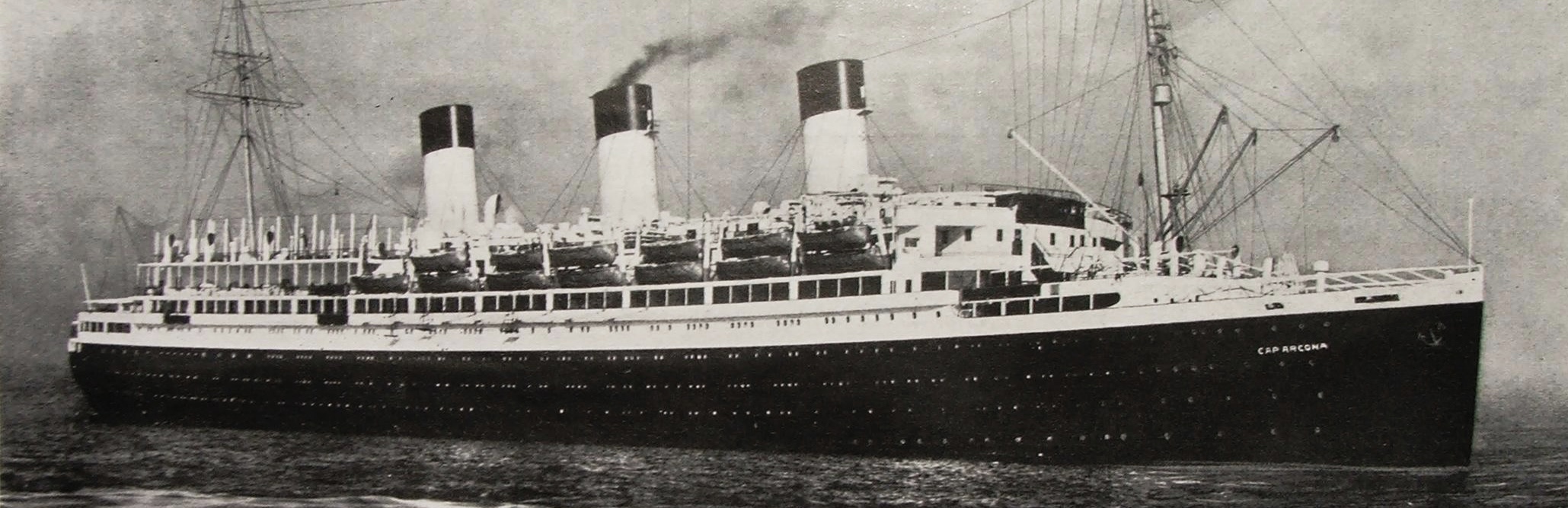
SS Cap Arcona
Hamburg Süd · entered service 1927 · Ship Guide
Overview
SS Cap Arcona was Hamburg Süd's late-1920s flagship for the Germany–South America trade. Built by Blohm & Voss and launched on 14 May 1927, she represented the company's effort to offer a large, prestigious passenger product on the Hamburg–Brazil–River Plate route rather than to compete directly in the North Atlantic speed race.
Her history later changed completely. Requisitioned by the Kriegsmarine in 1940, she served for years as an accommodation ship and was also used during production of the German film Titanic. In the final weeks of the Second World War she became part of the evacuation of the Neuengamme concentration-camp system. Thousands of prisoners were forced aboard, and on 3 May 1945 British aircraft attacked the ships in Lübeck Bay. Cap Arcona burned and capsized with catastrophic loss of life.
The liner, naval, film-production, evacuation and catastrophe phases must be kept distinct. Reducing the vessel to a sensational nickname or treating its entire career as a prelude to 1945 obscures both the evidence and the people involved.
Key Facts
Hamburg Süd Flagship
Before the war, Cap Arcona belonged to Hamburg Süd's prestige South Atlantic system. Her route linked Germany with Brazil, Uruguay and Argentina, and her public image emphasized comfort, scale and long-distance leisure rather than speed records. In this period she generated the familiar documentary trail of a major liner: passenger lists, deck plans, menus, postcards, brochures, baggage labels and route advertising.
That peacetime identity matters. A 1920s or 1930s Hamburg Süd artifact should be interpreted within the commercial world for which the ship was designed, not retroactively through the events of 1945.
Requisition and Wartime Use
The Kriegsmarine requisitioned Cap Arcona in 1940. She spent much of the war as an accommodation ship at Gotenhafen, today's Gdynia. This was already a fundamental change of context: civilian passenger documentation gave way to military administration and static accommodation use.
The ship was also used as a stand-in for Titanic during production of the 1943 German feature film. That episode is historically interesting, but it should remain a discrete wartime reuse rather than becoming the main interpretive frame for the vessel.
Late in the war, as German forces and civilians were evacuated westward from the Baltic, Cap Arcona also participated in evacuation transport. This phase again differs from both her prewar liner service and her later use as a prisoner ship.
Neuengamme Prisoners
In April 1945 the SS began evacuating Neuengamme and its satellite camps as Allied forces advanced. Prisoners were marched, transported and transferred toward the Baltic coast. More than 9,000 prisoners were ultimately placed aboard ships in Lübeck Bay, including Cap Arcona, Thielbek and other vessels.
The United States Holocaust Memorial Museum records more than 4,500 prisoners aboard Cap Arcona. Their presence was not a continuation of ordinary passenger or military transport. It belonged to the final violent dismantling of the concentration-camp system, and records from this phase should be described accordingly.
3 May 1945
On 3 May British aircraft attacked the ships in Lübeck Bay. Cap Arcona was hit, caught fire and capsized. Neuengamme Memorial records roughly 7,100 victims in the ship bombings, including about 6,600 concentration-camp prisoners; USHMM gives about 7,000 deaths across Cap Arcona and Thielbek and notes only about 600 prisoner survivors.
Those totals should not be forced into a single supposedly exact death figure for Cap Arcona alone. Different institutions count different groups and reconstruct the disaster from incomplete wartime evidence. Preserving that uncertainty is more responsible than manufacturing precision.
Collecting & Attribution Context
Cap Arcona material falls into sharply different documentary categories. Hamburg Süd passenger ephemera belongs to the interwar liner era. Kriegsmarine records, photographs and accommodation-ship material belong to military service. Film-production references form another narrow category. Neuengamme evacuation records and prisoner testimony belong to Holocaust and concentration-camp history.
Those categories should not be casually blended simply because the same hull appears in each. Date, issuing institution, route, military status and intended audience can materially change what an object means.
Interpretive Notes
The 1945 catastrophe is both maritime history and Holocaust history, but the latter context is essential. Sensational labels such as “Nazi Titanic” can obscure the concentration-camp evacuation process, the prisoners' identities and the evidentiary complexity of the loss.
At the same time, preserving the prewar liner history is not a way of minimizing the catastrophe. It establishes the sequence clearly: a Hamburg Süd passenger flagship was requisitioned, repurposed repeatedly during war, then drawn into the final crimes and chaos surrounding the collapse of the Nazi camp system.
For an evidence-first archive, that separation of phases is the central curatorial principle. Each object should be allowed to document the historical world that produced it rather than being forced into the most famous episode in the ship's life.
Evidence-first ship guide