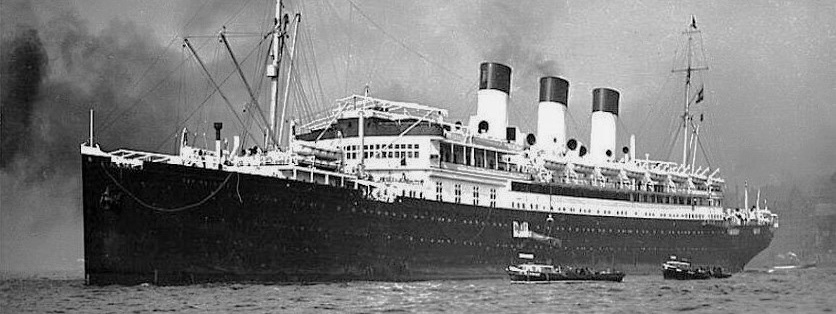
SS Cap Polonio
Hamburg Süd · 1914/1915 · Ship Guide
Overview
SS Cap Polonio was one of the best-known prewar and interwar prestige liners of Hamburg Süd, built for the company’s South American service between Hamburg and Buenos Aires. Large, visually striking, and fitted for both substantial passenger traffic and refrigerated cargo, she belonged to the world of German long-distance South Atlantic travel rather than the more familiar North Atlantic record race. Her career was interrupted before commercial service properly began, first by wartime requisition as an auxiliary cruiser and later by a difficult postwar passage through British control before she finally fulfilled the role for which she had originally been built.
In collecting and interpretation, Cap Polonio is best treated in three phases: pre-service wartime conversion as SMS Vineta, her successful Hamburg Süd passenger career after 1922, and her laid-up / end-of-career period after the rise of Cap Arcona. Material from those phases should be distinguished carefully rather than treated as a single undifferentiated service life.
Key Facts
Some published figures differ slightly because later summaries sometimes round the tonnage or describe the ship in narrative rather than registry form. For cataloging purposes, preserve the exact figures and wording used by the specific source or artifact being cited.
Design & Construction Context
Cap Polonio was built as a prestige South Atlantic liner for Hamburg Süd, intended as a running mate to Cap Trafalgar. In design terms she reflects the specific needs of the Hamburg–River Plate trade: long-distance passenger travel, substantial emigrant carriage, and useful refrigerated cargo capacity for perishable goods. She belongs to the South American service world, not to the North Atlantic speed-race culture that dominates public memory of ocean liners.
Technically, she is also interesting for her “combination machinery.” Like several notable liners of the period, she used two triple-expansion engines with exhaust steam feeding a low-pressure turbine on a center screw. This arrangement promised fuel economy and respectable speed, though in her early wartime trials it proved disappointing in practice.
Service History (Summary)
1912–1914: Ordered in 1912, laid down in 1913, and launched at Blohm & Voss on 25 March 1914 for Hamburg Süd’s South American express service. She was named after Cabo Polonio in Uruguay.
1914–1915 wartime interruption: The outbreak of the First World War prevented her from entering normal commercial service. Before completion, she was requisitioned by the Imperial German Navy, armed, and commissioned on 6 February 1915 as the auxiliary cruiser SMS Vineta.
1915 failed naval career: Sea trials as Vineta were unsatisfactory. She failed to meet her intended performance, consumed excessive coal, and did not become an effective commerce raider. The navy therefore decommissioned her and returned her to her owners.
1915–1918 blocked civilian phase: Restored to the name Cap Polonio, she remained trapped in Hamburg by the Allied blockade and could not begin the service for which she had been designed.
1919–1921 British-managed interlude: After the Armistice she passed into British control and was briefly operated under Union-Castle Line and then P&O management. These voyages were plagued by slow steaming and serious mechanical trouble, and neither operator retained her long.
1921–1922 return to Hamburg Süd: Hamburg Süd repurchased the ship in 1921. In February 1922 she finally entered the Hamburg–Buenos Aires service for which she had originally been built, and in this phase she at last achieved the performance expected of her.
1922–1931 successful liner service: During the 1920s, Cap Polonio became a leading Hamburg Süd passenger ship on the River Plate route. She served as the company’s flagship until the arrival of Cap Arcona in 1927.
1931–1935 end of career: Laid up in 1931 as newer and larger tonnage took precedence, she never regained a stable service role. In June 1935 she sailed to Bremerhaven for scrapping.
Interpretive Notes
This is a South Atlantic prestige liner first: Cap Polonio should be understood in the context of Hamburg Süd’s Hamburg–Buenos Aires service, not through North Atlantic assumptions.
Her wartime auxiliary-cruiser identity was brief and unsuccessful: references to SMS Vineta belong to a distinct and relatively short-lived phase that should not overshadow the ship’s later civilian importance.
The British-managed years are transitional rather than definitive: Union-Castle and P&O control matter historically, but they do not represent the ship’s intended or most successful service identity.
Success came late: unlike many liners whose fame begins with maiden voyages, Cap Polonio reached her real purpose only after war, blockade, and failed interim management. That delayed fulfillment is central to the ship’s story.
Surviving interiors matter: because parts of her luxurious interiors were reused in the Hotel Cap Polonio at Pinneberg, the ship has a small but notable afterlife in material culture beyond her scrapping.
Evidence-first ship guideSources (Selected)