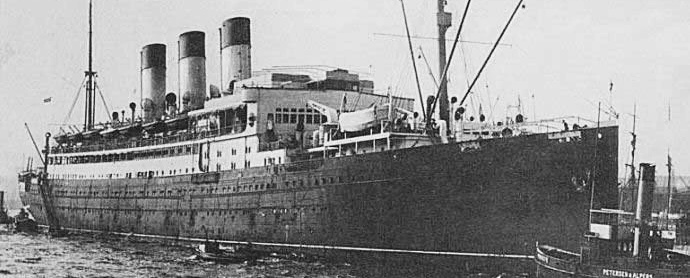
SS Cap Trafalgar
Hamburg Süd · 1913 · Ship Guide
Overview
SS Cap Trafalgar was one of Hamburg Süd’s largest and most luxurious South American liners, built for the prewar Germany–Brazil–River Plate service. She belonged to the interwar-adjacent but still distinctly pre-1914 world of large emigrant and passenger liners serving South America rather than the North Atlantic speed race. Her civilian career was extremely brief, however, and she is remembered above all for her dramatic wartime conversion into an auxiliary cruiser and her destruction in battle against the similarly converted British liner Carmania.
In collecting and interpretation, Cap Trafalgar is best divided into two sharply distinct phases: peacetime Hamburg Süd passenger service and wartime German auxiliary-cruiser service. Those phases should not be merged casually, because the ship’s meaning, appearance, and documentation changed radically within only a few months.
Key Facts
Some published passenger-capacity and luxury-description details vary in wording across sources. For cataloging purposes, it is best to preserve the exact terminology used by the original source or artifact, especially when distinguishing civilian and naval phases.
Design & Construction Context
Cap Trafalgar was conceived as one of Hamburg Süd’s great South American liners, built not for North Atlantic prestige competition but for the economically and socially important Germany–Brazil–River Plate route. In that context, she represented a blend of emigrant capacity, comfortable upper-class accommodation, and German prewar confidence in overseas passenger shipping.
Contemporary descriptions emphasized her luxury, including elaborate first-class interiors, a swimming pool, and a winter-garden-style café. That combination of size, glamour, and route specificity makes her significant as a South American service flagship even though her civilian career lasted only a few months.
Service History (Summary)
1913–1914 construction and entry into service: Built by AG Vulcan at Hamburg, Cap Trafalgar was launched in July 1913, entered service on 1 April 1914, and began her maiden voyage from Hamburg on 10 April 1914 for South American ports.
Peacetime liner service: Her civilian identity belongs squarely to the Germany–Brazil–River Plate passenger world. This is the correct interpretive frame for brochures, passenger lists, deck plans, menus, route ephemera, and commercial photographs tied to Hamburg Süd service.
August 1914 wartime conversion: When war broke out, the ship was in Buenos Aires and was requisitioned by the German Navy as an auxiliary cruiser. At that point, her identity moved abruptly from luxury South American liner to armed raider, and references to her increasingly belong to a naval rather than commercial framework.
Auxiliary-cruiser phase: In naval use she was disguised to resemble the British armed merchant cruiser Carmania, an extraordinary episode that has helped fix the ship in maritime memory. This disguise phase is important but should still be treated as a brief wartime identity distinct from the original passenger liner.
14 September 1914: Off Trindade Island in the South Atlantic, Cap Trafalgar encountered the real HMS Carmania. The result was one of the most striking early-war naval actions: a battle between two converted ocean liners.
Loss and aftermath: After a fierce close-range fight, Cap Trafalgar sank in the early afternoon. She became the first armed merchant cruiser to be sunk by another ship of the same class, a distinction that has dominated her historical reputation ever since.
Interpretive Notes
This is a South American liner first: Cap Trafalgar should be understood initially within the Hamburg Süd South American service world, not primarily through North Atlantic or purely naval comparisons.
The peacetime career was real, even if brief: because the battle with Carmania is so famous, it can overshadow the fact that the ship was designed and launched as a major civilian liner of the German South American trade.
Civilian and naval material belong to different interpretive worlds: prewar passenger ephemera reflects commercial travel culture, while auxiliary-cruiser records, disguise references, and battle accounts belong to a wartime naval framework.
The disguise story should be handled carefully: it is central to the ship’s wartime fame, but it should not eclipse her significance as a new and prestigious Hamburg Süd passenger liner.
The battle matters beyond novelty: although often remembered because two former liners fought each other, the sinking also illustrates how rapidly major passenger ships were pulled into improvised naval service at the start of the First World War.
Evidence-first ship guideSources (Selected)
- Ocean Liner Curator — Sources (master bibliography)
- SMS / SS Cap Trafalgar — overview chronology, technical particulars, service, and sinking
- Royal Museums Greenwich — battle image context and summary of the action with Carmania
- Naval-history.net — outline of the 14 September 1914 action
- Wrecksite — loss summary and wreck context