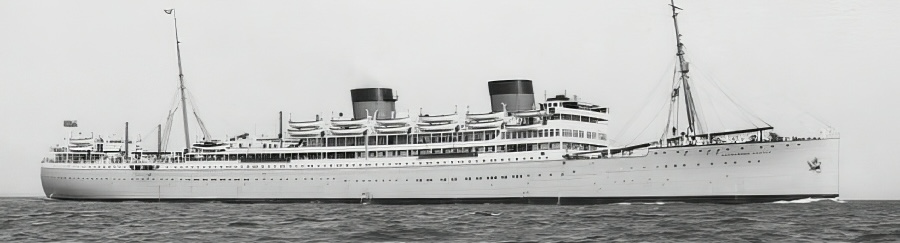
MV Carnarvon Castle
Union-Castle Line · entered service 1926 · Ship Guide
Overview
MV Carnarvon Castle was one of Union-Castle’s important interwar mail liners on the Southampton–South Africa route and a landmark ship within the company’s development. She was the first Union-Castle mail ship to exceed 20,000 gross tons and the first motor ship used regularly on the Cape route, making her a clear marker of technical and commercial change in the line’s history. Her later career expanded far beyond peacetime passenger work, including wartime service as an armed merchant cruiser, convoy duty, battle damage, troop transport work, and a postwar return to the South Africa service in altered form.
In collecting and interpretation, Carnarvon Castle is best divided into four phases: original pre-1937 Union-Castle mail service, post-1937 lengthened and modernized service, wartime armed merchant cruiser and troopship service, and postwar emigrant and passenger service. Material from those phases should be distinguished carefully rather than treated as one undifferentiated ship identity.
Key Facts
Design & Construction Context
Carnarvon Castle belonged to Union-Castle’s highly distinctive South Africa mail-service system, which operated in a very different cultural and commercial world from the North Atlantic express trade. Ships in this service emphasized route reliability, long-distance comfort, and the disciplined timetable of mail carriage rather than record-breaking speed. Her importance lies in that route identity.
She was also a technical landmark. As the first motor ship regularly used on the Cape route and the first Union-Castle mailship to exceed 20,000 tons, Carnarvon Castle represented a significant shift in the company’s fleet development. Her later lengthening and machinery improvements further underline that she was a ship repeatedly adapted to changing commercial demands.
Service History (Summary)
1926: Built by Harland & Wolff at Belfast, Carnarvon Castle was launched in January 1926, delivered in June, and began her maiden voyage in July. She entered Union-Castle’s South Africa mail service as a major new motor liner.
1926–1936 prewar service: In her original form, she worked the Britain–Cape mail and passenger route. This is the correct interpretive context for early passenger lists, menus, route brochures, and company ephemera tied to her peacetime identity.
1937–1938 rebuilding: In order to meet revised mail-contract speed requirements, she was lengthened in 1937 and re-engined in 1938. This created a materially altered version of the ship and forms an important dividing line for photographs, specifications, and passenger material.
1939 wartime conversion: With the outbreak of the Second World War, Carnarvon Castle was requisitioned and converted into an armed merchant cruiser. From this point onward, references to the ship increasingly belong to a wartime naval framework rather than a civilian passenger one.
1940 action with Thor: In December 1940 she fought the German auxiliary cruiser Thor in a notable South Atlantic engagement. She suffered substantial damage and casualties, but survived to reach Montevideo and then return for repair.
1941–1943 later wartime role: After repair she resumed armed merchant cruiser work and later troopship service. During this phase she moved through several distinct wartime functions, which should be separated carefully from her peacetime route identity.
1947–1949 postwar conversion: After the war she was refitted first as an “austerity” emigrant ship and then altered again for commercial passenger use. This created a distinct postwar service identity, different from both her original prewar form and her wartime naval one.
Postwar return and end of career: She returned to Union-Castle service and continued working into the early 1960s. Withdrawn and sold for scrapping, she was finally broken up in 1963.
Interpretive Notes
A Union-Castle South Africa liner first: Carnarvon Castle should be interpreted within the Britain–South Africa mail and passenger system, not through North Atlantic prestige assumptions.
The 1937–38 rebuilding matters: pre-rebuild and post-rebuild photographs, dimensions, and accommodation descriptions can refer to meaningfully different versions of the ship.
Wartime and peacetime material belong to different worlds: route brochures and passenger ephemera belong to one interpretive frame, while armed merchant cruiser action reports, battle references, and troopship records belong to another.
Her postwar identity is not simply a return to 1926: the emigrant and later revised passenger roles after the war should be treated as a separate phase with its own accommodation logic and social context.
Motor-liner transition: Carnarvon Castle represents Union-Castle’s move away from the earlier turbine-and-four-funnel aesthetic toward large motor liners designed for the same disciplined Cape route. That technological change is part of the fleet story, not merely an engineering footnote, because it shaped range, operating economy, and outward profile.
The 5 December 1940 action with the German raider Thor is best read as a discrete wartime episode rather than the definition of the ship’s whole career. The battle damage, casualties, and emergency repairs at Montevideo belong to a military-service provenance phase distinct from prewar passenger material. Surviving menus, passenger lists, and route brochures should not be retroactively framed through the raider action unless their date and context support it.
Her later return to ordinary service also matters because it prevents the wartime combat episode from becoming the entire story. The same motor liner that fought Thor had already built a substantial commercial record and would continue to be remembered within Union-Castle’s broader Cape service tradition.
Her long service also helps place the raider action in proportion: dramatic wartime survival sits inside a much broader commercial career.
Prewar schedules, passenger lists, and cabin material therefore remain primary evidence for the ship’s ordinary role on the Cape service and should not be overshadowed by the better-known wartime action alone in interpretation.
Evidence-first ship guide