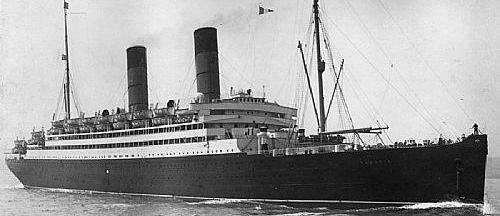
RMS Caronia
Cunard Line · 1905 · Ship Guide
Overview
RMS Caronia was one of Cunard’s large early-twentieth-century transatlantic liners, built for the Liverpool–New York service at a moment when the company was balancing prestige, regularity, and commercial versatility. She is especially significant as the conventional reciprocating-engine sister to the turbine-powered Carmania, making the pair an unusually useful case study in the technological transition then reshaping major liner fleets. Her career later extended beyond ordinary Atlantic passenger work into wartime naval service and, after refitting, a quieter late career in reduced passenger service.
In collecting and interpretation, Caronia is best divided into four phases: early transatlantic passenger service, cruising and special-service work, wartime armed merchant cruiser service, and later cabin-class passenger service. Material from those phases should be distinguished carefully rather than folded into one undifferentiated ship identity.
Key Facts
Published dimensions, tonnage, and passenger figures vary slightly across fleet lists, technical summaries, and publicity material. For cataloging purposes, preserve the exact wording and service phase used by the source or artifact being cited.
Design & Construction Context
Caronia occupied an especially interesting place in Cunard history because she and Carmania were near-sisters built to compare two propulsion approaches in real commercial service. While Carmania tested turbine machinery, Caronia embodied the established quadruple-expansion reciprocating system. That makes her significant not merely as a transatlantic liner, but as part of a practical experiment in marine engineering at a major transitional moment.
In passenger-service terms, she belonged to the large Liverpool–New York liner world rather than the more specialized imperial-route or Mediterranean service spheres. She should therefore be read in the context of Edwardian North Atlantic competition, but not solely through record-breaking speed comparisons.
Service History (Summary)
1904–1905: Built by John Brown & Co. at Clydebank, Caronia was launched in July 1904, completed in February 1905, and began her maiden voyage from Liverpool to New York later that month.
Early passenger service: In her initial peacetime years she served Cunard’s Liverpool–New York route. This is the correct context for passenger lists, menus, brochures, onboard imagery, and promotional literature tied to her original commercial identity.
Technological comparison with Carmania: Her service career was watched with special interest because Cunard could compare the operating qualities of her reciprocating machinery against the turbine-powered machinery of her sister. That relationship is one of the central interpretive features of the ship.
Cruising and special-service identity: Like several large Cunarders of the period, Caronia also acquired a reputation for more general passenger and cruise-related work beyond simple point-to-point Atlantic service. Material from this phase should be distinguished from ordinary scheduled New York service where possible.
1914 wartime requisition: At the outbreak of the First World War, she was taken up for naval use as the armed merchant cruiser HMS Caronia. From this point onward, references to the ship increasingly belong to a naval and military framework rather than a civilian passenger one.
Wartime service: In naval employment she served as an armed merchant cruiser rather than remaining in ordinary liner service. Curatorially, wartime records, naval photographs, and service references should be treated separately from peacetime passenger material.
Postwar return and refit: After the war she returned to commercial life and was later refitted for cabin-class service in the 1920s, reflecting broader changes in North Atlantic passenger demand and the decline of the older multi-class Edwardian liner structure.
End of career: Cunard disposed of her in 1932. Under Japanese ownership she was renamed Taiseiyo Maru, and she was scrapped in Osaka in 1933.
Interpretive Notes
This is a North Atlantic Cunarder first: Caronia should be understood above all within the Liverpool–New York transatlantic passenger world.
The engineering comparison is central: her relationship to Carmania is not a trivial fleet note but one of the main reasons the ship matters historically.
Peacetime and wartime material belong to different interpretive worlds: passenger ephemera, cruise literature, and onboard commercial imagery belong to one frame, while armed merchant cruiser documentation belongs to another.
The cabin-class refit matters for dating artifacts: class terminology and printed accommodation language can help place surviving material more precisely within her long career.
Do not confuse this ship with the later Cunard Caronia of 1947: for cataloging and indexing, this earlier vessel benefits from clear date distinction.
Evidence-first ship guideSources (Selected)