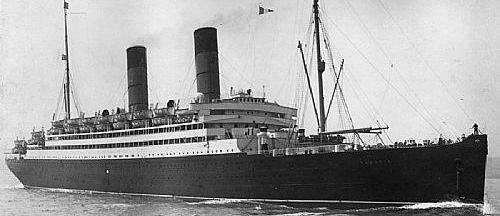
RMS Caronia (1904)
Cunard Line · entered service 1905 · Ship Guide
Overview
RMS Caronia was Cunard's reciprocating-engine counterpart to turbine-powered Carmania. John Brown & Co. launched her at Clydebank on 13 July 1904, and she entered Liverpool–New York service on 25 February 1905.
The near-sisters gave Cunard an unusually direct opportunity to compare two propulsion systems in ordinary commercial service. Caronia's quadruple-expansion engines represented mature technology; Carmania's turbines pointed toward the propulsion system Cunard would soon adopt for its new express giants. Caronia's own career, however, extended well beyond engineering comparison into cruising, wartime naval service, cabin-class refits, and a final Japanese ownership phase.
Key Facts
The Reciprocating Control Ship
Caronia and Carmania were near-sisters rather than exact mechanical twins, and that difference was intentional. Cunard could compare the well-understood quadruple-expansion machinery of Caronia against the newer turbine arrangement of Carmania under similar commercial conditions.
The result mattered beyond the two ships. Turbine advantages at higher sustained speeds helped shape Cunard's propulsion strategy for the next generation. Caronia therefore deserves attention not because her machinery “lost,” but because she provided the established benchmark against which a new technology was judged.
Early Passenger Service
In her first years, Caronia served Cunard's Liverpool–New York route. This is the main context for early passenger lists, menus, brochures, and photographic material.
Her role was not purely technological. She was a substantial Edwardian liner carrying multiple passenger classes, mail, baggage, and cargo. The engineering comparison occurred inside a normal commercial transport system rather than in laboratory conditions.
Cruising and Special Employment
Caronia also developed a secondary cruising role, including Mediterranean cruising from New York. That leisure work is historically important because it foreshadows the growing use of large liners outside simple point-to-point transport.
A cruise brochure and a scheduled Liverpool–New York passenger list may refer to the same ship but to different commercial products. Route and date should therefore accompany catalog descriptions whenever possible.
The Titanic Ice Warning
On 14 April 1912, Caronia transmitted an ice warning reporting bergs, growlers, and field ice to Titanic. The message is part of the documentary history of the Titanic voyage, but it should not be allowed to swallow Caronia's own story.
For attribution, this is another area where association can be overstated. A generic Caronia object is not automatically a Titanic-related artifact unless date and provenance connect it to the relevant voyage or communications record.
HMS Caronia
At the outbreak of the First World War, Caronia was requisitioned as an armed merchant cruiser. Naval employment shifted the ship into patrol and military service, altering both the documentary framework and the visual identity of the vessel.
Wartime photographs and service references should therefore be separated from civilian passenger material. The same hull served under a different administrative system and for different purposes.
Postwar Refit and Cabin-Class Service
After the war, Caronia returned to commercial use and later underwent refitting for cabin-class service. The change reflected broader shifts in the North Atlantic market, where older Edwardian class structures were being reorganized.
Class terminology is therefore a useful dating tool. Material using later cabin-class language belongs to a different commercial phase from prewar brochures describing the original accommodation structure.
Taiseiyo Maru
Cunard disposed of the ship in 1932. Under Japanese ownership she was renamed Taiseiyo Maru and proceeded to Osaka, where she was scrapped in 1933.
The name change marks a final provenance boundary. Japanese delivery and disposal material should not be retroactively described as Cunard-era Caronia material without explanation.
Passenger Markets Over Time
The ship's class structure changed during her long career, and those changes reflect shifts in the North Atlantic market itself. Early Edwardian multi-class service belonged to one social and commercial system; later cabin-class operation belonged to another.
For collectors, printed class terminology is therefore valuable dating evidence. A brochure advertising cabin class cannot simply be interpreted through the original 1905 accommodation plan.
Why the Cruise Phase Matters
Early cruising is easy to treat as a side note, but it shows Cunard already experimenting with leisure uses for large liners before the cruise industry became a separate business. Caronia's Mediterranean work demonstrates how a ship designed for scheduled transport could be repackaged around destination and experience.
That flexibility later became essential across the industry. In this sense the ship's cruise work belongs to the longer history of liners adapting to seasonal demand and changing passenger expectations.
Interpretive Notes
This ship should be understood first within Cunard's Edwardian North Atlantic system, with the machinery comparison to Carmania as a central technical theme rather than a footnote.
Her career then divides into distinct passenger, cruise, wartime, postwar cabin-class, and final Japanese phases. Keeping those identities separate preserves both historical accuracy and the usefulness of surviving artifacts.
This is the 1904-launched Caronia, not the famous green-hulled 1947 ship. Build year is the safest shorthand where ambiguity exists.
Evidence-first ship guide