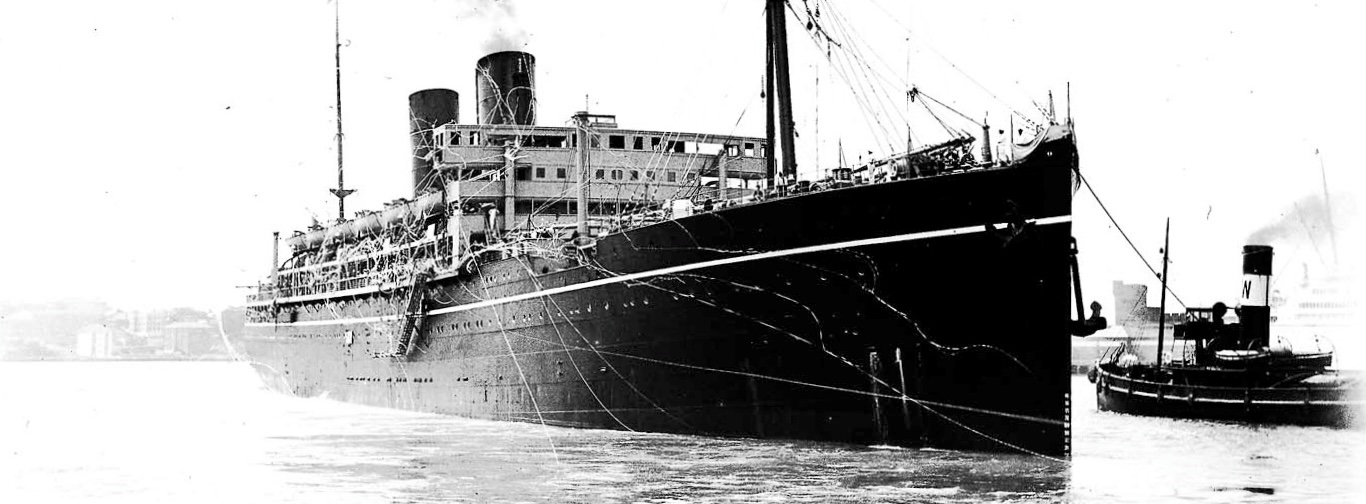
SS Cathay
P&O · 1924 / 1925 · Ship Guide
Overview
SS Cathay was a P&O passenger steamship built in Glasgow in the mid-1920s for the Britain–Australia route. She belongs to the interwar liner world rather than the classic Atlantic record-race tradition, and is best understood as part of the imperial long-distance route structure that linked Britain with Australia via the Suez Canal. In that sense, Cathay was not an express Atlantic champion but a substantial route liner designed for scheduled passenger, mail, and refrigerated-cargo service across one of the defining long-haul corridors of the British maritime world.
In interpretation, Cathay should be placed within the interwar P&O Australia service: a disciplined route ship shaped by imperial communications, passenger movement, and the economics of regular long-distance steam service rather than by Atlantic speed rivalry.
Key Facts
Interwar liner figures are generally more standardized than many nineteenth-century ship summaries, but tonnage revisions and different length conventions still appear in reference works. For cataloging, keep the precise measurement basis used by the cited source whenever possible.
Design & Construction Context
Cathay belongs to the interwar phase in which P&O was rebuilding and modernizing its long-distance passenger fleet after the losses and disruptions of the First World War. She and her sisters were ordered to help restore a regular service pattern between Britain and Australia, a route whose importance rested on endurance, comfort, and dependable scheduling more than on spectacular top speed. Her twin-screw quadruple-expansion machinery and substantial refrigerated cargo capacity reflect exactly that operational logic.
She should therefore be read as a route liner in the fullest sense: a ship shaped by system, not by showmanship alone. Her importance lies in sustaining a recurrent imperial corridor across the Suez route, carrying passengers, mail, and cargo in a setting where reliability and service integration mattered more than record passages.
Service History (Summary)
1924 launch and 1925 completion: Cathay was launched at Glasgow on 31 October 1924 and completed in March 1925 as the first finished ship of her three-vessel class. She was built at a moment when P&O was expanding and regularizing its interwar passenger services after the disruptions of the previous decade.
1925 maiden voyage: Her maiden voyage began on 27 March 1925 from London to Sydney. This placed her directly into P&O’s Britain–Australia route structure via the Suez Canal, the setting in which her core historical identity was formed.
Interwar civilian career: During the late 1920s and 1930s, Cathay served principally on the Australia route. From 1932 she also called at Bombay, and she occasionally appeared in P&O’s Far East service pattern. She was therefore part of a wider eastern network rather than a ship confined to a single simple end-to-end run.
Operational incident: In late 1933 she lost her starboard propeller between Colombo and Fremantle while attempting to make up time. Repairs in Sydney returned her to service in 1934, a reminder that even well-established liners remained heavily dependent on precise mechanical reliability across very long routes.
Wartime conversion: In August 1939 the Admiralty requisitioned Cathay. She was converted at Bombay into an armed merchant cruiser, and her dummy second funnel was removed. This phase belongs to a different interpretive frame from her civilian liner identity, but it forms an important part of her full career.
Final service and loss: In 1942 she returned to transport work as a troop ship and took part in Operation Torch. While landing troops at Bougie, Algeria, she was bombed by German aircraft on 11 November 1942 and was lost the following day after fire and explosions destroyed the ship.
HMS Cathay
The Admiralty requisitioned Cathay in August 1939 and converted her at Bombay into an armed merchant cruiser. Commissioned as HMS Cathay in October, she served on the East Indies Station, with the Freetown Escort Force, and later on the South Atlantic Station.
The conversion illustrates a recurring wartime use of large passenger liners: their endurance, communications facilities, and internal volume made them useful for patrol and escort work even though merchant hulls were not purpose-built warships.
Troopship and Loss During Operation Torch
In February 1942 Cathay left armed-merchant-cruiser service and was returned for troop transport under the Ministry of War Transport. Later that year she supported the Allied landings in North Africa.
German aircraft bombed and badly damaged the ship at Bougie on 11 November 1942 during Operation Torch. The loss ended a career that had moved from scheduled Britain–Australia passenger service to naval patrol and finally troop transport.
Why Cathay Matters
Cathay represents the imperial route liner more clearly than the Atlantic prestige liner. Her peacetime significance lay in scheduled long-distance service through Suez, while her wartime usefulness came from the same range, capacity, and global operating experience that had defined her civilian career.
Interpretive Notes
This is an imperial-route liner, not an Atlantic express liner: Cathay should not be framed through Blue Riband or North Atlantic prestige assumptions. Her importance lies in P&O’s long-haul Australia service.
She belongs to the interwar systems world: the key context is not technological experimentation in the Brunel sense or record competition in the Cunard sense, but dependable scheduled movement across a mature global route network.
Her passenger mix matters: with first- and second-class accommodation rather than an enormous multi-class migration emphasis, Cathay reflects a particular P&O service model aimed at imperial and long-distance travelers on the Australia run.
The wartime AMC phase should be separated from the liner phase: her later armament, naval requisition, and troopship work are historically significant, but they should not blur the fact that her primary historical identity was civilian P&O route service.
Her loss in 1942 closes a liner story reshaped by war: like many interwar passenger ships, Cathay ended not through routine obsolescence or peaceful withdrawal, but through wartime conversion and destruction.
Evidence-first ship guideSources (Selected)