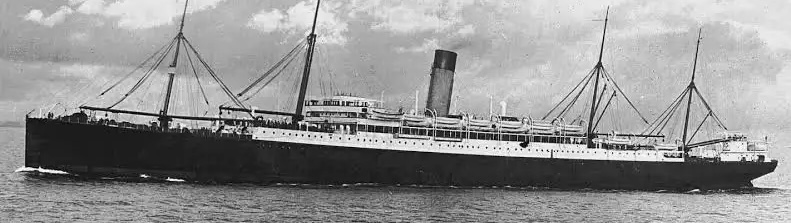
SS Ceramic
White Star Line · entered service 1913 · Ship Guide
Overview
SS Ceramic was the large successor to White Star's earlier Jubilee-class Australia ships. Built by Harland & Wolff, launched on 11 December 1912 and completed in July 1913, she was designed for the long Britain–Australia trade rather than North Atlantic express competition.
Her importance lies in the scale and longevity of that service. Ceramic carried passengers and cargo across a vast imperial route, served in transport roles during both world wars, later passed to Shaw, Savill & Albion, and remained active until her catastrophic loss in December 1942.
For interpretation, the ship is best divided into distinct documentary phases: White Star civilian service, First World War transport work, interwar passenger service, Shaw Savill operation and Second World War transport. The final sinking was historically overwhelming, but it should not erase nearly three decades of civilian history.
Key Facts
Successor to the Jubilee Ships
Ceramic carried forward White Star's Australia-route logic on a much larger scale. Cargo, migration and long-distance passenger transport remained central; speed records did not. Her size and accommodation reflected the continuing importance of the Britain–Australia corridor immediately before the First World War.
That route context matters for surviving passenger lists, brochures, deck plans, luggage labels and commercial photographs. These objects belong to a long-haul service world with different priorities from White Star's North Atlantic flagship trade.
Service History
1913: After completion at Belfast, Ceramic began her maiden voyage from Liverpool to Australia on 24 July. Her peacetime identity was rooted in scheduled Britain–Australia passenger and cargo work.
First World War: She entered transport service, moving from ordinary commercial employment into military logistics. Material from this period should be dated and described accordingly rather than treated as generic liner ephemera.
Interwar years: Ceramic returned to the Australia trade and resumed civilian operation. This long postwar phase is important because it represents a substantial part of her life that can be obscured by the later disaster.
Shaw, Savill & Albion: After White Star's withdrawal from the route, the ship continued under Shaw Savill ownership. The change of operator is a real provenance transition, but it also demonstrates continuity in the underlying Britain–Australia transport system.
Second World War: Once again employed for wartime transport, Ceramic operated in a military-logistical context rather than as an ordinary passenger liner.
7 December 1942
uboat.net records Ceramic as sunk by U-515 under Werner Henke on 7 December 1942 after detaching from convoy ON-149. Its compiled record lists 655 aboard and only one survivor. The casualty figure should be presented with its source because wartime passenger and crew totals can differ among accounts.
The scale of the loss makes it tempting to read the entire ship backward from the sinking. Curatorially, that should be resisted. The disaster belongs to the final wartime phase of a vessel that had already spent decades as a major Australia-route liner.
Interpretive Notes
Passenger-service material, wartime transport records and Shaw Savill documents belong to different interpretive contexts. The same name and hull can therefore appear in records that describe substantially different operational identities.
Ceramic also demonstrates why White Star's history should not be reduced to the North Atlantic. The company maintained important long-distance systems in which carrying capacity, migration and freight mattered at least as much as prestige.
Collecting & Attribution Context
Ceramic material benefits from careful operator and phase dating. White Star brochures, wartime transport records, interwar passenger documents and Shaw Savill material all relate to the same vessel, but they reflect different institutional and operational settings. A useful catalog entry should therefore record not only the ship name but, where possible, the operator, approximate date and service context.
Passenger-capacity figures also deserve source discipline. Accommodation changed over a long career, and wartime complements were not equivalent to peacetime passenger capacity. Rather than forcing every figure into a single master number, the archive should preserve the wording and date of the source being described.
Why Ceramic Matters
Ceramic links the late Edwardian migration-and-cargo world to the radically altered shipping conditions of the Second World War. Her career crossed changes in ownership, passenger markets and military use while remaining tied for most of its length to the Australia trade.
The 1942 sinking is therefore best understood as the final phase, not the whole biography. The scale of the loss demands careful documentation, but the civilian decades explain what kind of ship was lost and why her history belongs within the broader story of long-haul liner systems rather than only within wartime casualty history.
Evidence-first ship guide