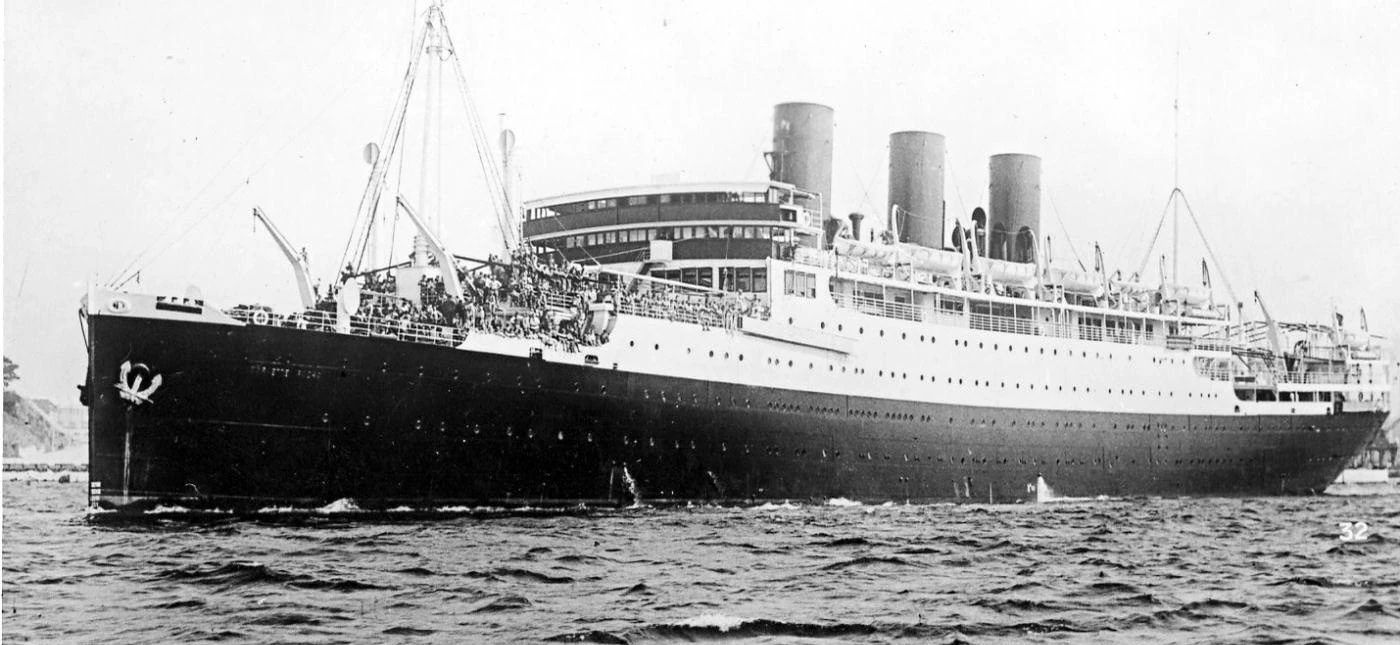
SS Champollion (1925)
Messageries Maritimes · entered service 1925 · Ship Guide
Overview
SS Champollion was a Messageries Maritimes mail and passenger liner built at La Ciotat for the company's fast service from Marseille to Alexandria, Port Said, and Beirut. Launched in March 1924 and entering service in September 1925, she belonged to a major interwar modernization program that emphasized dependable Mediterranean and Eastern routes rather than participation in the North Atlantic speed race.
Her career spanned nearly three decades and several distinct identities: interwar Levant liner, substantially rebuilt high-speed passenger ship, wartime troop transport, postwar Indochina transport, and finally a modernized Marseille–Beyrouth liner. She was lost on 22 December 1952 after grounding south of Beirut in heavy weather and breaking apart close to shore.
Key Facts
The Egypt–Syria Express Service
Champollion and sister Mariette Pacha were designed for Messageries Maritimes' fast Levant route linking Marseille with Alexandria, Port Said, and Beirut. The pair became highly successful on this service and came close to monopolizing Marseille–Alexandria passenger traffic before the Second World War.
This route placed Champollion within the busy social and commercial world of the eastern Mediterranean: tourists, officials, business travellers, families, migrants, pilgrims, and passengers moving onward through Egypt, Palestine, Syria, and Lebanon. Her importance therefore rested in frequency and connectivity rather than transatlantic prestige.
Passenger Spaces and Route Identity
The ship's interiors reflected her destination. Surviving photographs and decorative records show Egyptianizing motifs in first-class spaces, including sculpture and ornamental treatments intended to evoke the eastern Mediterranean and Egypt. The design belonged to a broader interwar practice in which route identity could be expressed through architecture and decoration.
Champollion carried multiple classes, including a substantial lower-cost passenger component. First-class public rooms included dining, smoking, music, children's, and winter-garden spaces, while second and third class had their own dining and social accommodation.
The 1934 Reconstruction
In 1934 Champollion underwent a major reconstruction at La Ciotat. The hull was lengthened from about 156.7 to 168.05 metres, the bow was reshaped, and the propulsion plant was supplemented by exhaust turbines. Gross tonnage increased and service speed rose from roughly 16 to more than 19 knots.
The rebuild also altered the ship's external appearance substantially. Her new bow profile was noticeably different from the original straight-stem form, while sister Mariette Pacha was not rebuilt in the same way. For photographic attribution, this makes pre-1934 and post-1934 images relatively easy to distinguish once the bow is visible.
Migration to Palestine
Before the Second World War, Champollion carried many Jewish emigrants travelling toward Palestine. This traffic forms an important part of the ship's social history and illustrates the role of Mediterranean liners in migration patterns that do not fit the more familiar Ellis Island or North Atlantic framework.
Such voyages should be described with voyage-level care. Passenger composition changed from sailing to sailing, and surviving photographs or lists tied to a particular departure are stronger evidence than broad retrospective claims about the ship's clientele as a whole.
War Service
The outbreak of war transformed Champollion's role. In September 1939 she was operating in convoy on the Levant route. In 1940 she was considered for troop-transport work connected with a proposed expedition to Finland, which was ultimately cancelled.
In November 1940 she passed through a naval engagement off Sardinia without damage. During 1941 she made voyages connected with the repatriation of troops from the Levant. After the Allied landings in North Africa, she was taken at Algiers in November 1942 and subsequently managed as a troop transport for the British Ministry of War Transport, with P&O acting as manager.
Her wartime record included a German air raid at Naples in March 1944, which caused minor damage, and a narrow escape at Bombay the following month when the explosives-laden freighter Fort Stikine detonated in the harbour. Champollion suffered only a small fire and survived.
Postwar Trooping and Return to Civilian Service
Returned to French control in 1946, Champollion continued to carry troops, including voyages associated with Indochina, while also making trips to North Africa and Madagascar. Photographs from the late 1940s show the ship moving gradually from wartime grey back toward commercial appearance.
In 1950–51 she underwent another major modernization. Two of her three funnels were removed, her accommodation was reorganized, and she emerged with a markedly simplified silhouette. She resumed the Marseille–Beyrouth service on 16 March 1951.
The Final Voyage
On 22 December 1952, approaching Beirut from Alexandria in poor weather, Champollion grounded on reefs south of the city. Contemporary and later accounts describe confusion involving shore lights in the vicinity of Beirut and the airport area, followed by a navigation error that brought the ship onto the breakers.
The grounding opened the hull and flooded machinery spaces. Heavy seas prevented an easy evacuation despite the ship being only a short distance from shore. Attempts to establish lines to the beach failed, aircraft dropped food and supplies, and local boatmen eventually carried out the decisive rescue work.
The ship broke apart under the pounding surf. Contemporary casualty reports changed repeatedly in the first days after the disaster, ranging from the low teens to higher provisional totals. Because those early figures conflict, this guide does not present a single casualty number as unquestionably settled.
Rescue at Beirut
The rescue was remarkable precisely because land was so close and yet the sea made it extremely difficult to reach. Lebanese pilots and boatmen worked in dangerous surf, while people ashore watched the wreck deteriorate. Some passengers and crew attempted to swim or reach shore independently, with fatal consequences.
Contemporary reporting also records offers of assistance from Israeli rescue vessels amid the political tensions of the period. That detail situates the disaster within the wider regional context of the early 1950s, though the practical rescue ultimately depended heavily on local Lebanese craft.
Why Champollion Matters
Champollion gives the archive a strong example of the Mediterranean liner as a long-lived working institution. Her story encompasses interwar tourism and migration, French imperial and Levant connections, major mechanical modernization, wartime troop service, postwar reconstruction, and regional passenger traffic.
She is also visually useful as a case study in how one ship could change across a career. The original three-funnel 1925 liner, the lengthened and reshaped 1934 vessel, the grey wartime transport, and the single-funnel 1951 reconstruction are all recognizably the same hull but belong to distinct historical phases.
Collecting Profile
Surviving material includes Messageries Maritimes postcards, menus, passenger lists, brochures, photographs, voyage documents, and images of the ship's changing interiors and external appearance. The wreck also generated extensive press photography.
For accurate attribution, dating matters unusually strongly. A photograph showing three funnels may belong to either the prewar or immediate postwar era, while the single-funnel appearance identifies the final 1951–52 configuration. The bow profile can also distinguish the pre-1934 ship from the lengthened reconstruction.
Interpretive Notes
The ship changed materially over time: length, tonnage, machinery, speed, accommodation, bow form, and funnel arrangement all changed during major rebuilds.
The grounding narrative requires caution: later summaries often simplify the casualty into a single mistaken-lighthouse story. The broad navigation-error explanation is well established, but detailed responsibility was investigated and contested after the wreck.
Casualty totals conflict: early press reports were provisional and sometimes contradictory. Where a specific figure is important, it should be tied to a named contemporary or official source rather than treated as universal.
Evidence-first ship guideSources (Selected)
- Ocean Liner Curator — Sources (master bibliography)
- Encyclopédie des Messageries Maritimes — Champollion specifications, career, photographs, and interiors
- Messageries Maritimes archive — account of the 1952 wreck and rescue
- Messageries Maritimes — company history and interwar fleet modernization
- Papers Past — contemporary December 1952 rescue and casualty reporting