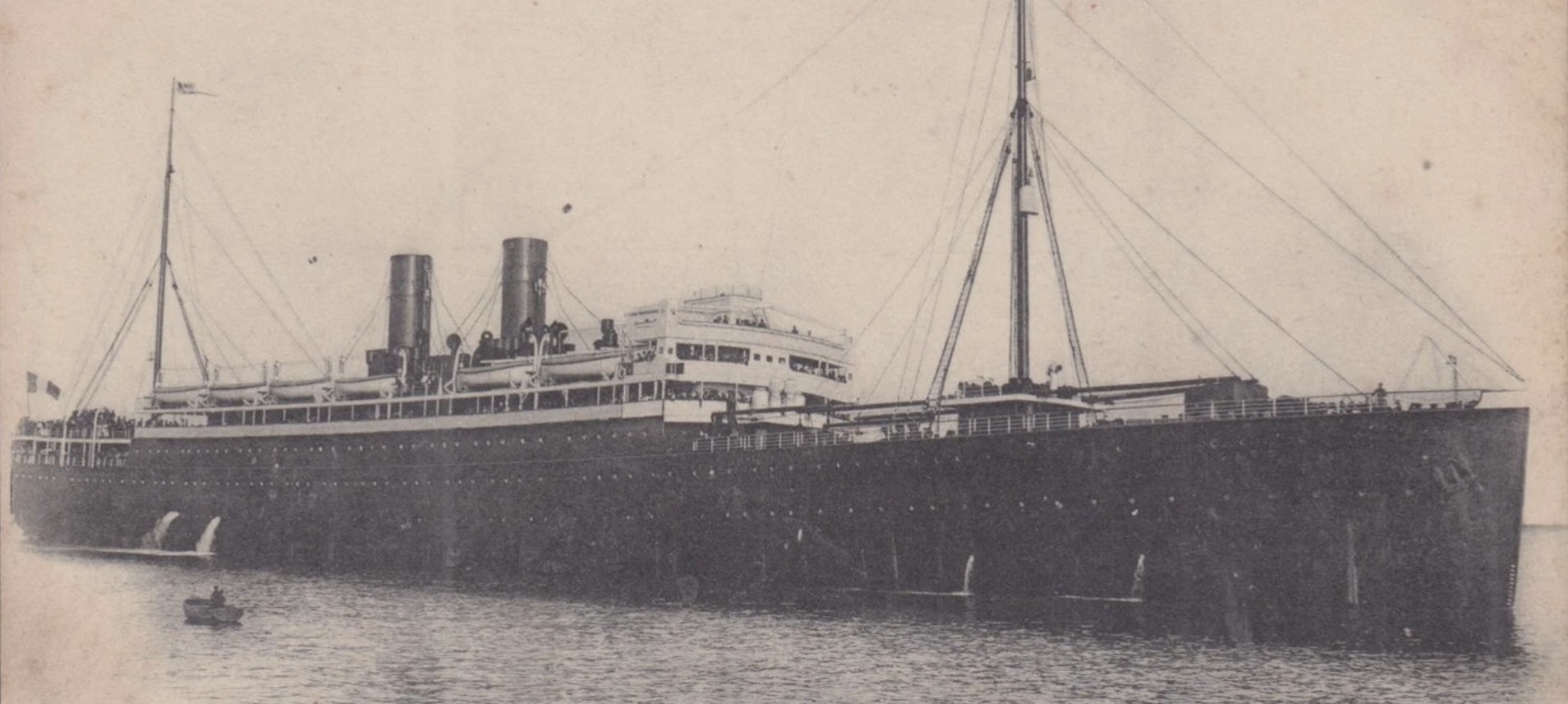
SS Chicago (1908)
Compagnie Générale Transatlantique / French Line · 1908 · Ship Guide
Overview
SS Chicago was a French Line ocean liner built at Saint-Nazaire for the Compagnie Générale Transatlantique and introduced in 1908. She belonged to the practical, commercially important side of the French Line fleet: smaller and slower than the great prestige liners, but useful for Le Havre–New York service, migrant traffic, and later Bordeaux–New York work.
In collecting and interpretation, Chicago is especially useful because she sits between several documentary categories: French Line passenger lists, emigrant travel, agency paperwork, Le Havre sailings, Bordeaux sailings, wartime continuity, and later colonial-route service under the name Guadeloupe. Those contexts should be kept distinct when cataloging surviving material.
Key Facts
Published summaries do not always agree on Chicago’s exact tonnage, speed, or disposal year. For curator-level use, preserve the figure supplied by the specific artifact, passenger list, or reference being cited rather than forcing all records into a single simplified number.
Design & Construction Context
Chicago was not a French Line showpiece in the later sense of France, Île de France, or Normandie. Her importance is quieter: she reflects the company’s need for economical, route-sustaining vessels that could carry large numbers of ordinary travelers across the Atlantic while supporting the line’s broader commercial network.
Built in France at Saint-Nazaire, she also belongs to the long French Line pattern of using domestic shipbuilding capacity for transatlantic service. Her size, speed, and passenger emphasis place her among the practical workhorses of the prewar fleet rather than among the high-speed prestige competitors.
Service History (Summary)
1908: Chicago entered French Line service with a maiden Le Havre–New York voyage on May 30, 1908. Contemporary and later summaries associate her with the company’s lower-cost Atlantic service, especially emigrant and non-luxury passenger traffic.
1908–1915: she operated primarily on the Le Havre–New York route. Passenger-list material from this period is especially valuable because it can identify sailing date, direction, class of travel, captain, passenger totals, and agency context.
1915–1920: during the First World War period, Chicago shifted into Bordeaux–New York sailings. This route change matters because Bordeaux material should not automatically be described as ordinary Le Havre service.
1921–1928: she resumed Le Havre–New York work and later appeared again in Bordeaux–New York context. In 1926 she was refitted for cabin, tourist, and third-class accommodation, reflecting changing passenger categories in the interwar Atlantic trade.
Late 1920s–1930s: after reconstruction and renaming as Guadeloupe, the ship was transferred away from her original North Atlantic identity into French Line service associated with the West Indies. She was ultimately broken up at Saint-Nazaire in the 1930s.
Migration Work on the French Line
Chicago was configured for a market weighted heavily toward second- and third-class traffic. That capacity places her squarely within the mass-migration infrastructure of the prewar French Line rather than the later luxury mythology more often associated with the company.
Surviving passenger lists and passage documents are especially useful because they can establish individual sailings between New York and Le Havre with a precision that fleet summaries cannot. The ship's value as a research subject lies in those ordinary movements of people as much as in her machinery or profile.
Guadeloupe and the Colonial Route
After reconstruction and transfer in the late 1920s, the vessel was renamed Guadeloupe. The new identity shifted the same hull away from its earlier transatlantic migrant role and into French colonial-route service.
That change is important for attribution. A late-career photograph or printed item may document the former Chicago while carrying a completely different ship name, route context, and commercial identity.
Interpretive Notes
The name can mislead: despite the American city name, Chicago was a French Line vessel built in France and operated by the Compagnie Générale Transatlantique. The name should not be treated as evidence of American ownership or United States Lines association.
She belongs to the workhorse French Line story: Chicago is most meaningful when read alongside ships that carried everyday transatlantic traffic, not only the glamorous French flagships. Her documentation can illuminate migration, agency networks, port changes, and class terminology more than luxury design history.
Route discipline matters: Le Havre–New York and Bordeaux–New York are related French Line contexts, but they are not interchangeable. Artifact captions, passenger lists, and sailing schedules should be checked for port sequence before being generalized.
Renaming changes the evidentiary frame: material from Guadeloupe service belongs to the same hull but a different operating identity. A catalog record should connect the names while still preserving the historical distinction between Chicago and Guadeloupe.
Evidence-first ship guideSources (Selected)
- Ocean Liner Curator — Sources (master bibliography)
- GG Archives — SS Chicago archival collection and summary particulars
- Norway Heritage — S/S Chicago, Compagnie Générale Transatlantique
- TheShipsList / Ted Finch summary — Chicago service chronology and particulars
- Forum PAGES 14-18 — Chicago reference notes and Miramar-derived particulars
- Compagnie Générale Transatlantique — company context and route history
- GG Archives — SS Chicago archival collection and particulars