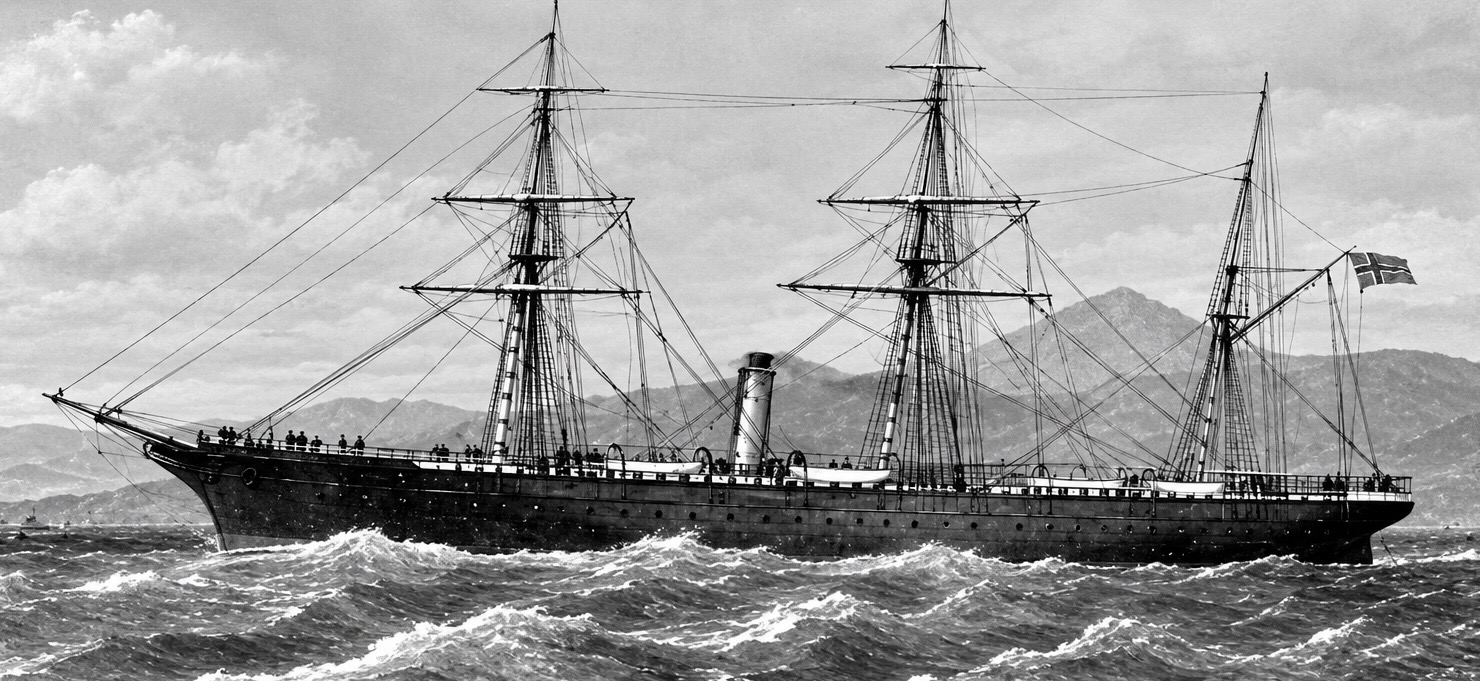
SS China (1862)
Cunard Line · North Atlantic Mail Service · Ship Guide
Overview
SS China was a pivotal Cunard liner: an iron-hulled, single-screw steamer built by Robert Napier & Sons at Glasgow and launched on 8 October 1861. She began her maiden voyage from Liverpool via Queenstown to New York on 15 March 1862.
More important than her size alone was what she represented. China was Cunard's first screw-propelled steamship built specifically for the Atlantic mail service. Her successful operation helped demonstrate that screw propulsion could provide the economy and reliability needed for regular liner service, even while paddle steamers such as Scotia still held an advantage in outright speed.
Key Facts
A Deliberate Experiment
Cunard had used screw steamers in secondary and cargo roles before China, but the company remained cautious about committing the technology to its prestigious Atlantic mail service. Paddle wheels were familiar, proven, and still capable of very high speeds in ships such as Persia and Scotia.
China was therefore an important test. Contemporary company histories describe her as something of an experiment: smaller than the great paddle express liners, but designed to determine whether an iron screw ship could meet mail-service requirements while consuming less fuel and carrying more useful cargo.
Iron Hull and Screw Propulsion
The contrast with Arabia, only a decade older, is striking. Arabia had been the culmination of Cunard's wooden paddle-steamer tradition; China combined an iron hull with a submerged propeller shaft, freeing the sides of the vessel from paddle boxes and improving the commercial use of hull volume.
Contemporary descriptions praised her strong framing and watertight subdivision. Her machinery consisted originally of geared oscillating engines driving a single screw. Later figures give about 2,250 indicated horsepower and an average speed close to 13.9 knots.
Economy Versus Speed
The transition from paddles to screws was not instantaneous because the engineering trade-offs were real. Large paddle steamers could still be exceptionally fast, and Scotia entered service at almost the same moment as China. Yet fuel economy increasingly favored the screw ship.
Later comparisons between China and Scotia are especially revealing: the paddle liner could maintain the higher speed, but at dramatically greater coal consumption. For a commercial liner operator, reduced fuel use meant more room and carrying capacity for revenue traffic as well as lower operating cost.
Atlantic Routes
China initially sailed the Liverpool–Queenstown–New York route. From 1865 she also worked the Liverpool–Halifax–Boston service, returning to New York service in 1868. These changes reflected Cunard's practice of moving useful ships between routes as traffic, contracts, and fleet composition evolved.
She was also significant in the company's emigrant trade. Fleet histories identify China as the first Cunarder designed to carry emigrants in addition to cabin passengers, a commercial shift that broadened the company's role beyond the premium mail-and-saloon market.
Re-engining and a Long Career
In September 1872 China was forced back to Queenstown after suffering a cracked cylinder while bound for New York. She was subsequently re-engined in Glasgow with compound machinery, returning to service in 1874.
The upgrade is historically important. Instead of discarding a twelve-year-old ship, Cunard invested in more economical machinery, allowing the iron hull to remain commercially useful through another phase of marine-engine development.
Zulu War Transport
In 1879 China was used as a transport during the Anglo-Zulu War. Descriptions of her internal arrangements noted that suspension rods could support large numbers of hammocks, allowing her to carry troops without completely dismantling her passenger accommodation.
As with Arabia's Crimean War employment, the episode demonstrates the strategic value governments placed on large commercial steamships capable of rapidly moving personnel over long distances.
Magallanes and Theodor
After nearly two decades with Cunard, the ship was sold in 1880 to Spanish interests and renamed Magallanes. She entered Spanish mail and passenger service, extending the working life of a vessel whose original design dated from the beginning of the 1860s.
In 1889 she changed hands again. Her machinery was removed and the former steam liner was converted into a four-masted sailing barque under the name Theodor. The transformation was dramatic but economically rational: an iron hull could continue earning long after its original machinery had become obsolete.
Disappearance
As Theodor, the former Cunarder remained in cargo service into the twentieth century. She sailed from Tampa, Florida, on 2 March 1906 with a cargo bound for Yokohama and disappeared with her crew.
Some later summaries give 1908 as her loss year, but contemporary shipping-loss compilations and Norwegian records place the disappearance in 1906. This guide follows the 1906 evidence while noting that the later date persists in secondary references.
Why China Matters
China is one of the clearest technological hinge points in Cunard history. She did not immediately make paddle steamers obsolete; Scotia remained faster and more prestigious in the short term. What China demonstrated was that the screw could provide a more economical foundation for the future of scheduled Atlantic service.
Her successors included Java and, later, Russia. By then the advantages of iron construction and screw propulsion were increasingly decisive, and the classic wooden paddle liner represented by Asia and Arabia had become a rapidly receding generation.
Interpretive Notes
1861 versus 1862: China was launched in October 1861 but entered Atlantic service in March 1862. The guide title follows the service year, consistent with common Cunard fleet references.
Passenger figures vary by source: capacities can reflect legal measurements, actual berths, or later configurations. They should not automatically be treated as a fixed maximum carried on every voyage.
Her distinction should be phrased carefully: China was not Cunard's first screw steamship of any kind; she was the first screw steamer built specifically for the company's Atlantic mail service.
Evidence-first ship guideSources (Selected)
- Ocean Liner Curator — Sources (master bibliography)
- GG Archives — Cunard fleet list and specifications for China
- GG Archives — Cunard historical account of the transition to screw propulsion
- Norway Heritage — SS China chronology and later career
- Illustrated London News contemporary description of the new Cunard steamer China, reproduced by Nova Scotia Historical Newspapers