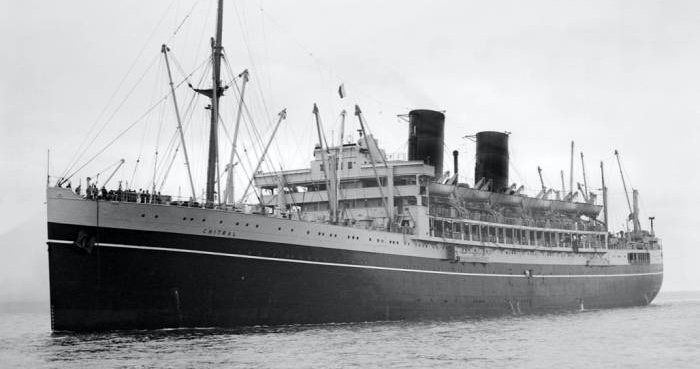
SS Chitral (1925)
P&O · entered service 1925 · Ship Guide
Overview
SS Chitral was the third of P&O's three mid-1920s C-class sisters, built for the Australia trade and launched by Alexander Stephen & Sons at Govan on 27 January 1925. She entered service that July and, like Cathay and Comorin, combined first- and second-class passengers with substantial refrigerated cargo capacity.
Her career was the longest and most varied of the trio. After Australia service she moved increasingly toward the Far East, was converted into the armed merchant cruiser HMS Chitral in 1939, later became a troopship, and ultimately returned to P&O for postwar emigrant work.
Key Facts
Australia and Far East Service
Chitral left London on 3 July 1925 for Australia via Marseilles, Suez, Aden, and Colombo. The three sisters helped restore P&O's prewar pattern of more frequent Australian mail service, though their modest speed limited their usefulness as true fast mail steamers.
In 1930 Chitral received Bauer-Wach low-pressure exhaust turbines and fuel-economy improvements. By 1935 she had transferred full-time to the UK–Far East service, showing how P&O redeployed the class as route economics changed.
HMS Chitral
Requisitioned on 30 August 1939, Chitral was converted by her builders into an armed merchant cruiser. Her after funnel was removed and heavy guns installed, materially changing the silhouette of the peacetime liner.
Her early wartime service included the Northern Patrol. On 23 November 1939 she rescued survivors from P&O's armed merchant cruiser Rawalpindi, sunk by the German battlecruisers Scharnhorst and Gneisenau. In 1940 she also searched for survivors of HMS Jervis Bay.
Indian Ocean Service and Trooping
From 1941 Chitral operated increasingly in the Indian Ocean, serving with the East Indies and Eastern Fleet. Her range and internal capacity again made a passenger liner useful as an auxiliary warship far from home waters.
In 1944 she left Admiralty AMC service and was converted in Baltimore into a troopship. The after funnel was restored, and she carried troops across the Atlantic in the final phase of the war.
Postwar Return
Chitral was returned to P&O in September 1947 and reconditioned in London. She resumed civilian operation in late 1948, carrying large numbers of emigrants to Australia in relatively austere accommodation.
She also participated in postwar repatriation work, including the movement of Dutch nationals from Indonesia in 1950. This phase makes Chitral a useful bridge between classic interwar liner service and the assisted-emigration traffic of the early postwar years.
Final Voyage and Scrapping
By 1953 the old machinery was increasingly troublesome. Her final Australia sailing suffered serious mechanical difficulty, including emergency alterations to keep the engines operating.
She reached London for the last time on 22 March 1953 and was sold for demolition. She arrived at Dalmuir on 1 April, ending a 28-year career that had included mail service, Far East liner work, armed patrol, troop transport, and postwar emigrant carriage.
Why Chitral Matters
Chitral is the survivor story of the trio. While Comorin was lost in 1941 and Cathay in 1942, Chitral survived the war and returned to civilian service, providing a rare full-life comparison within one closely matched sister group.
Her career also shows how P&O's older interwar tonnage could remain useful after 1945, not because it was technologically modern, but because Britain and Australia still needed large-scale sea transport for migrants and repatriation.
Interpretive Notes
Chitral's class identity is precise: her immediate sisters were Cathay and Comorin, all ordered for P&O's Australia service.
Her wartime silhouette changed: the dummy after funnel was removed during AMC conversion and later restored during troopship work.
Her postwar role was materially different from her 1920s role: emigrant and repatriation traffic should be treated as a distinct phase rather than a simple continuation of first- and second-class interwar service.
Evidence-first ship guide