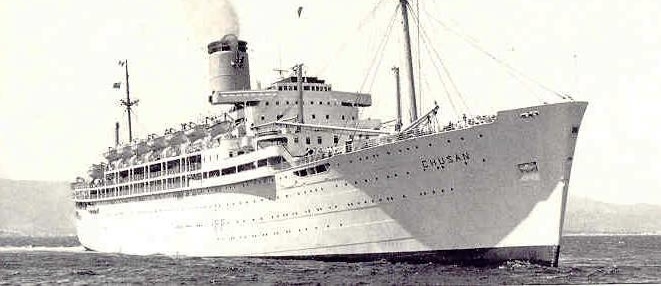
SS Chusan (1950)
P&O · entered service 1950 · Ship Guide
Overview
SS Chusan was P&O’s last major passenger liner built specifically for the company’s India and Far East service. Completed by Vickers-Armstrongs at Barrow-in-Furness in 1950, she linked Britain with Bombay, Hong Kong, and Japan before later expanding into Australia service and cruising.
She is also important technically. Chusan was among the earliest large passenger liners fitted with active anti-roll stabilizers, a feature that became increasingly common as postwar operators placed greater emphasis on passenger comfort. Her career therefore combines an old imperial route structure with technologies and operating patterns that pointed toward the modern cruise era.
Key Facts
Built for India and the Far East
P&O ordered Chusan in May 1946 as part of its postwar fleet rebuilding. Unlike the larger liners being prepared for Australia, she was designed around the company’s traditional Indian and Far Eastern network. Her regular route connected London with Bombay and continued eastward toward Hong Kong and Japan.
That distinction matters. The postwar British passenger fleet was not a single homogeneous Australia service: P&O still maintained multiple long-distance route systems, and Chusan was the most modern expression of its Far East trade.
A Smaller Relative of Himalaya
Chusan was broadly related in design philosophy to the larger Himalaya, also built by Vickers-Armstrongs. Both belonged to the same postwar generation of fast, turbine-driven P&O passenger ships, but Chusan was smaller and tailored to a different traffic pattern.
Her single-funnel profile, balanced superstructure, and relatively high service speed made her unmistakably postwar. Yet her cargo capacity and two-class accommodation retained the mixed passenger-and-cargo function that had long defined P&O’s eastern services.
Anti-Roll Stabilizers
One of Chusan’s most notable features was her anti-roll stabilizer system. Contemporary and later accounts identify her as the first ocean-going passenger liner fitted with this type of active stabilizing equipment.
The significance was practical rather than decorative. Stabilizers reduced rolling in rough seas, improving comfort for passengers and making public rooms, dining, and sleeping accommodation more usable in conditions that would otherwise produce pronounced ship motion. The technology would become standard on later passenger liners and cruise ships.
Entering Service
After sea trials in June 1950, Chusan was delivered to P&O on 14 June. Her first passenger sailing was a short all-first-class cruise from Southampton to Madeira and Lisbon beginning on 1 July, followed by another introductory cruise.
She sailed from London for Bombay on 15 September and began the regular London–Hong Kong service for which she had been built on 7 November 1950. The voyage took her through the Mediterranean and Suez Canal into the Indian Ocean and onward through the commercial ports of South and East Asia.
Life on the Far East Route
The India and Far East service demanded different rhythms from a North Atlantic express liner. Voyages were long, climates changed dramatically along the route, and passengers might remain aboard for weeks. Ventilation, deck space, public-room comfort, cargo handling, and dependable machinery were central to the ship’s usefulness.
Chusan carried officials, business travelers, families, tourists, and residents moving between Britain and Asia. She also served in a period when decolonization was changing the political and commercial relationships that had originally created P&O’s eastern route network.
Collision and World Cruising
On 12 June 1953, Chusan collided with the cargo ship Prospector near the Goodwin Sands, opening a substantial breach in her hull. She returned for repairs and soon resumed service.
In 1959 she undertook a major round-the-world voyage, reflecting the increasingly blurred boundary between scheduled liner service and cruising. Long-distance itineraries could now be marketed for the voyage experience itself rather than solely as transportation between two points.
Refit and P&O-Orient
A major refit at Harland & Wolff in Belfast from late 1959 into 1960 included full air conditioning. That modernization was essential for a vessel whose regular routes passed through tropical regions and whose passengers increasingly compared shipboard comfort with newer vessels and aircraft.
In 1960 she moved into the combined P&O-Orient organization. The corporate change placed Chusan within a much larger postwar passenger fleet that included ships such as Himalaya, Arcadia, Iberia, Orcades, Oronsay, and later Canberra.
Australia Service
From 1963, Chusan was increasingly used on services involving Australia, including routes linking Australia with Hong Kong and Japan. This broadened her geographic role considerably beyond the original London–India–Far East pattern.
The change also reflected the flexibility demanded of passenger liners in the 1960s. Operators could no longer assume that a ship would remain tied to the same route throughout her career; deployment increasingly followed seasonal demand and cruise opportunities.
The End of the India Service
In January 1970, Chusan completed P&O’s final traditional passenger voyage between Britain and India. The moment carried historical weight for a company whose identity had been deeply intertwined with the route for more than a century.
Afterward she was employed increasingly on cruises, including voyages from South Africa. By this stage her original role had effectively disappeared, not because the ship had failed but because the passenger market around her had been transformed by aviation and changing political geography.
Final Voyage
Chusan completed her final commercial voyage in March 1973. She subsequently sailed east for disposal and arrived at Kaohsiung on 1 July. She was sold for scrap shortly afterward, and demolition began in September.
Her twenty-three-year career encompassed scheduled eastern liner service, technological innovation, world cruising, Australia deployment, corporate consolidation, and the closing of one of P&O’s oldest passenger routes.
Why Chusan Matters
Chusan matters because she represents a branch of postwar liner history that can be overshadowed by the Britain–Australia ships. She was built specifically for India and the Far East and became the final major P&O liner created for that service.
At the same time, her stabilizers and later cruise employment point toward the future. She combined the route geography of nineteenth-century imperial shipping with technologies and operating practices that would become normal in the late twentieth-century passenger-ship industry.
Related Liners
Sources
- P&O Heritage Collection, ship records and photographic material for Chusan (1950).
- Royal Museums Greenwich, P&O archive, Individual Ships: CHUSAN: Miscellaneous material, 1950, P&O/65/104.
- Royal Museums Greenwich, National Maritime Museum P&O photographic collection, records of Chusan at Southampton and in service.
- Contemporary P&O timetables, brochures, and passenger material for the India, Far East, and later Australia services.