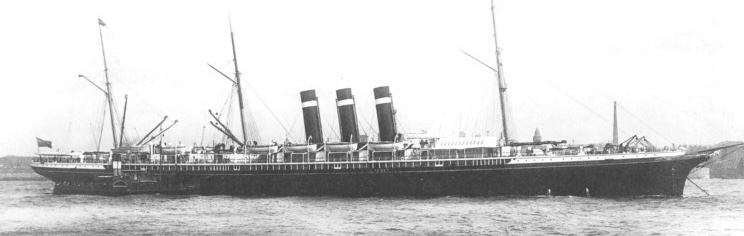
SS City of New York (1888)
Inman Line · American Line · 1888 · Ship Guide
Overview
SS City of New York (1888) was one of the defining express liners of the late Inman Line and, after 1893, became the American-flagged SS New York. Built by J. & G. Thomson at Clydebank, she and SS City of Paris formed a closely related pair intended to compete directly in the North Atlantic speed trade.
Her career is especially useful because it crosses corporate, national, and military identities. The same hull served as an Inman express liner, an American Line flagship, USS Harvard during the Spanish–American War, and USS Plattsburg during the First World War.
For cataloging precision, the year 1888 is useful whenever the full name City of New York is used; several unrelated vessels carried similar names.
Key Facts
Design and the Twin-Screw Transition
City of New York belonged to the generation in which twin screws became a major advantage for express liners. Two independent propellers offered both greater power and a degree of redundancy compared with a single-screw arrangement. The Mariners’ Museum records two three-cylinder triple-expansion engines developing roughly 18,500 indicated horsepower in the ship’s original configuration.
Her dimensions also illustrate how measurement conventions can create apparent contradictions in secondary sources. Period-derived records distinguish roughly 528 feet between perpendiculars from about 560 feet overall. For collection records, stating the measurement basis is better than treating one figure as universally definitive.
Inman Line Express Service
City of New York began her maiden voyage from Liverpool on 1 August 1888. Together with City of Paris, she gave Inman a modern paired express service capable of challenging Cunard and White Star. In 1892 she secured the eastbound Atlantic record, an achievement frequently compressed in later retellings into the generic phrase “Blue Riband holder.” The direction matters: speed records were tracked separately eastbound and westbound.
The ships were also products of an increasingly international business environment. They were British-built and initially British-registered, yet American capital was central to the enterprise. That tension between construction, ownership, flag, and route became one of the defining features of the liner business in the decades that followed.
American Flag and Refit
In 1893 the ship transferred to American registry and became simply New York. The change made one of the best-known Atlantic liners a visible American-flag presence in a trade dominated by European tonnage. The Mariners’ Museum notes that a major refit beginning in 1901 replaced machinery and ultimately altered the vessel’s external appearance from three funnels to two before she returned to service in 1903.
Military Service and Long Career
In 1898, during the Spanish–American War, the liner served the United States Navy as USS Harvard. She later returned to commercial service, only to be taken up again during the First World War as USS Plattsburg. Those changes make attribution particularly sensitive: an object associated with Harvard or Plattsburg belongs to a different operational phase from Inman or American Line passenger material even though the underlying ship was the same.
After more than three decades of changing service, she left the major Atlantic trade and was eventually broken up in Italy in 1923. Her longevity is striking for a vessel designed during the high-speed competition of the 1880s.
Why City of New York Matters
The ship sits at the intersection of several important liner stories: the adoption of twin-screw propulsion, the last major phase of Inman Line competition, the rise of American financial control in transatlantic shipping, and the use of large passenger liners as naval auxiliaries. Few ships illustrate the permeability between corporate and national identities quite as clearly.
For researchers, the many names are both the opportunity and the hazard. A complete history has to follow City of New York, New York, USS Harvard, and USS Plattsburg as phases of one physical vessel without collapsing the documentary context of those phases into one another.
Twin Screws and a New Express-Liner Pattern
City of New York and her running mate City of Paris belonged to an important transitional generation. Their twin-screw machinery provided both performance and redundancy at a time when the most powerful single-screw liners remained vulnerable to a single shaft or propeller failure. Combined with steel construction and extensive subdivision, the design pointed toward features that would become increasingly normal in large express liners.
The ship’s scale and appointments also reflected Inman Line’s attempt to compete at the prestige end of the North Atlantic market. She was not simply a faster packet steamer; she belonged to the emerging idea of the ocean liner as a large, technologically sophisticated passenger environment whose machinery, public rooms, and corporate identity were all part of the product.
An Identity That Followed Ownership
The vessel’s later names make her a particularly useful case study in the international business of shipping. After entering American Line service she became New York, and during wartime service she carried U.S. naval identities including USS Harvard and USS Plattsburg. Those changes were not cosmetic: each name belongs to a different operational and political context.
For that reason, surviving photographs, passenger material, and naval records should be dated before attribution. The same hull can appear in sources under several identities, and treating them as interchangeable obscures the corporate and wartime transitions that make the ship historically valuable.
Evidence-first ship guideSources (Selected)
- GG Archives — Inman Line fleet list and City of New York summary
- Ocean Liner Curator — Sources (master bibliography)
- The Mariners’ Museum — City of New York lithograph and vessel record
- The Mariners’ Museum — Twin Screw Steamship City of New York
- GG Archives — City of New York archival collection (secondary compilation)
- Norway Heritage — City of New York voyage chronology (specialist secondary source)