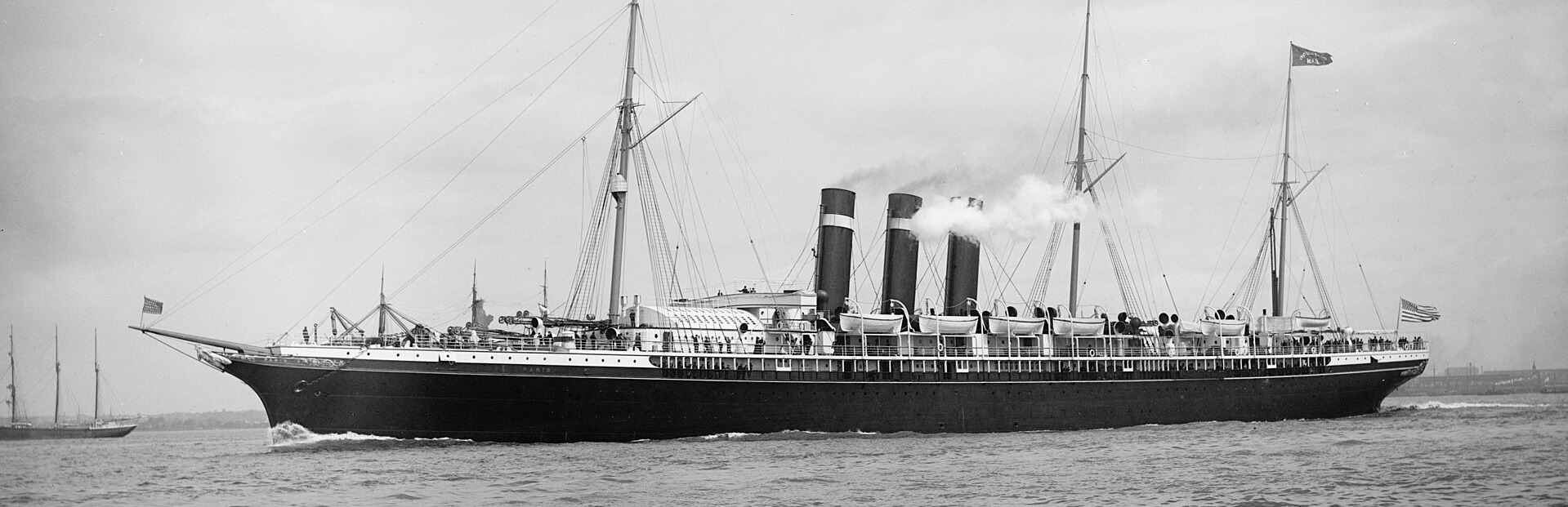
SS City of Paris
Inman Line · 1889 · Ship Guide
Overview
SS City of Paris was one of the Inman Line’s late-19th-century “express” North Atlantic liners, entering service in 1889 and quickly becoming known for fast passages. She sits at a transitional point in ocean-liner technology and marketing: steel-hulled, high-powered, and increasingly defined by schedule and speed prestige rather than the earlier hybrid steam-and-sail era.
In 1893, corporate consolidation and subsidy politics reshaped her identity: she transferred to U.S. registry and was renamed Paris. Her story then branches into a long “second life” under later names (including naval charter/service), culminating in scrapping in 1923. For collectors, that means you must treat “City of Paris” as an era-specific name rather than a catch-all label for any artifact connected to the ship’s later career.
Evidence-first note: Many listings conflate her identities (City of Paris → Paris → Philadelphia and later naval names). Anchor your attribution to what is printed on the object (ship name, operator, ports, and date), not a seller’s narrative.
Key Facts
Design & Construction (Context)
City of Paris was built for the prestige end of the North Atlantic trade, where speed, reliability, and public perception mattered. Her twin-screw configuration reflects the era’s push toward redundancy and confidence in long-distance schedules—exactly the kind of operational promise that shipping lines translated into marketing language and “modernity” cues in brochures and saloon ephemera.
Because the ship’s outward appearance changed later (especially after the 1899 grounding and subsequent rebuilding), visual identification can mislead. If an object’s image shows a different funnel count or later profile, treat it as a clue to era—but still prioritize printed name/date/route lines.
Service History (Summary)
1889–1893: Inman Line express service. Entering service in April 1889, City of Paris rapidly developed a reputation for fast crossings and became associated with the late-19th-century “Blue Riband” culture of publicized passage times. This is the core “ship-name era” for collectors: pieces that explicitly say “City of Paris” and carry late-1880s/early-1890s typography and agent marks.
1893–1899: U.S.-flag as Paris. In 1893 she transferred to U.S. registry and sailed as Paris. Ephemera from this period often shifts in branding language (American Line framing, ports, and U.S.-registry cues), which can be used as attribution anchors.
1898: Naval charter. During the Spanish–American War, she served under charter as USS Yale, a name that appears in naval-context photos and documentation.
1899 onward: Grounding, rebuilding, and later identities. On 21 May 1899, Paris grounded on The Manacles. After salvage she was rebuilt, re-engined, and later renamed Philadelphia. Later service includes troop/transport employment and additional naval service in WWI under USS Harrisburg, before the ship was sold and ultimately scrapped in 1923.
Interpretive Notes
The collecting trap with City of Paris is identity compression—a seller presenting any late artifact from her long career as if it belongs to the glamour of the 1889–1893 “express liner” moment. Your job is to keep names and eras clean in your cataloging.
Practical checks:
1) Ship name printed on the object: “City of Paris” vs “Paris” vs “Philadelphia” is your first divider.
2) Operator line: Inman vs American Line branding often separates pre-/post-1893 material.
3) Date + ports: Printed sailing date and route wording are stronger than any silhouette-based claim.
4) Naval names require naval-context documentation: “USS Yale” and “USS Harrisburg” attributions should be supported by headers, official forms, or clearly dated photos.
Sources (Selected)
Use these as a starting index; corroborate technical particulars against registers and contemporary company material where possible.
- Ocean Liner Curator — Sources (master bibliography)
- Wikipedia — SS City of Paris (starting index; verify against registers)
- ShipScribe — City of Paris / Paris / Philadelphia (naval-context summary; compiled)
- Lloyd’s Register Foundation (HEC) — City of Paris / Philadelphia survey documents index
- ShipIndex — SS City of Paris (bibliographic index for deeper research)
- Norway-Heritage — City of Paris (crossing log index; compiled; cross-check)