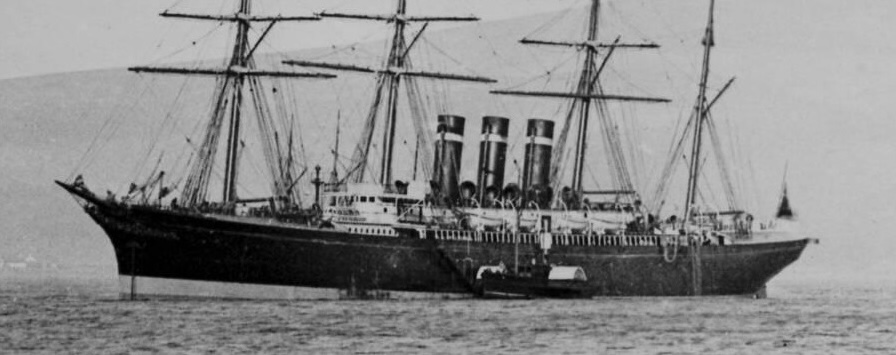
SS City of Rome (1881)
Inman Line · Anchor Line · 1881 · Ship Guide
Overview
SS City of Rome was one of the most ambitious Atlantic liners of the early 1880s. Built at Barrow-in-Furness for the Inman Line, she was intended to combine exceptional size, speed, and visual distinction at a moment when the North Atlantic express trade was rapidly becoming more competitive.
Her first career did not unfold as planned. Although imposing and fast by contemporary standards, she failed to meet the performance expected under Inman's arrangement with her builders. After only a handful of Inman voyages, she passed into service with the Anchor Line, under which she spent the great majority of her working life.
Key Facts
An Express Liner That Missed Its Target
City of Rome was designed at the edge of what merchant shipbuilding could then deliver. Her great length, three funnels, four masts, clipper bow, and elaborate profile gave her an appearance closer to the visual drama of a naval flagship than to the comparatively restrained steamers of the previous decade.
Inman expected the new ship to strengthen its position against Cunard and other competitors. Yet the vessel did not achieve the contractual speed expected of her during early service. That failure mattered commercially: the ship's technical promise was inseparable from the record-oriented ambitions surrounding her construction.
From Inman to Anchor Line
After five Inman voyages, City of Rome was transferred away from the company for which she had been built. By 1882 she was operated by Anchor Line, beginning a much longer and more stable phase of her career.
Under Anchor Line she continued North Atlantic service between Britain and New York. Passenger lists from the 1880s and 1890s document saloon, second-class, and emigrant traffic and show that the ship ultimately became a useful working liner even though her original express-liner objective had not been fully realized.
Machinery and Modification
The ship's machinery history illustrates the pace of steam development in the 1880s. Her original compound engines were later replaced by triple-expansion machinery, a change that improved efficiency and helped extend the commercial usefulness of an expensive hull.
This later mechanical phase should be kept distinct from the ship's 1881 configuration. Contemporary engravings and early photographs often emphasize her original rig and profile, while later images can reflect subsequent alterations.
Why City of Rome Matters
City of Rome is historically important precisely because she was both impressive and imperfect. She demonstrates how the drive for larger and faster ships could outrun the practical reliability of contemporary machinery, while also showing how a vessel that failed one commercial purpose could succeed in another.
She also forms a useful bridge between the iron express liners of the 1870s and the faster, more technically mature twin-screw ships of the late 1880s and 1890s. Her career belongs to a transitional moment when size, speed, appearance, and engineering prestige were becoming inseparable parts of liner competition.
Interpretive Notes
Operator attribution needs a date: early 1881 material belongs to Inman Line; most later material belongs to Anchor Line operation.
“Failure” needs context: the ship failed to meet the performance expectations that shaped her Inman contract, but she subsequently enjoyed many years of useful commercial service.
Published speed figures vary: references may describe original or post-re-engining performance, so date and machinery configuration matter.
Evidence-first ship guide