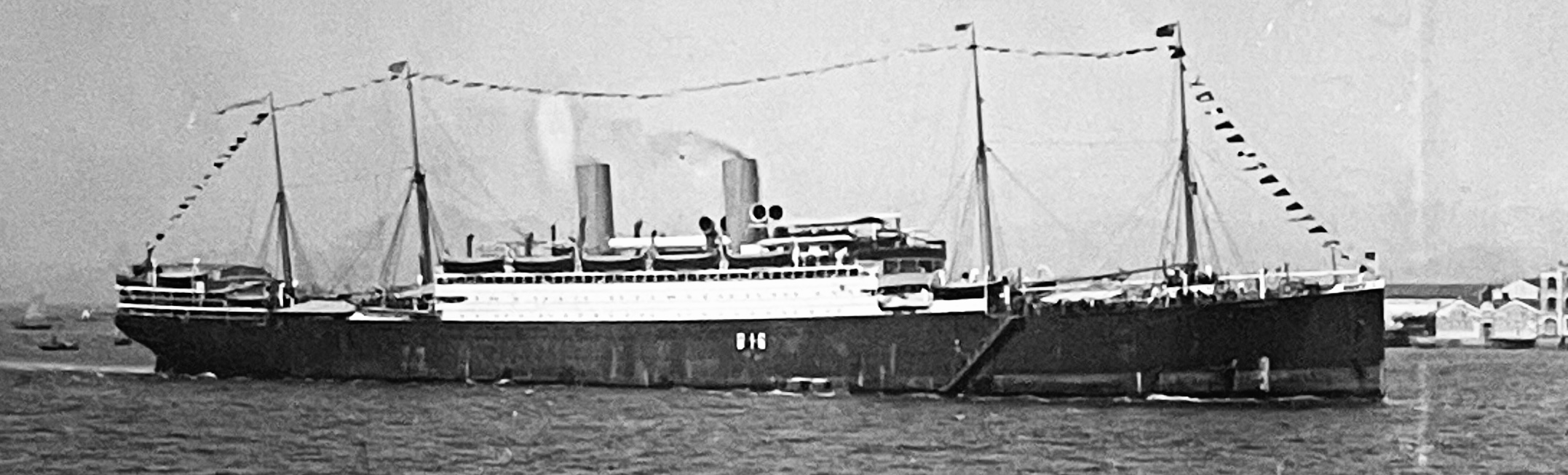
SS Cleveland
Hamburg America Line · 1908 · Ship Guide
Overview
SS Cleveland was one of Hamburg America Line’s large intermediate Atlantic liners of the pre-First World War period, built not for blue-riband prestige but for substantial mixed passenger and emigrant traffic with a strong cargo component. She entered service in 1909, served the North Atlantic out of Hamburg, later helped inaugurate HAPAG’s Boston service, and became one of the line’s better-documented ships because her career crossed prewar liner service, cruising, wartime seizure, and interwar restoration under her original name.
In collecting and interpretation, Cleveland is best separated into at least five phases: prewar HAPAG Atlantic service, world-cruise service, postwar U.S. troop transport service as Mobile, emigrant service as King Alexander, and restored interwar liner service again as Cleveland. Menus, passenger lists, cruise brochures, and military records belong to different documentary worlds and should not be merged casually.
Key Facts
This is one of those ships whose technical figures need light caution. Gross tonnage, accommodation, and even route shorthand can shift slightly depending on whether a source is describing her as built, after rebuilding, or under one of her later names. For cataloging purposes, the safest practice is to preserve both the original 1908–1909 identity and the later conversion phases.
Design & Construction Context
Cleveland belonged to the substantial middle tier of the Hamburg America fleet rather than its most famous express giants. She and her sister Cincinnati were large, commercially useful Atlantic liners designed to balance respectable cabin accommodation with extensive third-class and steerage traffic, plus cargo capacity. That makes her especially useful for interpreting the broader business of Atlantic migration and liner operation, not merely prestige travel.
Her design also helps explain why she later proved adaptable. Ships of this class were not fragile one-purpose showpieces; they were flexible commercial machines. That practicality helps make sense of her later use for cruising, troop transport, emigrant carriage under another flag, and renewed interwar Atlantic service after rebuilding.
Service History (Summary)
1908–1909 construction and entry into service: built by Blohm & Voss in Hamburg, Cleveland was launched on 26 September 1908 and began her maiden voyage on 27 March 1909 from Hamburg to New York via Southampton and Cherbourg. This is the correct starting point for most early passenger lists, promotional literature, and prewar photography.
Prewar HAPAG Atlantic service: in her early years she served HAPAG’s North Atlantic trade and, together with Cincinnati, later helped inaugurate a Hamburg–Boston service. This phase is the core setting for passenger ephemera, route maps, officers’ lists, and most of the ship’s liner-era printed material.
Cruising identity: Cleveland was not only a scheduled Atlantic liner. She also became notable in cruise history, including world-cruise service in the years before the First World War. That gives the ship a second interpretive identity beyond emigration and transatlantic transport: part liner, part early purpose-adapted cruise vessel.
First World War interruption: when war broke out, planned passenger and cruise work ended and the ship’s commercial role was suspended. As with many German liners, this created a sharp documentary break between prewar HAPAG material and what followed after the war settlement.
1919 wartime-afterlife as Mobile: after the war she passed to U.S. control and served as the troop transport Mobile. This is a completely separate documentary phase from her HAPAG passenger life. Military records, transport-service references, and government material from this period should not be treated as if they belong to ordinary civilian liner service.
1920 as King Alexander: in the next phase she entered civilian emigrant service under the name King Alexander, associated with movement from Greece to the United States. Material from this period often appears in migration or passenger-history contexts and can look deceptively similar to ordinary liner ephemera while belonging to a different ownership and route setting.
1923 restoration as Cleveland: after rebuilding, she re-emerged under the restored name Cleveland in United American Lines service, with changed accommodation and renewed Atlantic operation. This is the beginning of her later interwar identity, not a simple continuation of the exact pre-1914 shipboard world.
1926 return to HAPAG and final years: she returned to Hamburg America control in 1926, later received tourist-class adjustments and engineering improvement through Bauer-Wach turbines, and remained active into the early 1930s before lay-up and scrapping in 1933. Her long, interrupted, renamed career makes her unusually rich in surviving documentation.
USS Mobile and the 1919 Trooplift
After the Armistice, the former Cleveland was allocated to the United States and commissioned in March 1919. Renamed USS Mobile, she was fitted out as a troop transport and joined the Cruiser and Transport Force.
U.S. Navy records state that Mobile completed nine transatlantic crossings during the repatriation effort, carrying 21,073 servicemen home from Europe. That short naval phase is one of the best-documented chapters of the ship's career and demonstrates how quickly a large emigrant liner could be repurposed for mass military transport.
King Alexander and Return to Cleveland
After U.S. service the ship passed into civilian hands as King Alexander, carrying emigrant traffic under British registry. Her identity changed again when the vessel was rebuilt and restored to the name Cleveland in the 1920s.
This sequence—Cleveland, Mobile, King Alexander, and Cleveland again—makes the ship particularly vulnerable to fragmented cataloging. Treating the names as one hull chronology preserves the continuity that individual company histories can obscure.
Interpretive Notes
This is a migration-and-middle-market liner first: Cleveland is most useful when read within the practical commercial world of prewar Atlantic passenger and emigrant traffic, not through the mythology of the superliner.
1908 and 1909 both matter: 1908 is the launch year, while 1909 marks her entry into actual passenger service. Both dates are correct in context, but they should not be treated as interchangeable.
The renamings are not footnotes: Mobile and King Alexander are not trivial aliases. They mark genuinely different service identities with different operators, passenger contexts, and records.
Prewar and interwar “Cleveland” material should still be dated carefully: even when the ship carries the same name, 1909-era HAPAG material and 1923-onward restored service material may reflect different accommodation plans, routes, and corporate settings.
This is a strong ephemera ship: because Cleveland generated passenger lists, cruise publicity, route material, officer lists, and later interwar documents, she offers an excellent paper trail. That abundance is helpful, but it also increases the need for precise phase identification.
Evidence-first ship guideSources (Selected)
- Ocean Liner Curator — Sources (master bibliography)
- SS Cleveland — overview chronology, technical particulars, renamings, and final disposition
- GG Archives — concise ship history, dimensions, route context, passenger-list archive, and selected imagery
- GG Archives — passenger-list chronology for the ship’s postwar and restored interwar phases
- Norway Heritage — summary chronology including rebuilding, class changes, and return to HAPAG
- Naval History and Heritage Command — Mobile (Id. No. 4030) wartime transport reference
- U.S. Naval History and Heritage Command — USS Mobile II (former Cleveland)