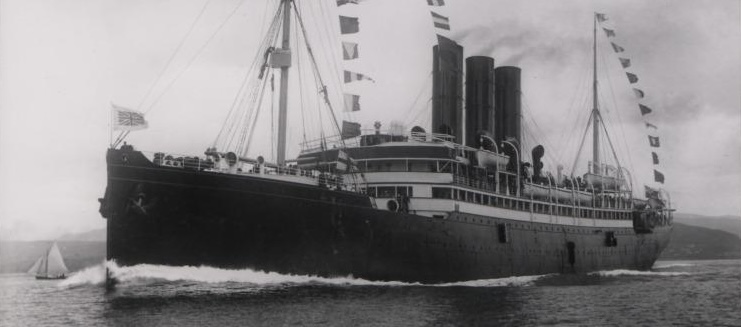
SS Columbia
Anchor Line · 1902 · Ship Guide
Overview
SS Columbia was an Anchor Line passenger-and-cargo liner of the early twentieth century, built for practical North Atlantic work rather than express-liner celebrity. She belonged to the Glasgow–New York service world that linked Scottish departure traffic, Irish calling points, and transatlantic migration, and she represents the sturdy middle range of Edwardian liner operation more clearly than the largest prestige ships of the era.
In collecting and interpretation, Columbia is best separated into four broad phases: prewar Anchor Line passenger service, wartime Admiralty service as the armed merchant cruiser Columbella, postwar civilian service as Moreas, and final Greek ownership before scrapping. Passenger lists, military references, and later ownership material belong to different documentary settings and should not be merged casually.
Key Facts
This ship should be handled carefully because “SS Columbia of the Anchor Line” can point researchers toward more than one vessel in surviving passenger material. For cataloging purposes, the safest practice is to identify this page specifically with the 1902-built Columbia.
Design & Construction Context
Columbia was not built as an Atlantic record-breaker. She belonged to the practical commercial world of the Anchor Line, carrying a mix of cabin passengers, second-cabin travelers, and large numbers of third-class passengers while also serving cargo needs. In that sense, she represents the dependable business of migration-era liner service more clearly than the mythology of luxury superliners.
Her scale also matters interpretively. At 400 feet long, she sat in that very useful middle range: large enough for substantial transatlantic work, but still recognizably part of a working fleet shaped by route economics, passenger-class balance, and regular service needs rather than pure prestige display.
Service History (Summary)
1902 construction and entry into service: built by D. & W. Henderson in Glasgow, Columbia was launched on 22 February 1902 and began her maiden voyage on 17 May 1902. This is the correct starting point for her surviving early passenger records, route references, and Anchor Line promotional material.
Prewar Anchor Line service: her peacetime identity belongs to the Anchor Line’s North Atlantic passenger-and-cargo system, especially the Glasgow–New York world with Irish embarkation or call-point context. This is the correct interpretive setting for passenger lists, passage contracts, and most commercial photography and printed ephemera.
Passenger traffic context: her accommodation balance shows clearly what kind of ship she was: a working Atlantic liner serving multiple passenger markets at once, with a particularly important third-class role. That makes her useful for interpreting migration history, family travel, prepaid passage certificates, and the documentary culture of routine transatlantic crossings.
First World War service: in November 1914 she was taken over and converted into the armed merchant cruiser Columbella. This marks a sharp documentary break. Naval references, armed-service records, and wartime imagery belong to a different interpretive framework from her original civilian passenger life.
Postwar return and renaming: after the war she was returned to her owners in June 1919 but was renamed Moreas. This means later material can look like a continuation of the same ship while no longer appearing under the name Columbia, an important point for both collectors and researchers.
Final ownership and scrapping: she was sold into Greek ownership in 1928 and scrapped in Italy in 1929. Her overall paper trail is therefore split between original Anchor Line material, wartime naval references, and later renamed civilian service.
Interpretive Notes
This is a working Atlantic liner first: Columbia should be read primarily within the commercial world of Anchor Line migration-era service, not through the lens of express-liner glamour.
The wartime phase is a distinct documentary world: once renamed Columbella and serving as an armed merchant cruiser, the ship no longer belongs to the same interpretive setting as passenger lists and Anchor Line advertising.
The postwar name change matters: because she returned to civilian life as Moreas, later records can easily be overlooked or separated from her earlier history unless the renaming is tracked carefully.
This is a useful ephemera ship: surviving passenger lists, tickets, and passage certificates make Columbia especially helpful for illustrating everyday transatlantic travel and migration systems rather than only elite ocean-liner culture.
Name duplication requires care: “SS Columbia” is not unique in maritime history. On a site index or in metadata, the safest approach is to keep the line and date attached whenever possible.
Evidence-first ship guideSources (Selected)
- Ocean Liner Curator — Sources (master bibliography)
- SS Columbia (1902 ocean liner) — overview chronology, dimensions, accommodation, wartime conversion, later names, and final fate
- GG Archives — archival material, passage certificates, and passenger-list context for Anchor Line Columbia
- GG Archives — Anchor Line route and service context
- GG Archives — 1912 passenger-list reference for SS Columbia on the Glasgow–New York route