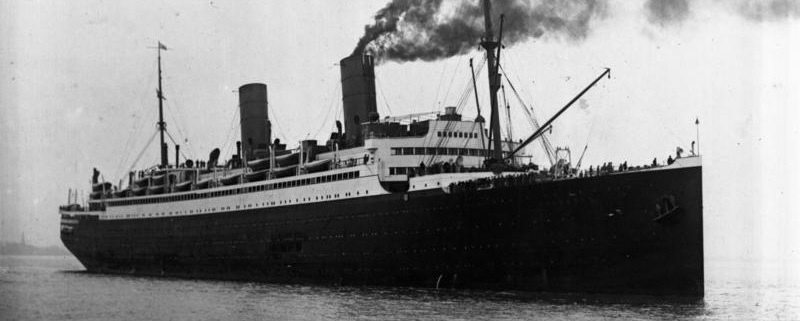
SS Columbus (1924)
Norddeutscher Lloyd · entered service 1924 · Ship Guide
Overview
SS Columbus (completed in 1924) was Norddeutscher Lloyd’s interwar “big ship” before the headline-grabbing duo of Bremen and Europa. Conceived before World War I and finished after it, she entered service as a large, comfortable Bremen/Bremerhaven–New York liner that also supported a lucrative cruising sideline. Her career is a useful case study in how ship identities can drift: built under one geopolitical moment, refitted into a new aesthetic in 1929, and ending with a wartime scuttling in 1939 rather than capture.
For collectors, Columbus material can be plentiful and visually strong—NDL brochures, passenger lists, menus, and deck plans often carry clear company branding. The most persistent hazard is name confusion: the earlier NDL Columbus (launched 1913) was ceded as a war reparation and became White Star’s Homeric. Sellers (and even some listings) sometimes blur these ships into one.
Evidence-first note: This page covers the NDL Columbus completed in 1924 (launched 1922; scuttled 1939). If your piece references Homeric, White Star Line, or appears clearly pre-1919 in style/printing, you may be dealing with the earlier sister ship (originally NDL Columbus, later White Star Homeric).
Key Facts
Design & Construction (Context)
Columbus is a “bridging ship”: designed in the pre-1914 competitive climate and completed after the war into a very different commercial world. That long build story explains why her early-1920s identity can feel like a hybrid—traditional machinery and layout expectations paired with the scale and ambition of a prestige liner meant to restore confidence in German transatlantic travel.
The 1929 modernization is central to how the ship is remembered in photos and ephemera. Many images (and some printed silhouettes) show the post-refit look, with shorter funnels and a more contemporary profile aligned with late-1920s “modern liner” aesthetics. For attribution, treat “look” as supporting evidence only; let printed dates and operator/route wording do the heavy lifting.
Service History (Summary)
1924–1929: Interwar liner service + cruising. After entering service in 1924, Columbus worked the Bremen/Bremerhaven–New York run and also developed a strong cruise role (often marketed through travel agencies). This period produces classic NDL artifacts: passenger lists, menus, on-board programmes, postcards, sailing cards, and brochures that frequently spell out the ship name clearly.
1929–1939: Modernized “new” Columbus. In 1929 she underwent a major refit that reshaped her appearance and updated propulsion (commonly described as re-engining with geared turbines) and speed. Post-refit materials can look more “graphic modern” in typography and layout—still absolutely legitimate Columbus artifacts, just a later design language.
1939: Neutrality-zone drama and scuttling. At the outbreak of World War II, Columbus attempted to return to Germany. On 19 December 1939 she was intercepted and, rather than be taken as a prize, her crew scuttled the ship. A U.S. Navy cruiser, USS Tuscaloosa, removed passengers and crew and brought them to the United States. This end-of-career episode produces a distinct category of associated material (press coverage, photographs, internment-related documentation) that should be handled with especially careful sourcing.
Interpretive Notes
SS Columbus is a reminder that ship names can be treacherous. The key confusion is with the earlier NDL Columbus (launched 1913), ceded as a war reparation and known in British service as White Star’s Homeric. Some sellers collapse these vessels into one “SS Columbus” narrative. Resist that drift: route, operator, dates, and design language will usually separate them quickly.
Practical checks:
1) Operator branding: Norddeutscher Lloyd (“NDL”) versus White Star Line (Homeric) is your first separator.
2) Route line: “Bremen/Bremerhaven–New York” is a strong anchor for the 1924 Columbus era.
3) Date + print style: 1920s German liner ephemera often dates cleanly; post-1929 materials can look noticeably more modern.
4) Don’t over-trust silhouettes: pre- and post-1929 profiles differ; use visuals as support, not proof.
Sources (Selected)
Use these as a starting index; corroborate technical particulars against registers and contemporary Norddeutscher Lloyd materials where possible.
- Ocean Liner Curator — Sources (master bibliography)
- Wikipedia — SS Columbus (completed 1924) (starting index; verify against registers)
- ShipIndex — SS Columbus (bibliographic index; good for chasing stronger references)
- NHHC (DANFS) — USS Tuscaloosa (context for the 1939 rescue episode)
- Norway-Heritage — Columbus / Homeric name-confusion context (cross-check)
- Trove (newspaper archive) — contemporary press reporting on the 1939 scuttling (context; cross-check)