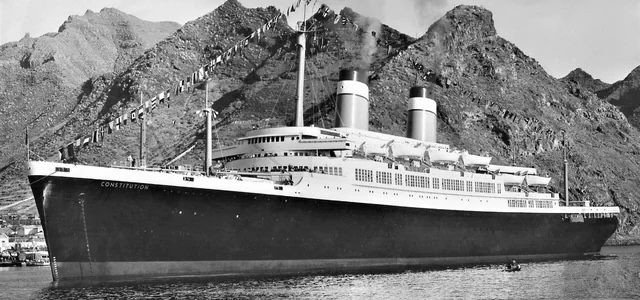
SS Constitution
American Export Lines · 1951 · Ship Guide
Overview
SS Constitution was a postwar American passenger liner built for American Export Lines and introduced in 1951. Sister ship to SS Independence, she represented a distinctly mid-century American answer to Mediterranean service: modern, air-conditioned, cruise-capable, and outward-facing toward both transatlantic travel and warm-weather leisure.
Although smaller and less famous than SS United States, Constitution became one of the most visible American liners of the 1950s. Her appearances in popular culture, her association with Grace Kelly’s 1956 voyage to Monaco, and her later Hawaiian service gave the ship a public memory that extends well beyond ordinary route history.
This page is written as a reference doorway: it summarizes widely documented facts, flags uncertainty where it exists, and avoids turning publicity lore or screen appearances into technical history without evidence.
Key Facts
Note on figures: passenger capacity, tonnage, and service description changed across refits. This guide treats exact numbers as “versioned” rather than fixed across the ship’s entire career.
Design & Construction (Context)
Constitution and Independence were built in the United States for American Export Lines’ Mediterranean service. Their scale and styling reflected a postwar market that was no longer only about point-to-point immigration or express prestige. Comfort, climate control, vacation cruising, and American modern design were central to how the ships were marketed.
In design-history terms, the ship belongs to the early Cold War moment when American liners carried soft-power meaning: they were commercial vessels, but also floating showcases of American shipbuilding, hospitality, modern interiors, and international mobility. For collectors, that context matters because menus, passenger lists, brochures, and onboard material often mix scheduled liner service with cruise-style promotion.
Service History (Summary)
Constitution entered service in 1951 and worked American Export Lines’ New York–Mediterranean pattern alongside her sister. The route linked New York with ports such as Gibraltar, Cannes, Naples, and Genoa, placing the ship in a hybrid role: part transatlantic liner, part Mediterranean vacation carrier, and part postwar cultural bridge.
The ship became especially prominent in the mid-1950s. She appeared in I Love Lucy episodes connected to the Ricardos’ European voyage, was used in the romantic liner imagery of An Affair to Remember, and carried Grace Kelly toward Monaco in 1956. These associations gave Constitution an unusually strong screen-and-celebrity afterlife for a liner of her size.
As air travel reshaped passenger shipping, Constitution moved increasingly toward cruise work. Later ownership periods included Hawaiian cruising, where her American registry and American crew became commercially important under U.S. passenger-service rules. By the 1980s and 1990s, she was remembered less as a Mediterranean liner and more as one of the surviving American-flag cruise vessels from the classic liner generation.
Later History & Final Disposition
After decades of service, layup, and refit, Constitution was withdrawn from active operation in the 1990s. In 1997, while under tow for scrapping, she sank in the Pacific north of Hawaii.
Her loss under tow complicates the usual preservation narrative. Unlike ships broken up in an orderly yard process, Constitution did not leave behind a large, well-documented dispersal of architectural interiors comparable to some scrapped liners. Surviving material should therefore be evaluated carefully by object type, date, and documentation rather than assumed from generalized “shipboard origin” claims.
Postwar American Engineering
Contemporary U.S. government material described Constitution as a roughly 683-foot, 89-foot-beam passenger liner with geared turbines designed for about 55,000 horsepower. The intended cruising speed of roughly 22½ knots was sufficient for a six-day New York–Gibraltar passage and reflected the ship's role as a fast Mediterranean liner rather than an Atlantic record contender.
She and Independence were commercial passenger ships, but their design also reflected Cold War-era expectations that large U.S.-flag liners might have strategic value. That combination of civilian comfort and reserve transport utility was characteristic of major American passenger-ship construction in the period.
The 1959 Refit
A major 1959 reconstruction altered the forward superstructure and significantly changed the ship's passenger distribution. Museum records describe the structure as being moved forward and raised by a deck, increasing first-class accommodation and giving the liner a visibly different later-career configuration.
This makes photographic dating especially important. An image of Constitution after the refit should not automatically be used to document her as-built 1951 appearance.
From Liner to Hawaiian Cruise Ship
As scheduled Mediterranean liner traffic declined, Constitution moved increasingly into cruise service. Later ownership brought the ship into Hawaiian cruising, extending her career deep into an era when almost all of her original transatlantic contemporaries had disappeared.
She was finally retired in the 1990s and sank on 17 November 1997 while under tow to shipbreakers. The loss closed a working life spanning the transition from postwar transatlantic liner to modern cruise vessel.
Interpretive Notes
Constitution is easy to underestimate because she was not the largest, fastest, or most technically famous American liner of her era. Her significance lies elsewhere: in postwar Mediterranean travel, American Export Lines’ identity, mid-century cruise culture, and the transition from scheduled ocean-liner service to leisure-focused passenger shipping.
Ocean Liner Curator treats the ship as both a historical subject and a collecting environment: a passenger list, dinner menu, brochure, deck plan, or photograph can be valuable evidence, but it should be dated to the correct service period. Material from American Export Lines, later Hawaiian service, and publicity tied to television or film may tell different stories. Where a claim materially affects identification or value, the strongest evidence remains contemporary documentation, institutional records, photographs with clear match points, and verifiable provenance.
Evidence-first ship guideSources (Selected)
This list is intentionally conservative.
- Ocean Liner Curator — Sources (master bibliography)
- Gjenvick-Gjønvik Archives — SS Constitution archival material
- ssMaritime — SS Independence & SS Constitution history and photographs
- The Mariners’ Museum and Park — American Export Lines / SS Constitution object record
- Cooper Hewitt — SS Independence and SS Constitution design context
- U.S. Coast Guard Proceedings — 1950 launch and machinery description of SS Constitution
- The Mariners' Museum — SS Constitution collection record and refit history