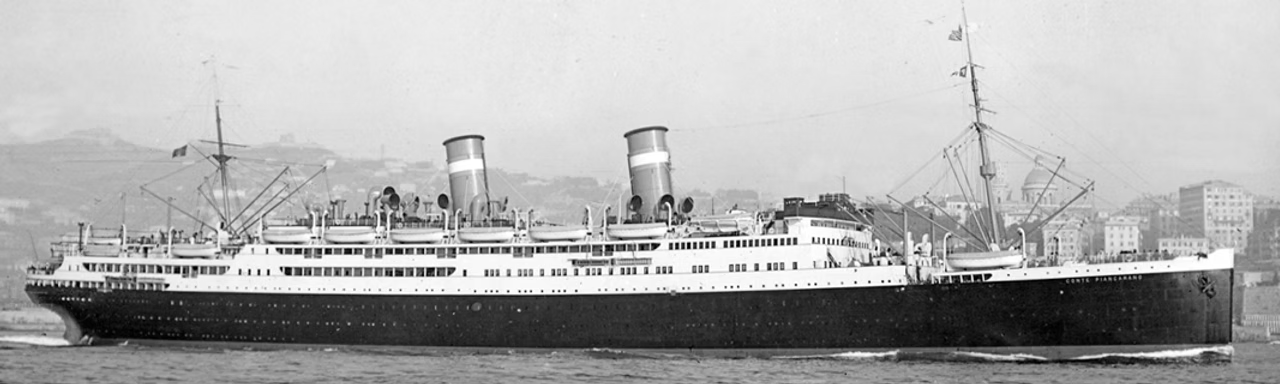
SS Conte Biancamano
Lloyd Sabaudo / Italian Line · 1925 · Ship Guide
Overview
SS Conte Biancamano was one of the major Italian liners of the interwar period, built for Lloyd Sabaudo and later operating under the reorganized Italian Line system. She belonged to the generation of large Italian passenger ships that projected national prestige abroad while also serving the practical demands of transatlantic migration and regular passenger traffic. Her long career bridged several distinct identities: a North Atlantic liner, a South American route ship, a wartime U.S. troop transport, and finally a rebuilt postwar Italian liner.
In collecting and interpretation, Conte Biancamano is best treated in clearly separated phases: Lloyd Sabaudo North Atlantic service, later Italian Line / Lloyd Triestino service, wartime service as USS Hermitage, and postwar reconstructed Italian Line service. Material from those phases should not be merged casually into one undifferentiated identity.
Key Facts
Tonnage and accommodation figures may differ between prewar, wartime, and postwar references. For cataloging purposes, preserve the exact phase and wording used by the source or artifact being cited.
Design & Construction Context
Conte Biancamano belongs to the ambitious interwar era of Italian passenger shipping, when major liners were expected to serve both practical and symbolic roles. Ships of this class were not simply transport machines; they also projected national style, modernity, and confidence abroad. Her name, drawn from the Savoy dynasty, underlines that representational function.
She is also notable as the last major Italian passenger ship built outside Italy. That makes her an interesting transitional vessel: unmistakably part of Italian liner history, yet physically built in Britain before later Italian rebuilding and service changes altered her identity further.
Service History (Summary)
1925: Launched in April 1925 and entered service later that year for Lloyd Sabaudo. Her maiden voyage began on 20 November 1925 from Genoa to New York.
Late 1920s–early 1930s: In her original phase, Conte Biancamano operated on the Italy–New York route as a major transatlantic liner. Passenger lists from this period show her role across multiple classes, from first-cabin travel to large-scale emigrant carriage.
1930s corporate shifts: With the restructuring of major Italian shipping concerns, Lloyd Sabaudo was absorbed into the Italian Line system. Conte Biancamano then passed through different operating contexts, including South American service and periods under Lloyd Triestino and Italian Line management.
1934–1936: She was also employed for military and state transport purposes in the broader context of Italian imperial policy, including movements tied to the Ethiopian campaign. This phase should be distinguished from her ordinary commercial passenger role.
1940–1941: At the outbreak of the Second World War, she eventually found refuge at Cristóbal in Panama. After the United States entered the war in December 1941, the ship was seized and converted for American transport use.
1942–1946: Commissioned as USS Hermitage (AP-54), she served as a U.S. troop transport. In this role she carried very large troop contingents and participated in wartime movement operations, including the North African campaign phase associated with Operation Torch.
1947–1949: Returned to Italy after the war and rebuilt at Monfalcone. Her postwar reconstruction substantially refreshed the ship and marked the beginning of a distinct final civilian career.
1949–1960: Re-entered service for Italian Line and resumed transatlantic passenger work. In this phase she belongs to the postwar Italian liner revival and should be interpreted through that newer service identity rather than as a simple continuation of the 1925 ship unchanged.
1960 onward: Withdrawn from service in 1960 and scrapped at La Spezia. Notably, parts of the ship were preserved and reassembled in Milan, making her one of the rare major liners to survive in fragmentary museum form.
Interpretive Notes
This is an Italian prestige liner first: Conte Biancamano should primarily be understood within the interwar Italian transatlantic and national-shipping context, not merely as the earlier hull behind the later U.S. transport Hermitage.
Operator changes matter: Lloyd Sabaudo, Italian Line, and Lloyd Triestino each frame the ship differently. Brochures, passenger lists, and markings should be read within the exact company phase they belong to.
Wartime identity is a separate evidentiary category: material referring to USS Hermitage belongs to a U.S. naval transport context, not an Italian passenger-line context, even though it is the same vessel.
Postwar material reflects a rebuilt ship: the post-1949 Conte Biancamano should not be treated as visually or operationally identical to her 1925 self. This is especially important for dating photographs, interiors, deck plans, and passenger ephemera.
Surviving fragments make her especially important: because portions of the ship survive in museum form, Conte Biancamano has a rare afterlife in Italian liner heritage that extends beyond her scrapping date.
Evidence-first ship guideSources (Selected)
- Ocean Liner Curator — Sources (master bibliography)
- SS Conte Biancamano — overview chronology, specifications, company changes, wartime service, and postwar career
- USS Hermitage (AP-54) — wartime U.S. transport phase
- Italian Liners Historical Society — Conte Biancamano overview and preservation context
- GG Archives — selected passenger-list evidence for route and service context