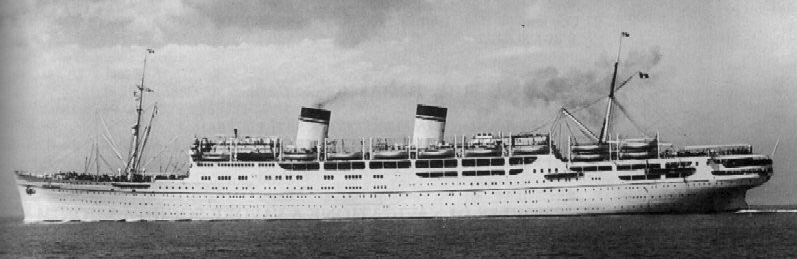
SS Conte Grande
Lloyd Sabaudo · 1927 · Ship Guide
Overview
SS Conte Grande was one of the major Italian transatlantic liners of the late 1920s and 1930s, built for Lloyd Sabaudo at a time when Italian passenger lines were trying to project greater prestige and commercial presence on the North Atlantic. She combined large passenger capacity with a distinctly Italian visual identity and became one of the best-known ships in the “Conte” group of liners associated with the interwar Italian passenger trade.
In collecting and interpretation, Conte Grande is especially important because she belongs to a family of ships whose names, appearance, and corporate histories are sometimes blurred together in seller descriptions and quick summaries. Artifacts should therefore be cataloged using the printed ship name, voyage date, and operator actually shown on the piece rather than by family resemblance alone.
Key Facts
Exact passenger totals and some dimensional shorthand vary slightly across quick-reference sources, particularly when later service-era configurations are folded into original specifications. For stricter catalog work, preserve the exact form used by the source or artifact being cited.
Design & Construction Context
Conte Grande was built in a period when Italian passenger lines were trying to strengthen their place in the North Atlantic trade through ships that combined substantial size, national style, and competitive passenger accommodation. She was not an all-out speed champion in the express-liner sense, but she was meant to be a prestige-bearing and commercially serious liner for the Italian emigrant and transatlantic passenger market.
This matters interpretively. Italian liners of this generation often expressed national identity as much through décor, atmosphere, and route culture as through technical record-setting. Conte Grande belongs to that world: a ship important not only because of tonnage and service, but because of what she represented within interwar Italian maritime ambition.
Service History (Summary)
1927–1928: Built at Monfalcone for Lloyd Sabaudo and entered passenger service in the late 1920s. She joined the Italian Atlantic fleet during a period of strong competition for emigrant and mixed-class passenger traffic to the United States.
Late 1920s–early 1930s: Operated primarily between Genoa, Naples, and New York. This is the principal prewar collecting phase, reflected in passenger lists, menus, brochures, and promotional material associated with Lloyd Sabaudo and later consolidated Italian branding.
1932 onward: After the consolidation of the major Italian passenger companies into Italia Flotte Riunite, she continued in service under the broader Italian Line framework. This corporate transition is important because artifacts may appear under more than one line identity while still referring to the same ship.
Second World War: At the outbreak of war she was in South America and became stranded by wartime conditions, leading to internment in Brazil. This interrupted her normal Atlantic service and shifted her documentary history away from ordinary passenger-trade material.
Postwar: After the war she returned to Italian ownership and resumed passenger service. Like many liners of her generation, she entered a changed maritime world in which the old emigrant and prestige liner model was becoming harder to sustain.
End of career: She remained in service well beyond the interwar period before final withdrawal and scrapping in 1961. Her long life gives her a broader documentary record than many more dramatic but shorter-lived liners.
Interpretive Notes
The “Conte” group can cause attribution drift: ships such as Conte Grande, Conte Biancamano, and Conte di Savoia are often blurred together in casual descriptions. Printed ship name and voyage evidence matter more than family resemblance.
Corporate branding changed: a piece may properly belong to the Lloyd Sabaudo phase or the later Italian Line phase. Those are related but not identical collecting categories.
Wartime interruption should be treated as a distinct phase: material from internment or government-control periods belongs to a different interpretive frame than ordinary Genoa–New York passenger service.
This is a strong representative of interwar Italian liner culture: even if she does not dominate popular memory like a few later or more technically dramatic ships, Conte Grande is highly useful for understanding how Italian lines presented themselves to the Atlantic passenger market.
Evidence-first ship guideSources (Selected)