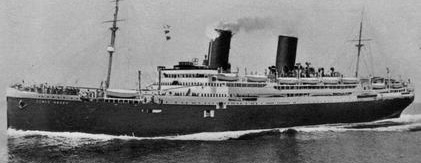
SS Conte Rosso
Lloyd Sabaudo · entered service 1922 · Ship Guide
Overview
SS Conte Rosso was a large Italian liner built in Scotland for Lloyd Sabaudo. Launched at William Beardmore & Company’s Dalmuir yard in 1921 and completed in 1922, she belonged to the generation that expanded Italy’s interwar passenger presence before the better-known state-consolidated Italian Line era.
Her story has two sharply different halves: a civilian liner career shaped by corporate reorganization and changing routes, followed by requisition as a troop transport in the Second World War. She was sunk by the British submarine HMS Upholder on 24 May 1941 with exceptionally heavy loss of life.
Key Facts
Civilian Service and Consolidation
Conte Rosso entered service during a period of intense competition among Italian passenger companies. Early material should be read in Lloyd Sabaudo context; later records reflect the state-directed mergers that brought fleets under Italia Flotte Riunite and then redistributed ships again. By the mid-1930s Conte Rosso was associated with Lloyd Triestino.
This matters for attribution because “Italian Line” can be used too loosely in later collecting descriptions. A dated document, operator imprint, route, and registry are better evidence than a retrospective umbrella label.
Interwar Route and Corporate Context
During the 1920s, Conte Rosso worked within the broad Italian passenger system linking Mediterranean ports with overseas destinations. Her career was shaped less by one permanent route than by the changing commercial priorities of Lloyd Sabaudo and, later, the state-directed consolidations of the Italian shipping industry. That broader network context is important because later summaries often flatten several corporate phases into the single label “Italian Line.”
Her construction in Scotland also places her within a wider pattern of Mediterranean companies commissioning major passenger ships from British yards. The result was an Italian-operated liner whose physical origins, corporate identity, and route history crossed national boundaries well before wartime requisition changed her role entirely.
Wartime Troopship
During the Second World War the liner was requisitioned for troop transport. On 24 May 1941 she sailed in a heavily escorted convoy carrying men toward Libya. Off southeastern Sicily, HMS Upholder, commanded by Lieutenant Commander Malcolm David Wanklyn, attacked the convoy and torpedoed Conte Rosso. The liner sank rapidly.
Contemporary and later official-derived counts vary in detail, but modern Italian research commonly gives roughly 2,729 people aboard, about 1,432 survivors, and 1,297 dead or missing. Because casualty totals have been revised across sources, exact numbers should be attributed rather than presented as if every record agrees.
Civilian Passenger Role
Before requisition, Conte Rosso belonged to the mixed passenger world of the interwar Mediterranean: cabin travel, emigrant traffic, and long-distance services all formed part of the same commercial system. Her accommodation and route history should therefore be read in the context of mass mobility as well as prestige shipping. Surviving passenger lists, postcards, menus, and company material can illuminate ordinary travel patterns that are almost invisible if the ship is remembered chiefly for her 1941 sinking.
That civilian record also helps distinguish Conte Rosso from the later, more famous Italian prestige liners. She was important not because she represented the final word in speed or luxury, but because she participated in the expansion and consolidation of Italian international passenger shipping between the wars.
Why the Loss Matters
The sinking was one of the deadliest Italian maritime losses of the war before the 1943 armistice. Treating Conte Rosso merely as an interwar “Conte” liner understates the scale of her troopship history; treating her only as a wartime casualty erases nearly two decades of civilian service. Both phases belong in the same biography, but should remain clearly separated.
Evidence-first ship guide