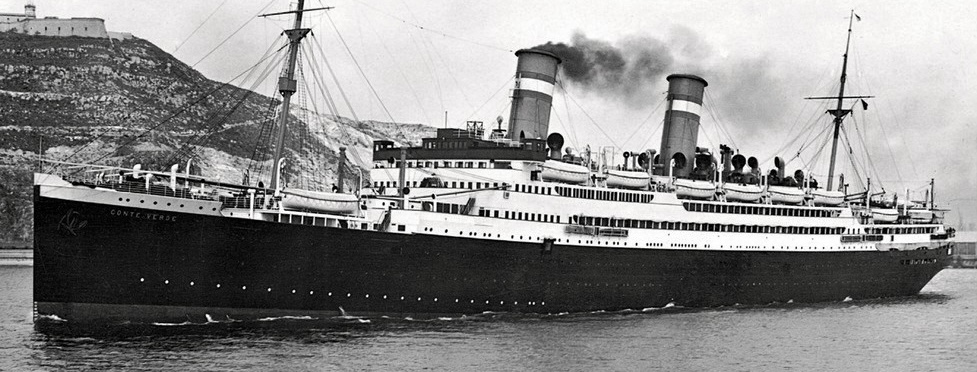
SS Conte Verde
Lloyd Sabaudo · entered service 1923 · Ship Guide
Overview
SS Conte Verde was a major Italian interwar liner built for Lloyd Sabaudo and later operated under Lloyd Triestino after the reorganization of Italian shipping in the early 1930s. She belonged to the generation of large Italian liners that carried emigrants, regular passengers, and symbolic prestige on routes linking Italy with South America and, later, Asia. Her significance lies not only in her normal commercial service but also in her remarkable association with international sporting history, wartime diplomatic exchange, and a complex final career in East Asia.
In collecting and interpretation, Conte Verde is best divided into four main phases: Lloyd Sabaudo South American liner service, Lloyd Triestino / Far Eastern service, wartime exchange-ship service, and final Shanghai / Japanese-controlled end-of-career service. Material from those phases should be cataloged carefully rather than treated as a single undifferentiated ship identity.
Key Facts
Design & Construction Context
Conte Verde belonged to the first post-First-World-War generation of large Italian liners intended to reassert commercial and symbolic presence on international routes. Her design balanced emigrant traffic with more prestigious passenger accommodations, making her part migrant carrier, part national showcase. In that sense, she should be understood less as a pure luxury liner than as a versatile Italian flagship of the South American service world.
She was also part of the broader “Conte” family associated with Lloyd Sabaudo’s interwar expansion. Her sister relationship to Conte Rosso and wider kinship with other “Count” liners helps place her within a recognizably branded Italian fleet identity.
Service History (Summary)
1920–1923: Built by William Beardmore & Co., Conte Verde was laid down in 1920, launched in October 1922, completed in April 1923, and began her maiden voyage from Genoa to Buenos Aires later that month.
1920s South American service: In her original role she served the Italy–South America trade, a route framework that is central to interpreting her early passenger lists, menus, brochures, luggage labels, and publicity photography. This is the core commercial identity with which the ship first became known.
1923 New York service: She also sailed to New York in June 1923, showing that her operating world was not confined entirely to the River Plate run. Still, her strongest interwar identity remained tied to the South American service sphere.
1930 FIFA World Cup voyage: One of her most famous crossings came in 1930, when she carried several national football teams, FIFA president Jules Rimet, referees, and the World Cup trophy toward Uruguay. This voyage gives the ship an unusual place in both sports history and liner history.
1932 company reorganization: When the Italian shipping system was reorganized, Conte Verde passed from Lloyd Sabaudo into Lloyd Triestino. Material after this point may reflect a different corporate identity and route emphasis, even though the ship herself remained the same.
Far Eastern service: In later peacetime service she became associated with the Far East, especially Shanghai. In curatorial terms, this means that South American-route and East Asian-route artifacts should not be collapsed together without attention to date and operator.
1942 exchange-ship service: During the Second World War she was used in the exchange of diplomats and civilians between Japan and the United States at Lourenço Marques. This phase belongs to a distinctive diplomatic and humanitarian framework, separate from both ordinary liner service and troop transport history.
1943 scuttling at Shanghai: After the Italian Armistice, her Italian crew scuttled the ship at Shanghai to prevent seizure by Japanese forces. This act belongs to the highly specific political context of shifting wartime loyalties rather than to a normal commercial end-of-career pattern.
Later wartime reuse and end: The wreck was raised, later bombed again by Allied aircraft, then raised once more, renamed Kotobuki Maru, and used under Japanese control before final destruction and postwar scrapping in 1949. Her end was therefore prolonged and unusually complex.
Interpretive Notes
This is a South American liner first, but not only that: Conte Verde began in the Italy–South America emigrant and passenger trade, yet later acquired major Far Eastern and wartime identities that matter just as much for serious interpretation.
The 1930 World Cup connection is historically real but should remain in proportion: it is one of the ship’s most famous episodes, but it should not completely overshadow her broader commercial and political history.
Corporate phase matters: Lloyd Sabaudo and Lloyd Triestino material belong to related but distinct operator contexts and should be cataloged accordingly.
The exchange-ship phase is its own category: wartime diplomatic exchange service is interpretively different from ordinary passenger service, emigrant transport, or military troopship employment.
The ship’s final fate is layered and complex: because she was scuttled, raised, bombed, raised again, renamed, and only later scrapped, end-of-career references may vary in tone and wording. Preserving exact source language is especially useful here.
From Lloyd Sabaudo to a state-backed fleet: Conte Verde began as part of Lloyd Sabaudo’s “Conti” prestige program, before the 1932 consolidation that created the Italian Line. That distinction matters because pre-1932 brochures, passenger lists, and stationery document a different corporate identity even when later histories group the ship under a single national fleet story.
Her later Far East and exchange-ship service also changed the geography of the evidence. A ship first associated with Mediterranean–New York traffic could later appear in Asian route material and wartime repatriation documentation. Route, operator, and date therefore have to travel together when attributing surviving ephemera.
The result is a career whose geography changed as dramatically as its corporate identity.
Evidence-first ship guide