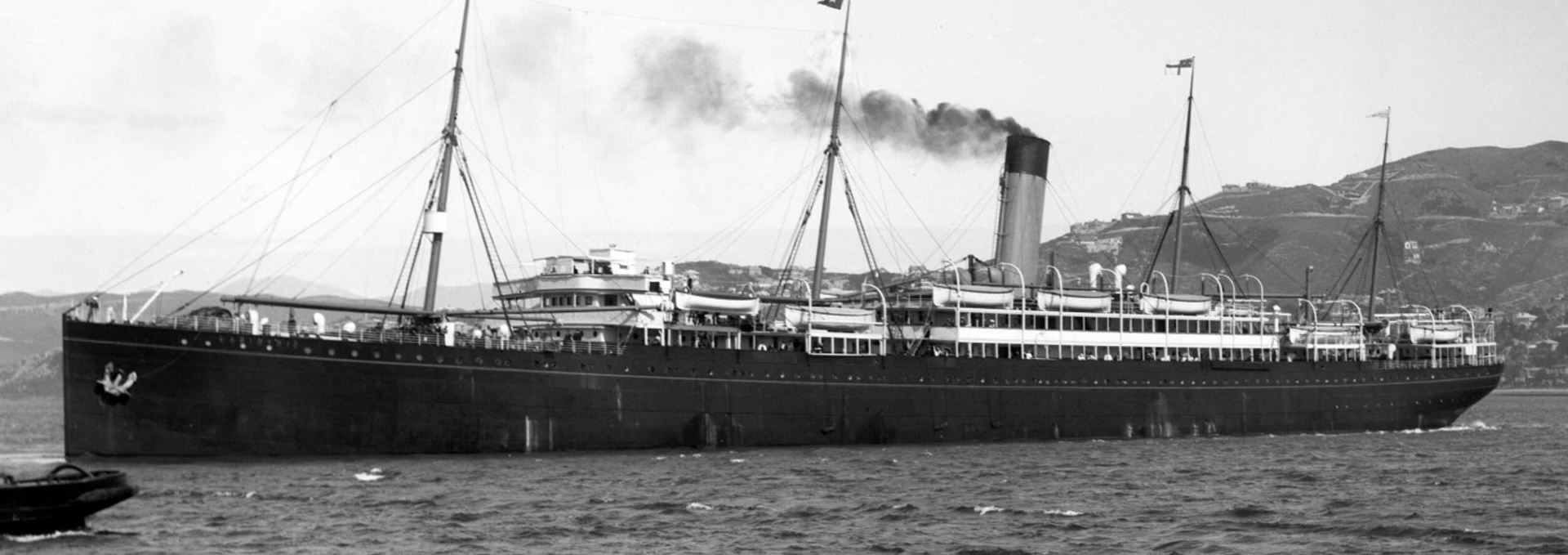
SS Corinthic
White Star Line · 1902 · Ship Guide
Overview
SS Corinthic was a White Star Line passenger-cargo liner built for the Britain–New Zealand service and operated in close association with Shaw, Savill & Albion Line rather than the better-known North Atlantic express trade. She was the second of the three Athenic-class ships, following Athenic and preceding Ionic, and was designed for long imperial-route service carrying passengers, emigrants, refrigerated cargo, and general freight between Britain and New Zealand. [oai_citation:0‡Norway Heritage](https://www.norwayheritage.com/p_ship.asp?sh=corio&utm_source=chatgpt.com)
In collecting and interpretation, Corinthic is important because she belongs to White Star’s dominion-service world rather than its New York-centered prestige-liner identity. Material tied to the ship often illuminates migration, cargo movement, and New Zealand route geography more clearly than the publicity-rich Atlantic fleet does. [oai_citation:1‡Wikipedia](https://en.wikipedia.org/wiki/SS_Corinthic_%281902%29?utm_source=chatgpt.com)
Key Facts
Tonnage, capacity, and wording vary slightly among quick-reference works. For cataloging purposes, retain the figures and terminology used by the specific source or artifact being cited. [oai_citation:2‡Norway Heritage](https://www.norwayheritage.com/p_ship.asp?sh=corio&utm_source=chatgpt.com)
Design & Construction Context
Corinthic was built for long-distance practical service rather than express prestige competition. Like her sisters, she combined passenger accommodation with heavy cargo capability, including refrigerated capacity suitable for the dominion trade. Her design reflects White Star’s ability to adapt its fleet-building program to very different commercial worlds: not only the Atlantic prestige route, but also the much longer and economically important New Zealand service. [oai_citation:3‡Norway Heritage](https://www.norwayheritage.com/p_ship.asp?sh=corio&utm_source=chatgpt.com)
The Athenic-class ships occupy an interesting place in White Star history because they belong to the company’s wider imperial network rather than its most famous transatlantic narrative. For interpretation, that means their significance lies in route structure, mixed traffic, and cargo-emigration service, not in speed records or celebrity status. [oai_citation:4‡Wikipedia](https://en.wikipedia.org/wiki/Athenic-class_ocean_liner?utm_source=chatgpt.com)
Service History (Summary)
1902: Built at Belfast, launched in April, completed in July, and placed into service late in the year. Her maiden voyage departed London in November 1902 for Wellington by way of Plymouth, Cape Town, and Hobart. [oai_citation:5‡Norway Heritage](https://www.norwayheritage.com/p_ship.asp?sh=corio&utm_source=chatgpt.com)
Early service: On her maiden voyage she reportedly carried a large emigrant contingent, with third-class passengers forming the majority. This is a useful reminder that the ship’s service world was shaped heavily by migration and dominion settlement traffic. [oai_citation:6‡Wikipedia](https://en.wikipedia.org/wiki/SS_Corinthic_%281902%29?utm_source=chatgpt.com)
1900s–1920s: Continued in the Britain–New Zealand trade as part of the White Star / Shaw, Savill service pattern. She served the long imperial route linking Britain with South Africa, Tasmania, and New Zealand rather than the shorter, more publicity-rich North Atlantic run. [oai_citation:7‡Wikipedia](https://en.wikipedia.org/wiki/SS_Corinthic_%281902%29?utm_source=chatgpt.com)
Final years: Unlike Athenic, she did not go on to a long second life as a factory ship. Instead, Corinthic was decommissioned in 1931 and scrapped shortly afterward, giving her a more straightforward terminal history than some related White Star working liners. [oai_citation:8‡Wikipedia](https://en.wikipedia.org/wiki/SS_Corinthic_%281902%29?utm_source=chatgpt.com)
Interpretive Notes
This is a dominion-route White Star ship: Corinthic should be understood within the London–New Zealand service framework, not primarily through the lens of White Star’s Liverpool–New York fame. Route references in surviving material are therefore especially important evidence. [oai_citation:9‡Wikipedia](https://en.wikipedia.org/wiki/SS_Corinthic_%281902%29?utm_source=chatgpt.com)
Associated-company context matters: because the ship operated in the service world shared by White Star and Shaw, Savill & Albion, surviving material can sometimes feel less purely “White Star Atlantic” than collectors might expect. That is a feature of the route structure, not a contradiction. [oai_citation:10‡Wikipedia](https://en.wikipedia.org/wiki/SS_Corinthic_%281902%29?utm_source=chatgpt.com)
Corinthic is best read as a working liner: her significance lies in migration, freight, and imperial-route continuity rather than dramatic disaster or prestige symbolism. That makes her especially useful for documenting the wider commercial reality behind famous liner brands. [oai_citation:11‡Norway Heritage](https://www.norwayheritage.com/p_ship.asp?sh=corio&utm_source=chatgpt.com)
Evidence-first ship guideSources (Selected)
- Ocean Liner Curator — Sources (master bibliography)
- Norway Heritage — SS Corinthic particulars and service summary
- SS Corinthic (1902) — overview chronology and specifications
- Athenic-class ocean liner — class and route context
- Norway Heritage — White Star Line fleet and route context
- GG Archives — SS Corinthic archival reference material