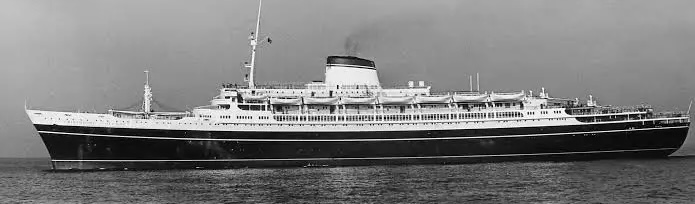
SS Cristoforo Colombo
Italian Line · 1954 · Ship Guide
Overview
SS Cristoforo Colombo was a major postwar Italian Line ocean liner and the sister ship of Andrea Doria. Entering service in 1954, she operated primarily on the Genoa–Naples–New York run and helped re-establish Italy’s presence on the North Atlantic after the destruction of the line’s great prewar flagships. Although her sister’s loss in 1956 has long overshadowed her in popular memory, Cristoforo Colombo had a substantial career of her own and remained an important Italian passenger ship into the late liner era.
In collecting and interpretation, Cristoforo Colombo belongs to the refined postwar transatlantic world shaped by modern Italian design, national image-making, and the final decades of scheduled ocean-liner service. She is often discussed alongside Andrea Doria and later Leonardo da Vinci, but her own career deserves distinct treatment rather than being reduced to sister-ship context alone.
Key Facts
Some summaries differ slightly in the way they present capacity and measurement figures, especially when rounded for general references. For cataloging purposes, retain the wording and figures used by the specific source or artifact being cited.
Design & Construction Context
Cristoforo Colombo emerged from the broader postwar rebuilding of the Italian merchant marine. Italian Line had lost the great prestige symbols of the prewar era, and the company’s new transatlantic ships needed to project modernity rather than simply recreate the scale or decorative language of Rex and Conte di Savoia. The result was a liner that balanced elegance, moderate size, technical competence, and national presentation.
As the sister ship of Andrea Doria, she belongs to one of the most recognizable postwar liner pairings. Yet her significance lies not only in shared design ancestry, but in the fact that she became the surviving standard-bearer of the class after 1956 and continued to represent Italian transatlantic service until later ships such as Leonardo da Vinci and then Michelangelo and Raffaello reshaped that role.
Service History (Summary)
1953–1954: Built and launched at Genoa, then completed for Italian Line service and placed on the North Atlantic route in 1954. She was slightly larger than Andrea Doria and, at the time of entry into service, the largest merchant ship in Italian service.
1954–1956: Operated alongside Andrea Doria on the Genoa–Naples–New York route, forming the core of Italian Line’s restored postwar transatlantic presence.
After 1956: Following the loss of Andrea Doria, Cristoforo Colombo carried the route largely alone until the arrival of Leonardo da Vinci. This gave her a particularly important transitional role in maintaining service continuity and national image.
1964: Gained additional public attention when she transported Michelangelo’s Pietà from the Vatican to New York for exhibition at the 1964 World’s Fair. That voyage remains one of the more distinctive episodes in her career.
1960s–1970s: Continued in Italian Line service during the increasingly difficult late-liner period, when jet air travel sharply reduced the economic basis of scheduled North Atlantic crossings. Like many passenger ships of her generation, she survived into a world that no longer fully supported the kind of route system for which she had been built.
Final years: Withdrawn from front-rank service, eventually sold for scrapping in 1977, laid up for several years, and finally broken up in 1982.
Beyond the Andrea Doria Comparison
Cristoforo Colombo is often treated primarily as the sister ship that survived Andrea Doria, but that framing can obscure her own long service record. She continued carrying passengers for the Italian Line for more than two decades and therefore documented the postwar Italian Atlantic trade far beyond the 1956 disaster.
Her survival also makes her especially valuable for comparative research. Photographs, deck plans, and onboard material can illuminate the shared design language of the class without assuming that every feature remained identical throughout both ships' careers.
The Pietà Voyage
In 1964 Cristoforo Colombo carried Michelangelo's Pietà from Italy to New York for display at the World's Fair. The sculpture was transported under elaborate protective arrangements, making the voyage one of the ship's most unusual non-passenger cargo assignments.
That episode is a useful reminder that liner histories sometimes intersect directly with museum and cultural history, and that unusual cargo can produce documentation very different from normal passenger-service ephemera.
Final Years
The ship remained in service as the transatlantic market contracted, but by the 1970s the economic basis for her original role had largely disappeared. She was sold out of Italian Line service in 1977 and spent years laid up before final demolition in Taiwan.
Interpretive Notes
She should not be treated merely as “Andrea Doria’s sister”: although that relationship is historically important, Cristoforo Colombo had a longer and more sustained operational career and deserves interpretation as a major liner in her own right.
This is a postwar prestige liner, but of moderate scale: she belongs to a world of refined national presentation and transatlantic respectability rather than the superliner competition of the prewar Blue Riband era.
Late-career material may reflect a shrinking liner world: ephemera from her later years can illuminate the contraction of the scheduled North Atlantic trade, and should not be read in exactly the same commercial context as material from her 1950s peak.
Evidence-first ship guideSources (Selected)
- Ocean Liner Curator — Sources (master bibliography)
- SS Cristoforo Colombo — overview chronology, specifications, and service summary
- The Great Ocean Liners — SS Cristoforo Colombo article and specifications summary
- SS Maritime — general historical liner reference context
- Italian Line — company background and fleet context
- SS Leonardo da Vinci — replacement-era context for later Italian Line transatlantic service