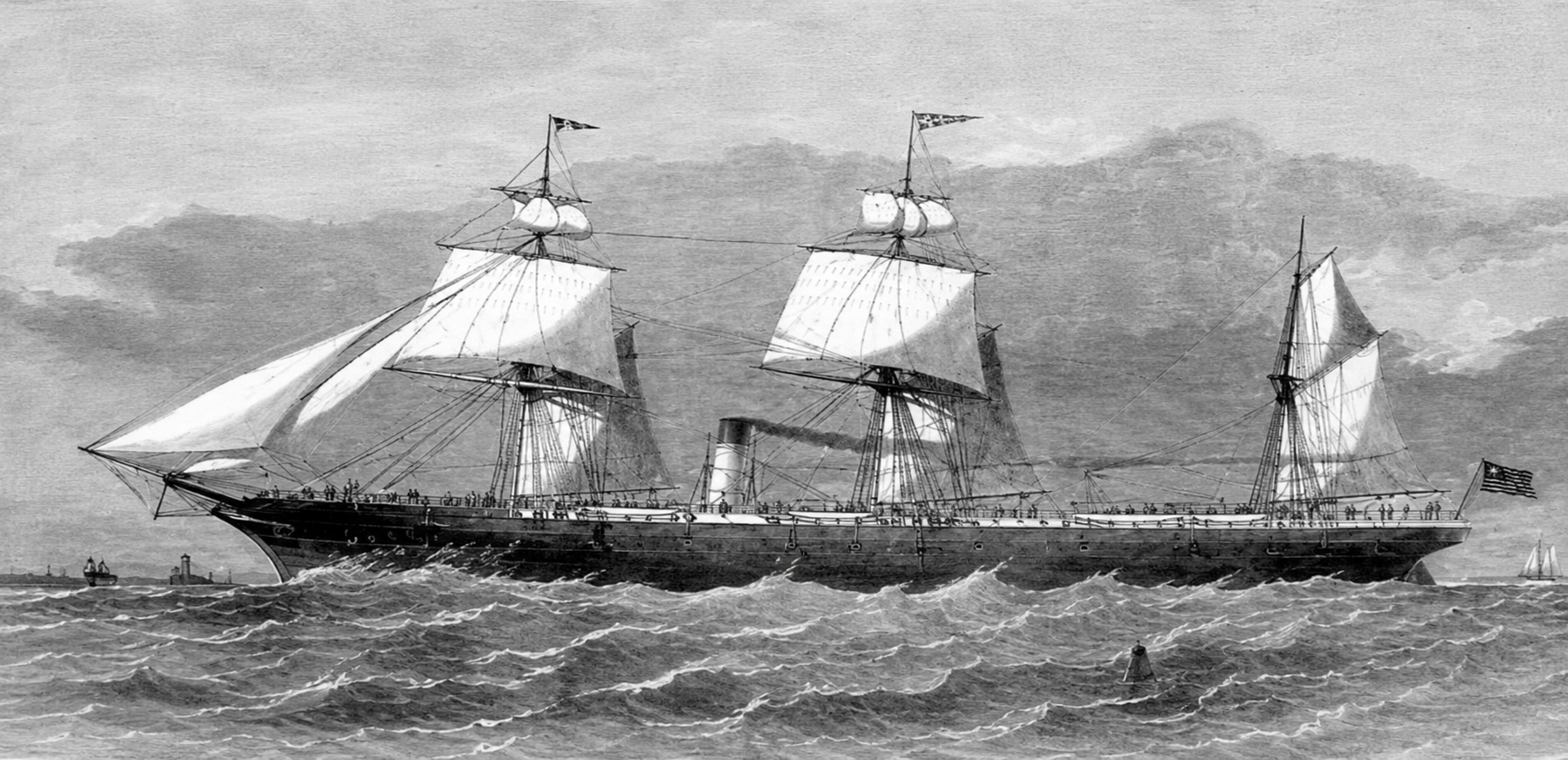
SS Cuba
Cunard Line · 1864 · Ship Guide
Overview
SS Cuba was a Cunard Line iron screw steamer launched at Glasgow by Tod & McGregor on 21 July 1864. She entered service on 3 December that year between Liverpool, Queenstown, and New York, belonging to the generation that helped carry Cunard from the early paddle-steamer era toward a more mature screw-driven Atlantic system.
Her significance lies less in prestige than in continuity: scheduled mail and passenger service, migration, and the repetitive commercial discipline that made the Atlantic crossing increasingly dependable. After leaving Cunard in 1876, the same hull was converted into the sailing ship Earl of Beaconsfield and remained in service until wrecked near Aldbrough, Yorkshire, on 6 November 1887.
Key Facts
From Paddle Era to Screw-Liner Routine
Cuba belongs to a transitional technical generation. Cunard’s earliest Atlantic reputation had been built by wooden-hulled paddle steamers; by the mid-1860s, iron construction and screw propulsion were becoming increasingly normal. Ships such as Cuba helped turn that transition into routine commercial practice.
That makes her important even without a dramatic record or celebrity passenger list. The historical achievement was dependable repetition: departures, mail contracts, emigrant traffic, freight, and the ability to sustain regular service across seasons.
Passenger and Migration Service
The Liverpool–Queenstown–New York pattern placed Cuba directly within one of the major nineteenth-century migration corridors. Queenstown calls connected the ship to Irish emigration, while Liverpool linked the route to passengers arriving from across Britain and continental Europe.
For collecting, passenger lists and sailing notices are therefore especially valuable. Unlike later luxury-liner material, much of the best evidence for Cuba is functional rather than decorative: dated advertisements, manifests, arrival reports, agency notices, and correspondence.
A Workhorse Rather Than a Celebrity Ship
Cuba should not be interpreted with the language of the later “floating palace.” Her public importance was quieter: she was one component of a network that made scheduled steamship travel normal enough to be taken for granted.
That perspective also helps correct a common bias in ocean-liner history. The famous record-breakers depended on decades of operational learning accumulated by smaller vessels that standardized routes, port procedures, and passenger handling.
Sale and Conversion to Earl of Beaconsfield
In 1876 Cunard sold the vessel to D. Brown, after which she was converted from a steamship into the sailing ship Earl of Beaconsfield. That is a major identity break, not merely a name change. Propulsion, ownership, route possibilities, and the documentary context all changed.
Artifacts after 1876 should therefore be cataloged primarily under Earl of Beaconsfield unless the object explicitly refers back to the former Cunard identity.
Wreck in 1887
The former Cuba remained in service for another eleven years after leaving Cunard. On 6 November 1887, as Earl of Beaconsfield, she was wrecked near Aldbrough on the Yorkshire coast.
This long afterlife is a useful corrective to the assumption that a liner’s historical biography ends when it leaves its famous operator. The Cunard phase is only one part of the hull’s full career.
Collecting Profile
Material connected to Cuba is more likely to survive as working documentation than as luxury souvenirware. Passenger lists, sailing notices, newspaper arrival reports, agent advertisements, and correspondence can all provide stronger evidence than undated decorative material. In a ship of this period, typography, printer, route wording, and master’s name may carry as much evidentiary weight as an illustration.
Because the name “Cuba” is also a place name, search noise is unusually high. A credible attribution should combine the vessel name with Cunard, a nineteenth-century date, Liverpool or Queenstown, Tod & McGregor, or a known voyage. Bare references to “Cuba” in Caribbean or later cruise contexts should not be assumed to concern the ship.
Interpretive Caution
The main interpretive risk is projecting later liner culture backward. Cuba predates the era of elaborate onboard branding and large decorative souvenir programs. Her importance is therefore best expressed through transport history, migration, mail, and technological transition rather than by trying to force her into the luxury-liner model.
Why Cuba Matters
Cuba matters because she represents the working infrastructure behind the Victorian Atlantic system. Her story connects steam technology, migration, mail, regular scheduling, and later commercial reuse without relying on luxury or disaster to make the ship historically meaningful.
For attribution, combine the name with Cunard, 1864–76, Tod & McGregor, and Liverpool–Queenstown–New York. After 1876, the safer primary identity is Earl of Beaconsfield.
Evidence-first ship guideSources (Selected)
This list is intentionally conservative.