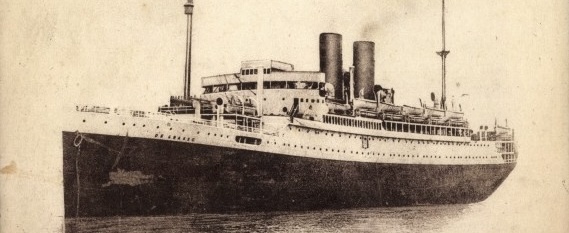
SS De Grasse
Compagnie Générale Transatlantique · entered service 1924 · Ship Guide
Overview
SS De Grasse was a major Compagnie Générale Transatlantique liner of the interwar and postwar eras, remembered less as a pure speed champion than as a durable, handsome, and adaptable French Atlantic passenger ship. She served the Le Havre–New York route in the 1920s and 1930s, survived a dramatic wartime interruption, and returned after the Second World War in a rebuilt form that gave her a second life as one of the most recognizable French Line ships of the late 1940s and early 1950s.
In collecting and interpretation, De Grasse is especially important because she spans three quite different identities: prewar French Line De Grasse, rebuilt postwar French Line De Grasse, and later service as Empress of Australia and Venezuela. Artifacts should therefore be cataloged under the printed name and date actually shown on the piece, not under a single continuous hull identity alone.
Key Facts
Design & Construction Context
De Grasse belonged to the interwar generation of French Line ships that offered a strong national style without existing primarily as record-breaking Atlantic greyhounds. She was not built to rival the fastest Cunard or German ships. Instead, she occupied the commercially important space of a large, attractive, and efficient French liner able to sustain a serious transatlantic presence while embodying the line’s visual identity.
That makes her historically revealing. She shows that French prestige at sea in the 1920s and 1930s was not limited to the singular fame of Île de France or later Normandie. Ships like De Grasse carried much of the real continuity of passenger service, brand recognition, and fleet utility.
Service History (Summary)
1920–1924: Built by Cammell Laird at Birkenhead for the Compagnie Générale Transatlantique. After a long gestation from laid-down date to launch and completion, she entered service with her maiden voyage from Le Havre to New York on August 21, 1924.
1924–1939: Served as a significant French Line transatlantic liner on the North Atlantic. This is the principal prewar collecting phase, represented by passenger lists, brochures, menus, and other CGT material that reflects interwar French passenger culture.
1930s fleet context: De Grasse was not the French Line’s supreme showpiece, but she was an important supporting liner in a fleet increasingly associated with strong design identity and national prestige. Her service speed and role placed her in the “important working liner” category rather than the absolute top speed tier.
Second World War: After the fall of France, her ordinary passenger service ceased. She was used as a barracks ship and, in August 1944, was scuttled at Bordeaux during the German retreat.
Postwar return: Refloated and repaired after the war, she re-entered service in a substantially altered form, most visibly with a single funnel. This rebuilt postwar De Grasse became one of the key French Line ships helping re-establish French Atlantic service in the late 1940s and early 1950s.
Later careers: In 1953 she was sold to Canadian Pacific and became Empress of Australia. In 1956 she was sold again, became Venezuela, and entered Mediterranean/Caribbean service before her final 1962 wreck and scrapping.
Interpretive Notes
Name discipline is essential: prewar French Line De Grasse, rebuilt postwar De Grasse, Canadian Pacific Empress of Australia, and Italian-line Venezuela all belong to the same hull, but not to the same collecting category.
The rebuild matters visually: a two-funnel prewar image and a one-funnel postwar image can both correctly depict the same ship. Collectors should be careful not to treat that appearance shift as proof of misidentification.
This is a strong French Line ship beyond the flagship narrative: because public memory gravitates toward Normandie or Île de France, De Grasse can be underappreciated. Yet she is highly useful for understanding CGT continuity across war and rebuilding.
Later renaming can distort attribution: sellers sometimes collapse the ship’s biography into one simplified story. Good curator practice follows the evidence on the object itself: printed name, voyage date, operator, route, and visual configuration.
One hull, several national identities: De Grasse moved through French passenger service, German wartime accommodation use, wartime sinking, postwar reconstruction, and later careers as Empress of Australia and Venezuela. Each phase changed the ship’s presentation, route, and documentary trail, making name-and-date discipline especially important.
The postwar reconstruction is not merely a continuation of the prewar liner in untouched form. Wartime damage and rebuilding created a renewed passenger vessel whose later Canadian Pacific and Venezuelan identities deserve their own provenance treatment. A photograph under one name should not automatically be used to illustrate another phase without visual and chronological confirmation.
Her changing identities also make surviving ephemera unusually informative. French Line passenger material, German wartime records, Canadian Pacific items, and Venezuelan-era documentation all describe the same hull at different moments, but they should be cataloged under the contemporary operator and name first. This preserves the historical sequence instead of treating later ownership as a footnote.
Evidence-first ship guide