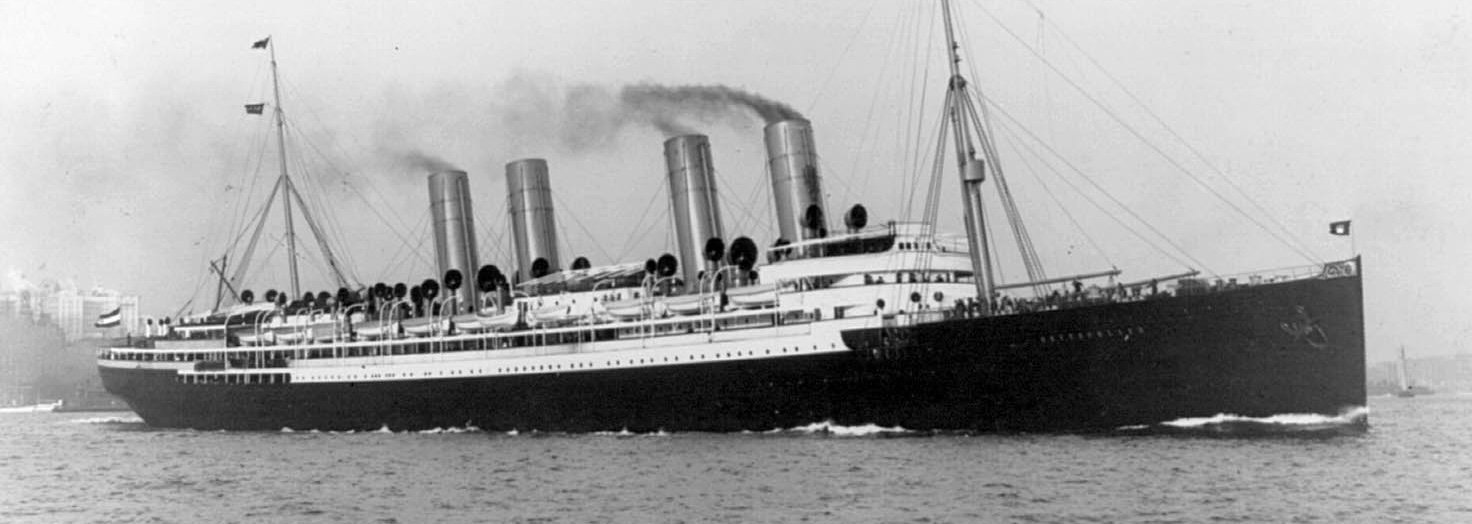
SS Deutschland (1900)
Hamburg America Line (HAPAG) · launched 1900 · Ship Guide
Overview
SS Deutschland (1900) was Hamburg America Line’s deliberate answer to Norddeutscher Lloyd’s late-1890s “greyhound” moment: an express liner built not primarily for size or steadiness, but for speed, prestige, and headlines. Completed in 1900 with four funnels (a visual shorthand for power in the public imagination), she entered the North Atlantic race at full volume and immediately seized the Blue Riband on her maiden crossing.
Her story, however, is just as much about the limits of that race. Persistent vibration—especially felt aft—hurt her reputation with first-class passengers and earned her the enduring nickname “the Cocktail Shaker.” In evidence-first collecting terms, Deutschland is unusually instructive because she lives as three materially distinct ships across time: a speed-obsessed Atlantic express liner (1900–1910), an early-purpose cruise ship as Viktoria Luise (1910–1920), and a stripped-down emigrant carrier as Hansa (1920–1925). Each phase generates artifacts with different typography, route language, fare structures, and onboard “promises.”
Evidence-first note: even widely repeated facts (tonnage figures, passenger capacities, “maiden voyage” dating, and Blue Riband passage details) can vary by source and edition. When publishing numbers, prefer dated registers or contemporary reports and cite the specific reference you used.
Key Facts
Design & Construction (Context)
Deutschland was conceived as a “statement ship”: fast, outwardly powerful, and meant to reclaim attention in a market where national prestige and commercial success were often treated as the same thing. Four funnels broadcasted that intention—regardless of how much each funnel was “needed” in a purely functional sense, the silhouette was part of the product.
The catch was comfort. High power, high speed, and a long hull were an invitation to vibration if the structure and machinery harmonics did not behave. The resulting passenger experience matters to collectors, because it influences what a line emphasized in marketing and what it quietly stopped promising once reality intruded. When you interpret an advertising claim (speed, smoothness, luxury), it helps to know whether the ship’s reputation supported it.
Service History (Summary)
1900: An instant headline. Launched 10 January 1900 and completed by June, Deutschland entered service in early July. Her maiden Atlantic passage captured the Blue Riband—an immediate propaganda victory for HAPAG and a blow to rivals.
1900–1910: Express-liner years, with an asterisk. Despite record-making capability, persistent vibration damaged her popularity, especially with the very clientele HAPAG wanted most. In period terms, she could win the “race” and still lose the “room.”
1910–1920: Reinvention as Viktoria Luise. In 1910 she was rebuilt and renamed Viktoria Luise, shifting toward early cruising—an instructive pivot that signals how quickly the business case for pure speed could collapse when it didn’t align with passenger preference. (This is also the moment when artifacts can shift from transatlantic “liner language” to itinerary/seasonal “cruise language.”)
1920–1925: Emigrant service as Hansa, then the end. In the early 1920s she was renamed Hansa and adapted for emigrant/immigrant carriage, including visible external and internal changes in many summaries (often described as reductions in funnels and amenities). Restrictive U.S. immigration laws in the early 1920s sharply reduced the market, and she was sold for scrap in 1925.
Interpretive Notes
Deutschland is a useful “truth serum” ship: she exposes the tension between speed as a national trophy and comfort as a commercial necessity. If you collect menus, lettercards, baggage labels, sailing lists, or brochures tied to her, your first job is to identify which Deutschland you’re dealing with—Atlantic express liner, white-painted cruise-era Viktoria Luise, or emigrant-era Hansa. The same hull can generate radically different artifact ecologies.
A common attribution trap is funnel-count imagery and name-only captions. A postcard labeled “Deutschland” might refer to the four-stacker at speed, the cruise ship version in all-white, or even a generic patriotic title used elsewhere. Anchor your claim to (1) a date, (2) an operator/branding mark, and (3) route language or itinerary evidence—then tell the story.
Evidence-first ship guideSources (Selected)
Use these as a starting index; for publish-ready specs and dates, corroborate with dated registers, company records, and contemporary reports.
- Ocean Liner Curator — Sources (master bibliography)
- Wikipedia — SS Deutschland (1900) (starting index; corroborate key facts)
- Norway-Heritage — Deutschland (HAPAG) (specs and service outline)
- SS Maritime — Blue Riband transatlantic records (tabular reference; verify passage definitions)
- GG Archives — Deutschland (immigrant-era index; corroborate with primary sources)