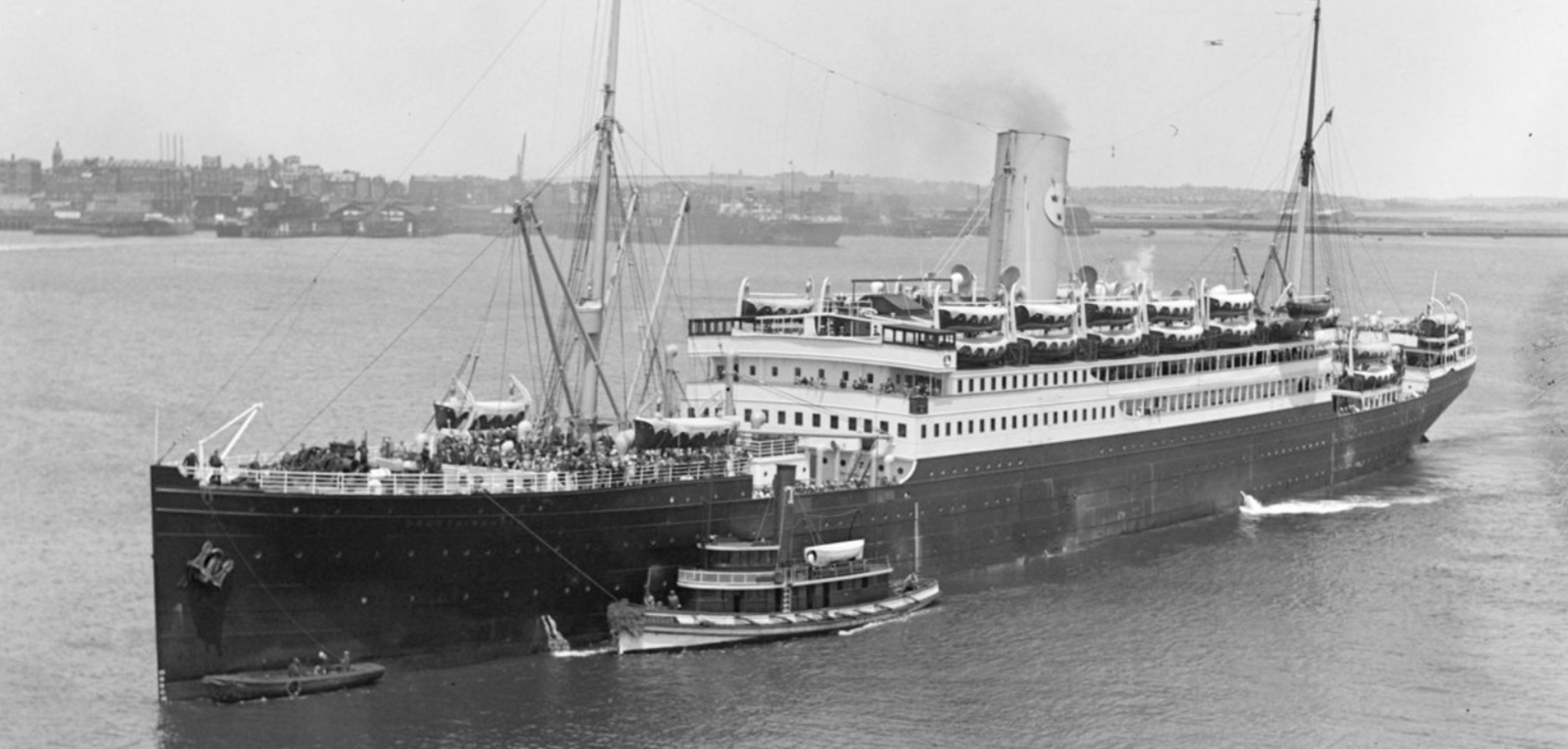
SS Drottningholm
Swedish American Line · in Swedish service from 1920 · Ship Guide
Overview
SS Drottningholm was a Swedish American Line transatlantic liner best understood in two lives: first as Allan Line’s turbine liner Virginian, completed in 1905 for the Canadian service, and later as Drottningholm, the Swedish American Line ship that linked Gothenburg and New York through the interwar years and into the Second World War era. Her career makes her an especially useful vessel for studying how older Edwardian liners were adapted, renamed, and repurposed across changing Atlantic markets.
As Drottningholm, she was not a new Swedish-built prestige liner in the manner of later SAL ships. She was an acquired, refitted, and recontextualized ship: an earlier turbine vessel given a Swedish American Line identity and placed into a route shaped by migration, family travel, diplomatic movement, and wartime neutrality. That layered identity matters for interpretation, because material may legitimately belong to her Allan Line, Canadian Pacific, Swedish American Line, Home Lines, or Hamburg America afterlife depending on date and markings.
This page treats Drottningholm as a documentation problem as much as a ship biography: the name, flag, owner, route, and passenger market changed over time, so object attributions should be anchored to date and operating context.
Compare Drottningholm with other North Atlantic liners whose identities changed through sale, wartime service, refit, and postwar redeployment.
Key Facts
Note on spelling: the Swedish name is Drottningholm. Misspellings such as “Drotningholm” appear in casual references, dealer listings, and search queries, but formal labeling should use the double-t form unless quoting a source exactly.
Design & Construction (Context)
The ship began as Virginian, one of the early turbine-powered North Atlantic liners ordered for Allan Line’s Canadian service. Her machinery and triple-screw arrangement place her in the transitional period when turbine propulsion was moving from novelty into serious ocean-liner practice. Unlike the very large express liners of the same broad era, Virginian / Drottningholm belonged to a practical mail-and-passenger category: substantial, modern for her day, but not built as a record-breaking giant.
Her later Swedish American Line career shows how a ship’s identity can be rebuilt through refit, route, paint scheme, interior use, and corporate presentation. For collectors, that means SAL-era paper and imagery should not be judged only by the ship’s original construction date. A 1920s or 1930s Drottningholm item belongs to a legitimate later operating identity, not simply to a renamed “old Allan liner.”
Service History (Summary)
As Virginian, the ship served the North Atlantic in Allan Line service and later passed through the Canadian Pacific system. In 1920 she was acquired by Swedish American Line, renamed Drottningholm, and refitted for Gothenburg–New York work. This period made her part of the Swedish Atlantic world: migration, return travel, family visits, business travel, and the cultural connection between Sweden and North America.
During the Second World War, Drottningholm became especially notable as a neutral exchange and repatriation ship. In that role she carried civilians, diplomats, internees, and other passengers whose movements depended on negotiated safe conduct. This wartime service gives the ship a documentary importance beyond ordinary passenger schedules, but it also means that “wartime Drottningholm” material must be interpreted with particular care.
Swedish American Line Identity
Swedish American Line’s identity was built around national connection as much as transportation. Drottningholm helped establish and maintain that identity before newer SAL tonnage became better known. Her name linked the ship to Swedish royal and national symbolism, while her route connected Gothenburg with New York, two endpoints that appear frequently in passenger lists, postcards, sailing cards, and immigrant travel records.
A good interpretive label should therefore identify both the ship and the operating layer: “SS Drottningholm, Swedish American Line, Gothenburg–New York service” is stronger than a generic “Swedish liner” label, especially when working with menus, passenger lists, postcards, or voyage ephemera.
World War II Repatriation Context
Drottningholm’s neutral wartime voyages are among the most historically charged parts of her career. These voyages can involve refugees, diplomats, exchanged nationals, internees, Red Cross-related movements, and complex government arrangements. Because those categories overlap but are not identical, a collector or writer should avoid flattening every wartime voyage into a single “refugee ship” story.
If a document is tied to a wartime crossing, the evidentiary questions become more specific: date of sailing, port sequence, passenger category, chartering authority, safe-conduct context, and whether the item was produced by the line, a government office, a relief organization, or a passenger. Those details can materially change the meaning of the object.
Collecting Profile (What Tends to Survive)
Surviving Drottningholm material may include passenger lists, postcards, sailing schedules, baggage labels, menus, cabin-class ephemera, immigration-related documents, and press references to wartime voyages. Because she served under multiple names, material connected to Virginian, Drottningholm, Brasil / Brazil, and Homeland should not be merged without date evidence.
Practical attribution method: first identify the name printed on the object; then match it to the correct operator and route; then check whether the style, language, port pair, and date make sense for that operating period. An item marked “Gothenburg–New York” points toward the SAL identity, while an earlier Canadian-service document belongs to the Virginian chapter.
Interpretive Notes (What to Avoid)
Avoid describing Drottningholm as if she were a single-purpose refugee ship, a purely Swedish-built liner, or a minor footnote to larger liners. Her importance is more subtle: she is a long-career vessel whose documentary value comes from changed ownership, changed national identity, and wartime diplomatic use. That complexity is exactly what makes careful labeling worthwhile.
Evidence-first ship guideSources (Selected)
This list is intentionally conservative.
- Ocean Liner Curator — Sources (master bibliography)
- Norway-Heritage — S/S Drottningholm / Virginian
- Gjenvick-Gjønvik Archives — SS Drottningholm Archival Collection
- Swedish American Line history resource — S/S Drottningholm
- Wikipedia — RMS Virginian / SS Drottningholm (use as a pointer map; verify key claims in specialist sources)