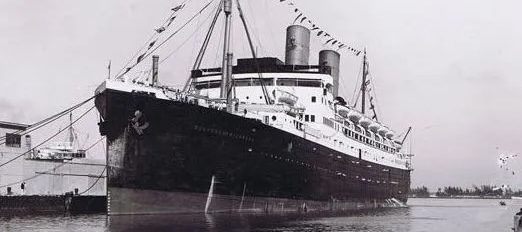
SS Duchess of Richmond
Canadian Pacific Steamships · entered service 1929 · Ship Guide
Overview
SS Duchess of Richmond was one of Canadian Pacific’s important interwar transatlantic liners and the third of the company’s “Duchess” quartet built for the Atlantic Canada service. She belonged to the specifically Canadian route pattern linking Liverpool with Quebec, Montreal, and Saint John, rather than the better-known New York-centered transatlantic framework. Her later career became especially significant in wartime troop transport, after which she survived to re-enter postwar service in rebuilt form under a new name, Empress of Canada.
In collecting and interpretation, Duchess of Richmond is best divided into three phases: prewar Canadian Pacific three-class passenger service, wartime troopship service, and postwar rebuilding and service as Empress of Canada. Material from those phases should not be treated as interchangeable, even though it belongs to the same hull.
Key Facts
Design & Construction Context
Duchess of Richmond belonged to Canadian Pacific’s distinctive transatlantic Canada strategy, which aimed to funnel passengers through Quebec, Montreal, and Saint John rather than exclusively through New York. The “Duchess” ships were designed to serve the St. Lawrence in season and then shift winter service to Saint John, integrating sea passage with Canadian rail connections inland. That route pattern is central to understanding her place in liner history.
She also belonged to a recognizable family of sister ships whose commercial importance was matched by a shared reputation for lively motion in rough weather. This combination of prestige, practicality, and occasionally uncomfortable seakeeping became part of the identity of the “Duchess” group as remembered by passengers and commentators.
Service History (Summary)
1928–1929: Built by John Brown at Clydebank, Duchess of Richmond was launched in June 1928 and entered service in early 1929. After an initial cruise voyage, she began her regular transatlantic role with a Liverpool–Saint John sailing in March 1929.
1929–1939 prewar service: In peacetime she served the Canadian Pacific Atlantic route, alternating seasonally between Saint John and the St. Lawrence ports of Quebec and Montreal. This is the correct context for early passenger lists, brochures, menus, and other liner ephemera tied to her original commercial identity.
Interwar route role: She should be understood as part of Canadian Pacific’s Canada-bound service network rather than as a generic North Atlantic liner. Her passenger culture and route geography were shaped by this distinctly Canadian service model.
1939–1945 wartime service: With the outbreak of the Second World War, Duchess of Richmond was taken into troopship service. In this phase she moved into the world of military transport and away from the civilian passenger framework for which she had been built.
Wartime significance: Her troopship career became a major part of her historical identity and should be treated separately from her prewar passenger role. Wartime records, convoy references, and movement documentation belong to a different interpretive category from peacetime Canadian Pacific material.
1947 rebuilding and renaming: After the war, she was rebuilt and renamed Empress of Canada. This was not merely a cosmetic change of name but the beginning of a distinct postwar commercial identity.
1947–1953 postwar career: In her rebuilt form she returned to Canadian Pacific Atlantic service as Empress of Canada, operating with revised accommodation and a new postwar service context.
1953–1954 end of career: In January 1953 she was destroyed by fire and capsized in Liverpool. Refloated later, she was ultimately sold for scrapping in Italy, ending the career of one of Canadian Pacific’s major Atlantic liners.
Interpretive Notes
This is a Canada-route liner first: Duchess of Richmond should be interpreted within Canadian Pacific’s Liverpool–Canada service pattern, not as a New York-centered Atlantic express liner.
The “Duchess” and “Empress” phases are distinct: prewar material under Duchess of Richmond and postwar material under Empress of Canada belong to different commercial and visual identities, even though they refer to the same hull.
Wartime and peacetime material belong to different worlds: passenger brochures, menus, and class references belong to one interpretive frame, while troopship records and wartime transport references belong to another.
Accommodation language is a useful dating clue: references to cabin, tourist, third, first, and later postwar class arrangements can often help place an artifact or document into the correct phase of the ship’s long career.
A long-lived member of the class: Duchess of Richmond is particularly useful for comparison because she survived into the postwar era and became Empress of Canada in 1947. That rename should not be confused with the earlier 1922 Empress of Canada, a different ship entirely. Builder, date, and route should accompany the name whenever ambiguity is possible.
The postwar identity change also illustrates Canadian Pacific’s habit of using “Empress” branding for renewed peacetime service. Wartime troopship documentation, prewar Duchess material, and postwar Empress material should therefore remain separate evidence categories even when they refer to the same physical vessel.
Her long survival also lets researchers trace continuity across three very different environments: prewar Canadian Pacific passenger service, wartime transport, and postwar Empress-era travel. Each phase deserves its own date range and operating context.
The rename also creates a common catalog trap because “Empress of Canada” can refer to three different Canadian Pacific liners. For the former Duchess of Richmond, a 1947-or-later date and matching postwar configuration are essential evidence. Earlier material belongs under the Duchess name, even when later histories emphasize the Empress identity.
Evidence-first ship guide