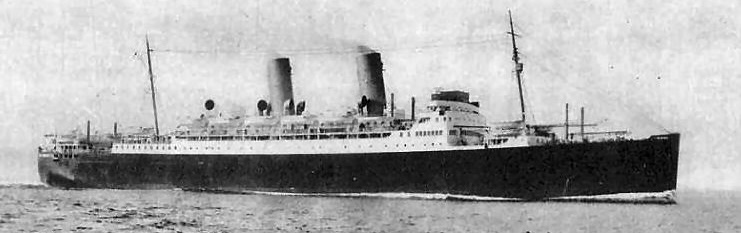
SS Duchess of York
Canadian Pacific Steamships · entered service 1929 · Ship Guide
Overview
SS Duchess of York was one of Canadian Pacific’s large interwar transatlantic cabin liners built for the Britain–Canada route. She belonged to the well-known group later nicknamed the “Drunken Duchesses,” ships remembered for their lively motion in heavy weather but also for their importance in maintaining regular passenger and mail service between Liverpool and eastern Canada. Her peacetime career belongs to the North Atlantic cabin-liner world rather than the Atlantic express-liner race, and her later wartime life as a troopship ended violently in 1943.
In collecting and interpretation, Duchess of York is best divided into two main phases: prewar Canadian Pacific passenger service and wartime troopship service. Passenger ephemera, deck plans, and route literature should be kept distinct from military transport material and loss-related documentation.
Key Facts
Design & Construction Context
Duchess of York belonged to the interwar Canadian Pacific cabin-liner fleet rather than the top rank of speed-focused Atlantic prestige ships. Her role was to provide dependable and comparatively comfortable service between Britain and Canada, linking Liverpool with Quebec and Montreal in the navigable season and Saint John during the winter. That route context matters more than comparison with the largest express liners.
She was one of four related ships—Duchess of Bedford, Duchess of Richmond, Duchess of York, and Duchess of Atholl—that came to be remembered collectively for their distinctive motion in heavy seas. In fleet history, this class occupies a useful middle ground between the glamorous Atlantic giants and the more workmanlike mail-passenger liners.
Service History (Summary)
1928–1929: Built by John Brown & Company at Clydebank, Duchess of York was launched in September 1928 and completed in March 1929. She entered Canadian Pacific service that same month on the Liverpool–Canada route.
Prewar Atlantic service: Her normal employment connected Liverpool with Quebec and Montreal during the St. Lawrence season, with winter service redirected to Saint John, New Brunswick. This is the correct interpretive frame for passenger lists, tourist material, menus, brochures, deck plans, and commercial photography tied to her civilian identity.
1930s variations in service: She also undertook some cruise and Bermuda-associated work during the interwar period, but her main identity remained that of a Canadian Pacific Atlantic cabin liner.
1940 conversion: During the Second World War, Duchess of York was converted into a troopship. From that point onward, references to the ship increasingly belong to a military transport framework rather than a commercial passenger one.
11 July 1943: While serving as a troopship in the Mediterranean theater, she was attacked by German aircraft and badly damaged by bombing and fire. The attack caused casualties aboard and left the ship beyond practical recovery.
12 July 1943: Because of the extent of the damage, Royal Navy forces scuttled the ship on the following day. Her loss therefore belongs to the wartime troopship narrative, not to her earlier peacetime transatlantic identity.
Interpretive Notes
This is a Canada-route liner first: Duchess of York should be understood chiefly through Canadian Pacific’s Britain–Canada service system, not through North Atlantic speed-race assumptions.
The “Drunken Duchesses” context matters: the nickname links her with a recognizable fleet subgroup and can help interpret period references, reminiscences, and promotional material.
Peacetime and wartime material belong to different worlds: prewar passenger ephemera reflects commercial liner life, while wartime records concern troop movement, military logistics, and ship loss.
The 1943 destruction dominates memory, but not the whole career: because her end was violent and wartime, it can overshadow her importance as a substantial interwar Canadian Pacific liner. For curatorial purposes, both phases should remain visible.
Wartime divergence within the class: the Duchess sisters began with closely related commercial roles, but war separated their careers sharply. Duchess of York was not lost to a submarine: German aircraft fatally damaged her off Spain on 11 July 1943, after which the Royal Navy sank the wreck the following day. Keeping the mode and date of loss precise matters because submarine attribution is an easy error when several sister ships were lost in wartime service.
Her surviving prewar material belongs to the Canadian Pacific passenger-and-cruise system; wartime photographs and transport records belong to a different operational world. Similar hull form across the Duchess class makes ship-name evidence especially valuable when photographs lack an obvious date.
That distinction is especially useful when wartime loss summaries are compared across the Duchess class.
Evidence-first ship guide