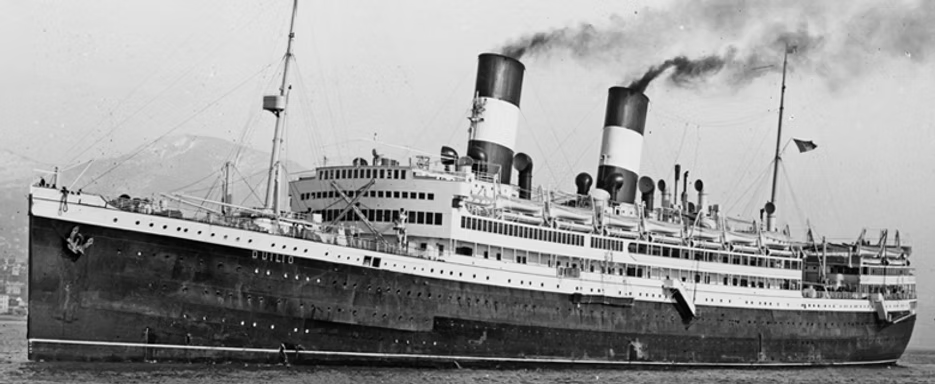
SS Duilio
Navigazione Generale Italiana · entered service 1923 · Ship Guide
Overview
SS Duilio was a large Italian liner built for Navigazione Generale Italiana and completed in 1923 for the South America trade. She was the sister ship to Giulio Cesare and belonged to the important interwar generation of Italian liners that linked Genoa and Naples with South American ports, especially Buenos Aires.
In collecting and interpretation, Duilio is especially useful because she sits at the intersection of Italian migration history, national liner prestige, and the reorganization of Italian passenger shipping in the interwar period. Material from her NGI and later Italian Line phases should be dated carefully rather than treated as one undifferentiated corporate identity.
Key Facts
Design & Construction Context
Duilio belonged to the post-First World War Italian effort to restore and modernize long-distance passenger service, especially on the South American routes that were central to Italian migration and commercial travel. She was not conceived as a North Atlantic speed champion in the German or British express-liner mold, but as a large, capable, and prestigious liner for the Italy–River Plate trade.
That makes her especially important for interpretation. Ships like Duilio remind us that ocean-liner history was not only shaped by the Liverpool–New York rivalry. The Mediterranean–South America corridor was a major artery of movement, and Italian ships serving it were often as socially important as better-known Atlantic greyhounds, even if they receive less attention in English-language liner memory.
Service History (Summary)
1923–1932: Entered service for Navigazione Generale Italiana in 1923 on the Italy–South America route. This is the principal collecting era for NGI-branded passenger lists, menus, route brochures, emigrant-related material, and South Atlantic travel ephemera tied specifically to Duilio.
Interwar context: together with Giulio Cesare, she was among the most substantial Italian liners of the early 1920s and an important symbol of the restored Italian merchant fleet after the disruptions of the First World War.
1932 corporate transition: when NGI and related companies were reorganized, Duilio passed into Italian Line operation. This is a crucial cataloging boundary, since later printed material may reflect a different corporate visual identity and house style even though the ship remained the same hull.
Later interwar years: she continued in commercial passenger service, remaining part of the South America trade and the broader Italian transatlantic network during a period when migration controls, economics, and passenger patterns were changing.
Second World War and end of career: as with many interwar liners, the war effectively ended her commercial identity. Her postwar future was limited, and she did not re-emerge as a major peacetime passenger ship in the way some later survivors did.
Interpretive Notes
Company identity should be dated carefully: early material belongs to Navigazione Generale Italiana, while later artifacts may belong to Italian Line. For a curator-minded record, that distinction should be preserved explicitly.
Migration history is central: Duilio was not merely a prestige passenger liner for elite travelers. Her large lower-class accommodation means she also belongs squarely to the history of Italian migration and family travel to South America.
She is best understood through route history: the real historical value of Duilio lies in the Italy–South America connection. Interpreting her through a generic “famous liner” frame misses the social world she actually served.
Sister-ship confusion is easy: because Duilio and Giulio Cesare were close sisters and often discussed together, silhouette-level identifications and broad seller descriptions can drift. Curator practice should be stricter than simply “one of the Italian sisters.”
The eight-year construction gap matters: Duilio was launched in 1916 but did not enter service until 1923, a delay created by war and postwar disruption. Treating the launch year as though it marked the beginning of an ordinary operating career obscures the ship’s real chronology and can lead to impossible date attributions for passenger material.
Her route history is equally important. The ship moved from New York work into South American and later South African service, so a valid Duilio artifact may belong to several very different geographic markets. Red Cross repatriation work adds another distinct documentary phase in which humanitarian transport replaced normal passenger commerce.
The ship’s late completion also places her in an awkward generational position: conceived before the war, but entering service in a postwar market already changing in class structure, migration policy, and route economics. That helps explain why her later assignments diversified rather than remaining tied to one prestige transatlantic role.
That makes chronology especially important in any concise summary.
Evidence-first ship guide