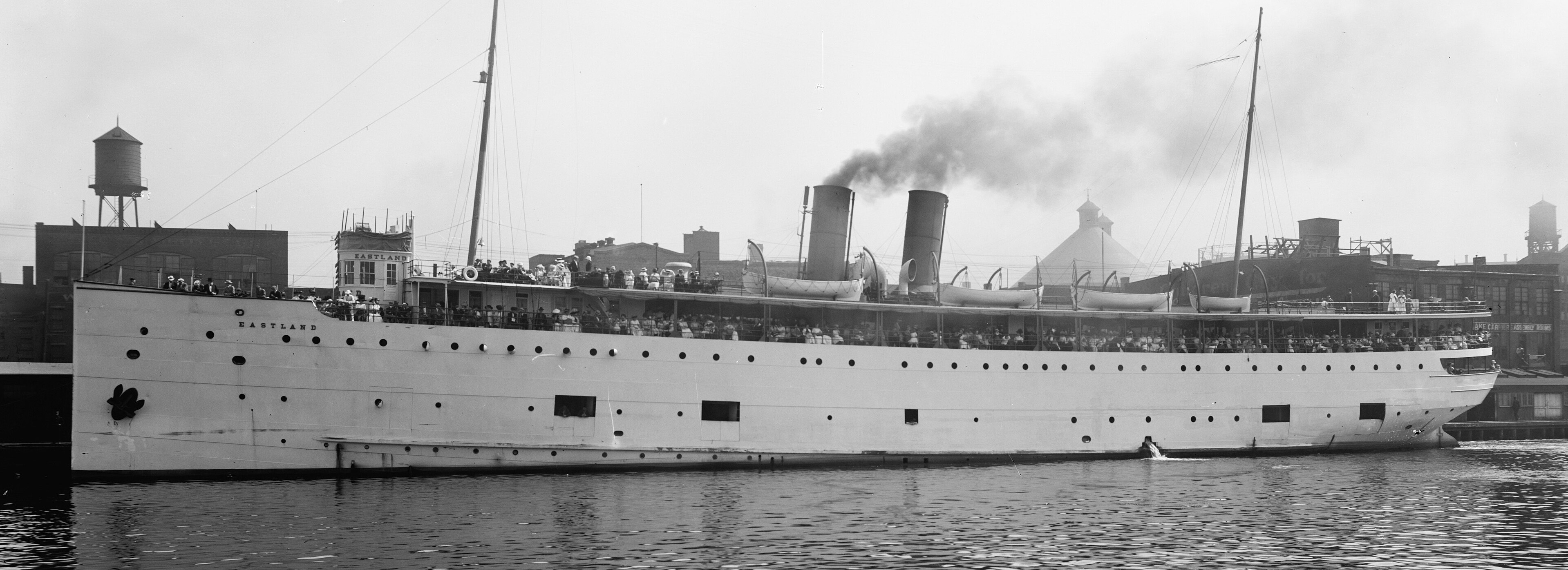
SS Eastland
Great Lakes passenger ship · 1903 · Ship Guide
Overview
SS Eastland was a Great Lakes passenger steamer whose historical importance rests less on route prestige than on structural instability, excursion-traffic culture, and one of the deadliest maritime disasters in American history. Built in 1903 for short-haul lake service, she spent her commercial life in excursion and passenger work before capsizing while tied to a dock in the Chicago River on July 24, 1915.
In collecting and interpretation, Eastland is especially important because her identity spans two very different historical lives: the pre-1915 excursion steamer and the later naval training ship USS Wilmette. Artifacts should therefore be cataloged under the printed name and date actually shown on the piece rather than under a simplified single-name hull biography.
Key Facts
On Eastland, even seemingly simple technical facts require care. Passenger capacity, stability commentary, and causation summaries vary depending on whether a source is describing the ship as built, in later modified excursion service, or in retrospective disaster analysis. For museum-level cataloging, preserve the exact form used by the source being cited.
Design & Construction Context
Eastland was not an ocean liner in the transatlantic sense. She belonged instead to the dense regional world of Great Lakes passenger steamers: short-haul excursion vessels built for speed, heavy seasonal traffic, and the commercial movement of large numbers of people between Midwestern ports. In that world, compactness, speed, and passenger volume could be more commercially important than long-voyage seaworthiness in the ocean-liner tradition.
That context is critical to interpretation. Eastland was a regional passenger ship shaped by the economics of excursion service, not by the prestige logic of Atlantic express liners. Yet her disaster came to occupy a place in public memory comparable to far better-known ocean-liner tragedies because it exposed the dangers of overcapacity, unstable design, and regulatory unintended consequences.
Service History (Summary)
1902–1903: Ordered by the Michigan Steamship Company in 1902, built by Jenks Ship Building Company, launched in May 1903, and sent into service that July. She was intended for Great Lakes passenger work rather than deep-sea liner service.
1903–1914: Passed through several ownership structures and route patterns, including Chicago–South Haven and Cleveland–Cedar Point service. Throughout these years she acquired a reputation for speed, but also for recurring stability concerns and listing behavior.
1914–1915: Operated for the St. Joseph-Chicago Steamship Company. By this phase, modifications and loading practices had not solved the vessel’s underlying top-heaviness. Retrofitting required under the post-Titanic safety regime is often cited as having worsened an already unstable condition rather than creating it from nothing.
July 24, 1915: While boarding passengers for a Western Electric employee excursion, Eastland reached well over 2,500 people aboard. She began listing and then rolled over to port while still tied to the dock in the Chicago River. The catastrophe killed 844 people and remains one of the great passenger-ship disasters in American history.
Post-disaster: Unlike some wrecked passenger vessels, Eastland did not vanish immediately from service history. She was raised, sold, rebuilt, and converted to naval use as USS Wilmette, creating a second and very different documentary life for the same hull.
Later naval phase: As USS Wilmette, the ship served primarily as a Great Lakes training vessel. This later career should be kept clearly separate from the excursion-steamer identity when cataloging photographs, postcards, and surviving artifacts.
24 July 1915: A Dockside Catastrophe
On the morning of 24 July 1915, Eastland rolled onto her side while still tied to the wharf in the Chicago River and before the excursion voyage had begun. The U.S. Coast Guard's historical chronology records 844 passengers and crew killed, making the disaster the deadliest maritime casualty on the Great Lakes.
The setting is what makes the disaster so unusual: this was not a storm or collision at sea, but the catastrophic loss of a loaded passenger vessel alongside the dock.
Stability as the Central Historical Question
Eastland had a documented history of stability concerns before 1915, and later investigations focused heavily on loading, freeboard, ballast, passenger distribution, and modifications affecting the vessel's ability to remain upright.
For interpretation, it is better to treat the disaster as a systems failure involving ship design, operating practice, regulation, and loading conditions rather than reducing it to one dramatic cause.
USS Wilmette
After the wreck was raised, the hull was rebuilt for U.S. naval service and became USS Wilmette. That later career is a distinct second life and should not be mixed casually with pre-disaster Eastland material.
Interpretive Notes
Disaster memory can flatten ship history: Eastland is remembered overwhelmingly through the 1915 capsizing, but she also had a significant pre-disaster commercial career and a later naval afterlife. Good catalog practice preserves those separate phases rather than reducing the hull to a single day.
This is a Great Lakes passenger ship, not an Atlantic liner: the collecting language around Eastland should reflect excursion, river, and lake service rather than forcing the ship into a transatlantic-liner framework. Route culture, scale, and passenger expectations were different.
Causation should be phrased carefully: the disaster is commonly explained through a combination of top-heaviness, loading conditions, ballast management, and the added weight of lifeboat requirements. Curator-minded writing should avoid oversimplifying this into a single-cause morality tale.
Name discipline matters after 1915: material from the later Wilmette phase belongs to a different institutional and interpretive world than excursion-era Eastland ephemera. The continuity is structural, not categorical.
Evidence-first ship guideSources (Selected)
- Ocean Liner Curator — Sources (master bibliography)
- SS Eastland — overview chronology, specifications, disaster summary, and later service as USS Wilmette
- Britannica — Eastland disaster overview and national-historical context
- Eastland Disaster Historical Society — disaster narrative, casualty context, and memorial framing
- U.S. Coast Guard historical summary — construction, casualty figures, and stability-context overview
- U.S. Coast Guard — chronology entry for the 24 July 1915 Eastland disaster