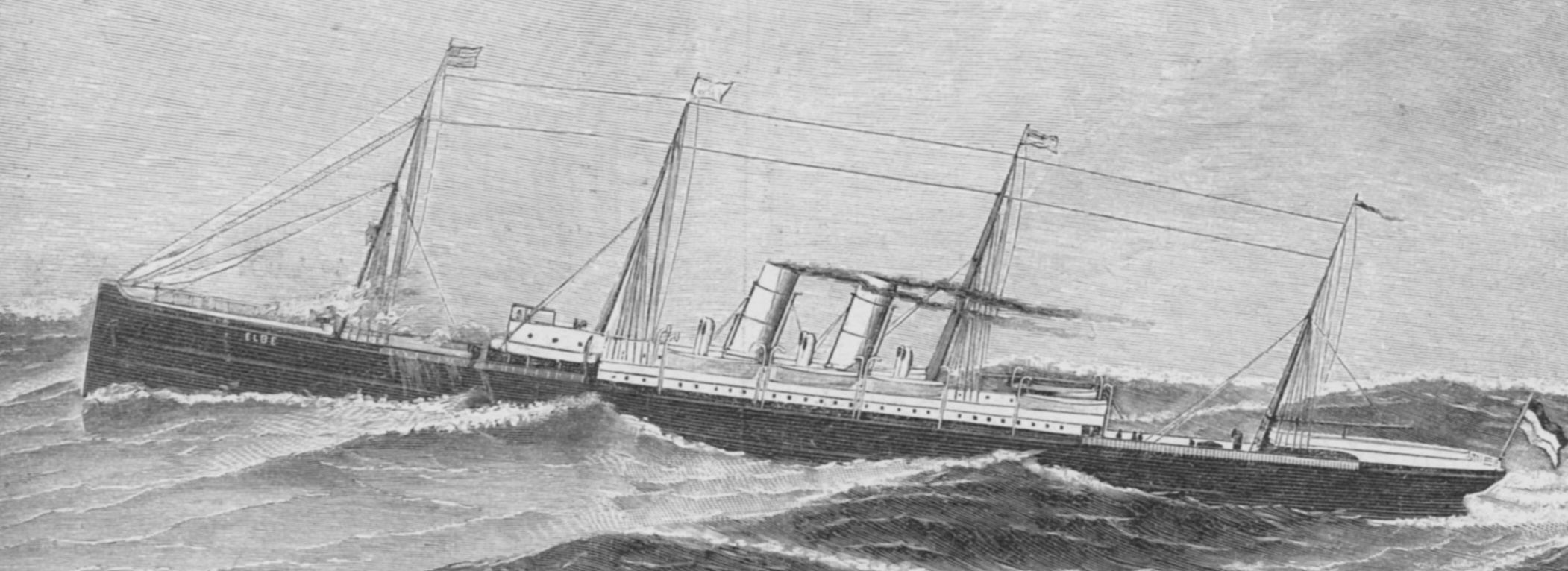
SS Elbe (1881)
Norddeutscher Lloyd · Bremen–Southampton–New York · Ship Guide
Overview
SS Elbe was a fast transatlantic liner built by John Elder & Co. at Govan for Norddeutscher Lloyd of Bremen. Launched in April 1881, she entered the Bremen–Southampton–New York service that June and became the first of the line's eleven-ship Rivers class of express steamers.
At roughly 4,500 gross tons, with an iron hull, compound machinery, a single screw, two funnels, and four masts, Elbe was a major step forward for German transatlantic service. She combined improved speed with substantial steerage capacity and helped establish Norddeutscher Lloyd as an increasingly formidable North Atlantic competitor.
Key Facts
The First Rivers-Class Express Steamer
Elbe inaugurated a series of eleven express liners named after German rivers. The class marked a deliberate escalation in Norddeutscher Lloyd's North Atlantic ambitions and moved the company beyond the smaller steamers that had characterized much of its earlier service.
The design combined greater speed with large passenger capacity, especially in steerage. That made the ships important not only in prestige competition but also in the mass migration economy that connected Central and Eastern Europe with the United States.
Built in Glasgow for Bremen
Like many major continental European liners of the era, Elbe was built in Britain. John Elder & Co. at Govan had a strong reputation for advanced marine engineering, and British yards were still central to international liner construction in the early 1880s.
Her iron hull, compound engine, and single screw placed her squarely within the mature screw-steamer era. She retained four masts, reflecting the continued use of auxiliary sail and the conservative rigging traditions that persisted even on comparatively modern express liners.
Speed and Competition
Elbe was fast for her time. Contemporary and later fleet histories give service speeds around 15 to 16 knots, and GG Archives records an 1882 Southampton–New York crossing in 8 days and 1 hour.
Those figures placed Norddeutscher Lloyd in a stronger competitive position against British and American lines. The goal was not simply to chase records, but to offer a credible combination of speed, reliability, passenger capacity, and schedule frequency.
Passenger Service
The ship's published accommodation figures—approximately 179 first-class, 142 second-class, and 796 steerage passengers—show the mixed commercial model of the late nineteenth-century liner. Premium passengers and mass migration traffic occupied the same vessel but in very different accommodations.
For many emigrants, ships such as Elbe were not symbols of luxury so much as practical transportation across the Atlantic. Her large steerage capacity therefore forms a central part of her historical significance.
Australian Voyages
Although primarily associated with the North Atlantic, Elbe was temporarily transferred to the Bremen–Australia service in 1889 and 1890, making three round voyages. The deployment demonstrates the flexibility of large liners within global company networks when traffic conditions required it.
She subsequently returned to her better-known Atlantic work.
The 1895 Collision
In the early hours of 31 January 1895, while outbound from Germany toward New York, Elbe collided in the North Sea with the British steamship Crathie. The collision opened the liner's port side and caused rapid flooding.
The disaster became the most serious loss in Norddeutscher Lloyd's history to that date. Sources differ slightly in their totals, but more than 330 people died and only about twenty survived. The scale of the loss was intensified by severe winter conditions, darkness, confusion, and the limited number of boats successfully launched.
Aftermath and Investigation
The loss prompted extensive investigation and public attention in Britain and Germany. Questions centered on navigation, lookout practices, collision avoidance, and the actions of the vessels before impact.
As with many nineteenth-century maritime disasters, later summaries sometimes compress the event into a simple statement of blame. The surviving inquiry material is more useful when read as evidence of how difficult collision prevention and emergency evacuation remained in poor visibility and heavy weather.
Why Elbe Matters
Elbe matters for two very different reasons. In service, she represented the rise of Norddeutscher Lloyd as a major express-liner operator and helped define the company's Rivers class. In loss, she became one of the most consequential German passenger-ship disasters of the nineteenth century.
Placed beside the Cunard ships just added to the archive, she also broadens the technological story beyond Britain. By the 1880s, the North Atlantic liner system was increasingly international, competitive, and shaped by large-scale migration as much as by elite travel.
Interpretive Notes
Launch date varies by source: English-language summaries commonly give 2 April 1881, while some German references give 4 April. This guide therefore states the month in the key narrative while retaining the more stable service chronology.
Tonnage figures also vary: Norway Heritage and German fleet records give about 4,510 gross tons, while GG Archives lists 4,897. Such differences can reflect measurement conventions, later remeasurement, or secondary-source transmission.
Casualty totals are not perfectly uniform: later accounts vary by a few persons. The safest summary is that more than 330 people died and roughly twenty survived.
Evidence-first ship guide