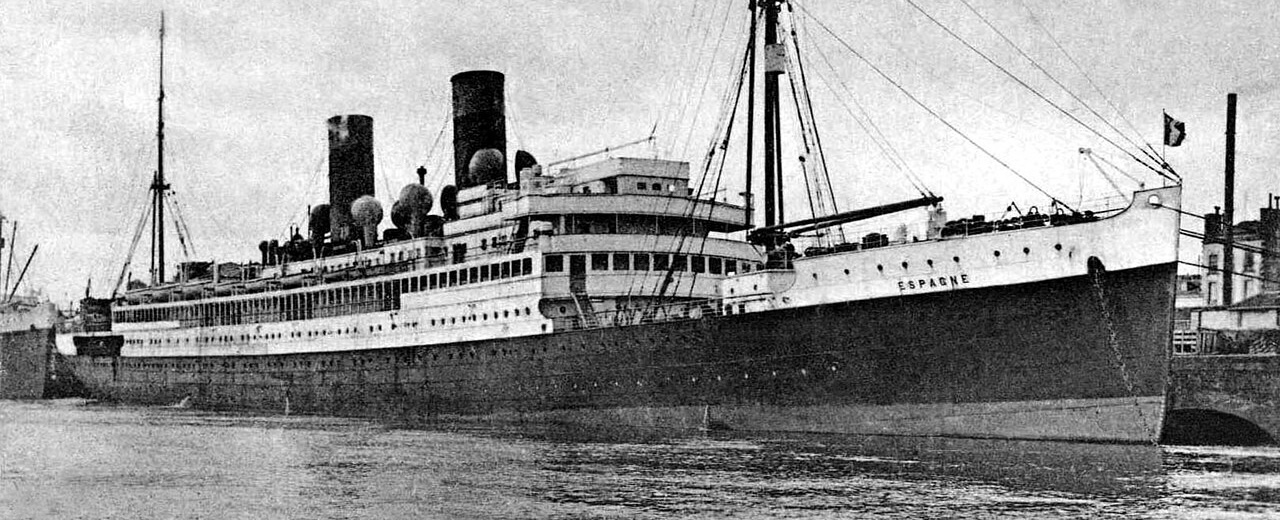
SS Espagne
Compagnie Générale Transatlantique · entered service 1910 · Ship Guide
Overview
SS Espagne was a medium-sized Compagnie Générale Transatlantique liner built by Chantiers & Ateliers de Provence at Port-de-Bouc as yard no. 30. Ordered on 29 May 1908, launched on 19 December 1909, and completed in October 1910, she was designed for practical French Line network service rather than North Atlantic prestige competition.
Her career connected Central America, the West Indies, New York, military transport, and interwar French colonial routes. That geographic flexibility is the main reason she matters historically.
Key Facts
Design and Network Role
Espagne was not conceived as a direct answer to the giant express liners competing for North Atlantic headlines. Her size, speed, and machinery instead suited the broader French Line network, where a ship might need to carry passengers, mail, and cargo across several regional trades over the course of a long career. That distinction helps explain why her history is geographically dispersed rather than dominated by one celebrated route.
Built at Port-de-Bouc, she also illustrates how ocean-liner history extends beyond the handful of famous yards and flagships most often photographed. Medium-sized ships such as Espagne were commercially important because they could be reassigned as demand changed. Their historical value lies in regular network work: connecting colonial, Caribbean, Central American, Mediterranean-adjacent, and transatlantic services rather than monopolizing a single prestige lane.
Route Flexibility
Espagne initially served French Line routes to Central America and the West Indies. She also appeared on Le Havre–New York service in 1912 and again in 1914, then on Bordeaux–New York in 1915. These changes are more informative than forcing one “primary route” onto a ship whose commercial value lay in flexibility.
Military and Wartime Service
In 1911 she was already used for troop transport in the Mediterranean. During the First World War she served as a troopship from 1916 to 1920 before returning to commercial Caribbean and Central American work. Her biography therefore shows how civilian liners could be repeatedly redirected into state service without permanently losing their commercial identity.
Postwar Return and a Working Liner's Career
After wartime troop transport, Espagne returned to the commercial network rather than entering a wholly new identity. That continuity is easy to miss when liner histories are organized around wars as hard dividing lines. In practice, the same ship could move between state service and ordinary passenger work, carrying the institutional memory of both phases into the next.
Her postwar employment again centered on routes outside the glamorous express corridor. Caribbean and Central American services required dependable ships able to handle mixed passenger and cargo demands over varied port sequences. In that setting, consistency and adaptability mattered more than maximum speed. Espagne's longevity into the early 1930s is therefore best understood as evidence of practical usefulness rather than technological prominence.
Historical Significance
Espagne represents the large class of liners that made international passenger networks function without becoming household names. CGT's identity was broader than France, Paris, or later Normandie; it also depended on ships serving colonial, Caribbean, Central American, and secondary transatlantic routes. Recovering that network context keeps ocean-liner history from becoming only a sequence of ever-larger flagships.
1926 Damage and Final Years
On 20 August 1926 Espagne struck a rock off A Coruña and damaged a propeller. She returned to service and continued until June 1932, when she was laid up. Scrapping followed at Saint-Nazaire in May 1934.
Interpretive Note
Espagne is useful precisely because she was not a celebrity flagship. She represents the large population of mid-sized liners that maintained route networks, moved troops and refugees when required, and connected ports outside the best-known express lanes.
Evidence-first ship guideSources (Selected)
- Ocean Liner Curator — Sources
- Duncan Haws, French Line (Compagnie Générale Transatlantique)
- Lloyd's Register, Steamers & Motorships
- SS Espagne — consolidated chronology with cited register and press sources