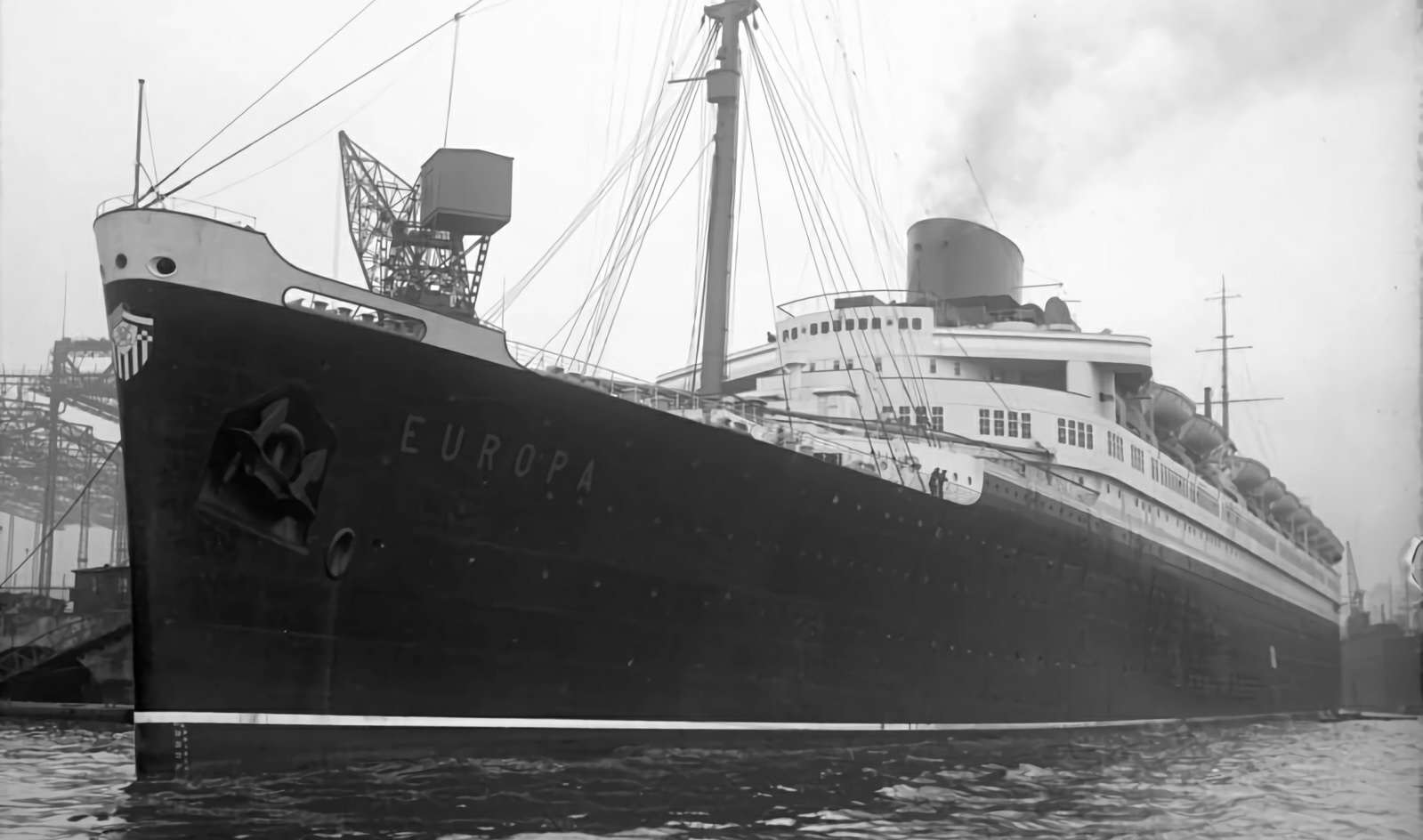
SS Europa
Norddeutscher Lloyd · entered service 1930 · launched 1928 · Ship Guide
Overview
SS Europa was Norddeutscher Lloyd’s second great interwar “speed queen,” built with her sister Bremen to restore German prestige on the North Atlantic through fast schedules, modern engineering, and a deliberately contemporary silhouette. Although launched in 1928, a severe fire during fitting-out delayed her completion—so her public debut arrived in 1930, right at the edge of the Depression-era contraction in luxury travel.
Her most compact, documentable headline is her first Atlantic: on her maiden voyage (19 March 1930) Europa captured the westbound Blue Riband, commonly cited at 27.91 knots average and a crossing time of 4 days, 17 hours, and 6 minutes. Like Bremen, Europa became a “systems ship”: a floating intersection of schedule, publicity, and national projection—leaving behind a rich collectible paper trail.
Evidence-first note: “Europa” is a recurring ship name across decades. When labeling artifacts or images, use “SS Europa (1928/1930)” if there is any risk of ambiguity.
Key Facts
Design & Construction (Context)
Europa belongs to the same interwar design moment as Bremen: an engineering-forward modernism where speed and schedule were the product. The intent was operational—two fast ships sustaining a tight, prestige timetable—while the silhouette and interiors carried the cultural message. In curatorial writing, it’s worth separating those layers: machinery and schedule on one side; publicity and national self-presentation on the other.
The 1929 fitting-out fire matters not as drama but as evidence context. It shapes the ship’s documentary footprint (repairs, delays, press coverage) and creates common confusion in secondary summaries. When describing build chronology, use dated milestones (launch, fire, completion, maiden) rather than a single “built in 1928/1930” shorthand.
Service History (Summary)
1930–late 1930s: Prestige express service. Europa entered service in March 1930 and immediately seized the westbound speed record. She operated the North Atlantic run (Bremerhaven/Southampton/Cherbourg–New York) as a flagship paired with Bremen, with intense photographic and printed publicity that produced abundant ephemera.
1939–1945: War disruption and lay-up. With war, the transatlantic passenger role ended. Like many major liners, her wartime story is defined by non-commercial status and changing administrative control rather than “service” in the usual passenger sense.
1945–1962: Postwar transfer and second life as SS Liberté. After capture/claim and troop transport duties under U.S. control, the ship was transferred to France and rebuilt for the French Line, entering service as SS Liberté in 1950. This later phase is essential for collectors: many surviving objects encountered today are actually Liberté-era material and should be cataloged as such.
Interpretive Notes
For evidence-first attribution, Europa is both rewarding and risky. Rewarding because the “flagship” paper trail is thick—menus, passenger lists, sailing notices, route brochures, agent materials. Risky because the name is generic and later reuse (as Liberté) is common. Ship-specific proof tends to live in: (1) the ship’s name printed on the item, (2) route chain and dated sailing, (3) onboard department markers (dining room, class, cabin), or (4) imagery precise enough to match funnel height/silhouette details.
A practical cataloging split: NDL Europa era (1930–1945) vs French Line Liberté era (1950–1962). The same object type (menu, letterhead, passenger list) can be historically “about” two different systems and two different national brand stories.
Sistership continuity across three identities: Europa began as the German companion to Bremen, later served the United States as USS Europa, and was rebuilt for French service as Liberté. Those identities represent major changes in operator, fittings, route, and documentary context rather than simple renaming.
The 1946 collision with the submerged wreck of Paris belongs specifically to the difficult postwar reconstruction period. That episode, U.S. transport service, and later French passenger operation should be kept distinct when attributing photographs or ephemera to a particular phase.
The later Liberté phase is especially important because postwar reconstruction substantially changed the passenger environment. French Line brochures and interior photographs therefore document a rebuilt vessel in a new national service, not simply the unchanged prewar German liner under another name.
Evidence-first ship guide