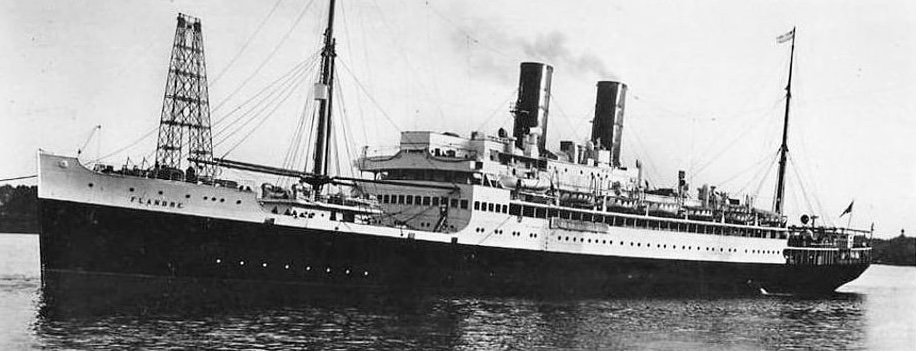
SS Flandre
Compagnie Générale Transatlantique · 1913 · Ship Guide
Overview
SS Flandre was a Compagnie Générale Transatlantique (French Line) liner built at Saint-Nazaire and launched in 1913. She belongs to a less-discussed but historically rich category of French passenger ship: not a giant North Atlantic celebrity liner, but a versatile route vessel whose career ranged from prewar commercial service to First World War hospital-ship work, interwar Caribbean sailings, refugee transport context, and eventual loss in 1940.
In collecting and interpretation, Flandre is especially important because her surviving documentation can belong to several very different historical worlds: prewar CGT passenger service, wartime naval or hospital-ship service, interwar Caribbean travel, and the 1939 refugee crisis. Those contexts should not be collapsed into a single generic “French liner” identity.
Key Facts
Flandre's registered dimensions and tonnages changed slightly in later wartime and interwar records. For museum-level cataloging, it is wise to preserve the exact specification set used by the source or artifact rather than silently harmonizing all figures.
Design & Construction Context
Flandre was part of a CGT generation influenced by mixed reciprocating-and-turbine machinery already seen in Rochambeau. She had four screws, with reciprocating engines and low-pressure turbines working together, a technically interesting arrangement that sits between older compound-engine practice and the later dominance of turbine-driven liners.
She was also significantly smaller than some of the more famous French Atlantic liners, which makes her interpretively useful. Flandre helps show that the French passenger fleet was not composed only of prestige flagships. It also included adaptable medium-sized liners suited to varied commercial routes and, later, wartime conversion.
Service History (Summary)
1914: Began her commercial career on a France–Vera Cruz voyage. The outbreak of war almost immediately disrupted that early peacetime identity.
August 1914: Briefly requisitioned by the French Navy as an auxiliary vessel to help protect English Channel troop crossings associated with the British Expeditionary Force, before being returned to CGT later that month.
1914–1916: Worked the France–Senegal–Brazil route after CGT absorbed the Compagnie de Navigation Sud-Atlantique. This is an important reminder that not all French Line material from this period belongs to a Le Havre–New York frame.
1917–1919: Requisitioned and converted into a hospital ship. She served in Mediterranean evacuation and transport work linked to the Armée d'Orient and Serbian forces, making repeated voyages between Salonica and Toulon with calls including Corfu, Bizerte, and Bône.
1918–1919: Continued in combined hospital-ship and troop repatriation service after the Armistice, carrying thousands of patients and troops before returning to CGT in 1919.
Late 1920s–1930s: Served Caribbean and Cristóbal routes via Le Havre, Plymouth, and sometimes Bordeaux, with calls that could include Guadeloupe, Martinique, Trinidad, La Guaira, Puerto Colombia, Curaçao, and Puerto Limón.
1933: Converted from coal to oil fuel, a practical modernization that extended her useful commercial life.
1939 refugee voyage: Carried hundreds of refugees, including Jewish refugees from Germany, Austria, and Czechoslovakia, to the Caribbean. More than one hundred were refused landing in Cuba and then refused again in Mexico, making Flandre part of the wider refugee crisis often discussed alongside the better-known St. Louis.
1940: After wartime lay-up and brief troopship use connected with the Norwegian campaign, she was taken by German occupation authorities for intended use in Operation Sea Lion preparations. On September 13, 1940, she was grounded by a magnetic mine near the mouth of the Gironde and broke apart the following day.
Not the Postwar Flandre
This guide covers the first French Line Flandre, launched in 1913 and entering service in 1914. A completely different CGT liner of the same name entered service in 1952. The shared name makes date control essential when cataloging postcards, menus, timetables, and photographs.
War Service and the Return to Caribbean Routes
The First World War interrupted Flandre's civilian career almost immediately. She later returned to French Line passenger service, including Caribbean and Gulf routes that placed her outside the better-known Le Havre–New York prestige corridor.
That geography is important because surviving material may reference Vera Cruz, Havana, or other Caribbean destinations rather than the North Atlantic routes most often associated with Compagnie Générale Transatlantique.
Refugee Context in 1939
In 1939 Flandre became entangled in the refugee crisis surrounding Jewish passengers seeking entry into Cuba. Contemporary Jewish Telegraphic Agency reporting documents a departure from Havana carrying refugees who had been unable to remain there.
This material should be handled carefully: the ship's role was transport within a much larger refugee-policy crisis, not an isolated maritime episode.
Interpretive Notes
Route discipline matters: Flandre should not be treated as a simple “French Atlantic liner” without qualification. Depending on date, a surviving item may belong to Mexican service, South Atlantic service, Caribbean service, hospital-ship service, or wartime transport context.
Hospital-ship material needs careful handling: items from the 1917–1919 period belong to a substantially different documentary world than peacetime passenger ephemera. Same hull, different administrative system, different visual culture, different historical meaning.
The 1939 refugee voyage deserves separate catalog attention: material tied to that sailing should not be described in ordinary tourist- or passenger-route language without noting the refugee crisis context.
Loss narratives can obscure the longer career: many summaries move quickly from “launched in 1913” to “sunk in 1940.” Curator practice should preserve the ship’s unusually layered life across commercial, naval, medical, and humanitarian histories.
Evidence-first ship guideSources (Selected)
- Ocean Liner Curator — Sources (master bibliography)
- SS Flandre (1913) — overview and chronology
- French Line timetable material — Caribbean route context (research aid)
- United States Holocaust Memorial Museum — refugee context in Cuba, 1939
- Jewish Telegraphic Agency — Flandre refugee voyage reporting
- British Pathé — Havana refugee footage context