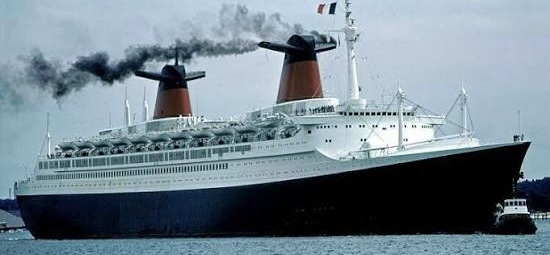
SS France
Compagnie Générale Transatlantique (French Line) · 1962 · Ship Guide
Overview
SS France was Compagnie Générale Transatlantique’s final purpose-built transatlantic flagship and one of the clearest examples of a great liner entering service just as its original market was disappearing. Launched at Saint-Nazaire on 11 May 1960 and entering the Le Havre–Southampton–New York service in February 1962, she combined national prestige, fast scheduled crossings, and a heavily curated program of French design.
Her French Line career lasted until 1974. Official French heritage material records 377 transatlantic crossings, 93 cruises, and two world cruises before the ship was laid up at Le Havre. Sold in 1979, she re-emerged in 1980 as the cruise ship Norway, beginning an entirely different commercial and physical phase.
Key Facts
A National Flagship in the Jet Age
France was conceived as a continuation of the French state-and-style tradition associated with earlier flagships, but she entered service in a radically changed transportation market. Jet aircraft were already taking a rapidly increasing share of Atlantic travel. That tension shaped the ship’s entire career: she was both a fully modern liner and an expensive national statement launched into a shrinking route.
Her scale and visual identity were part of the message. French Line publicity emphasized the ship as an expression of national industry, art, cuisine, and engineering rather than merely as a fast way to cross the Atlantic.
Design and Passenger Experience
The ship’s interiors were conceived as a coordinated showcase of contemporary French design. First- and tourist-class spaces were distinct, but both were used heavily in company publicity. For collectors, menus, deck plans, cabin literature, dining-room material, and dated sailing documents are especially useful because many can be tied to a specific class and voyage.
Official museum collections preserve French Line brochures, deck plans, menus, fare schedules, and world-cruise material from across the service period. That makes France unusually well suited to evidence-first object attribution.
377 Atlantic Crossings and a Growing Cruise Role
French heritage sources record 377 transatlantic crossings during the ship’s French Line career, along with 93 cruises. Those cruises were not a late afterthought: they increasingly supplemented the seasonal liner schedule as aviation eroded the transportation market.
The ship also completed two world cruises, in 1972 and 1974. These voyages illustrate the growing pressure to deploy a purpose-built liner in leisure markets that had not dictated her original layout or economics.
Withdrawal in 1974
The French government’s decision to end operating support in 1974 effectively sealed the ship’s fate as a state-subsidized Atlantic liner. Rising fuel costs after the 1973 oil crisis compounded the competitive pressure from aviation.
The final months produced their own documentary phase: labor protest, press coverage, farewell cruises, final schedules, and lay-up imagery. France was eventually berthed at Le Havre’s so-called “quai de l’oubli,” where she remained for roughly five years.
Norway: A Different Ship on the Same Hull
Sold to Klosters in 1979, the vessel was extensively rebuilt and returned to service in 1980 as SS Norway. The conversion changed passenger capacity, public spaces, operating geography, and commercial purpose. Later refits altered her again.
For curatorial work, France and Norway should therefore be treated as distinct operational identities even though they share the same hull. A cruise-era menu, deck plan, or photograph should not be used to reconstruct the 1962 French Line ship without checking the date and configuration.
Why France Matters
France matters because she was not merely “the last French liner.” She was a ship designed at the peak of postwar confidence and forced almost immediately to prove that the ocean liner could remain culturally desirable after losing its transportation monopoly.
Her archive is strongest when divided into French Line liner service, French Line cruising, 1974 withdrawal and lay-up, Norway cruise service, and final disposal. Those phases preserve the economic and physical changes that a single famous name can otherwise obscure.
Evidence-first ship guideSources (Selected)
Use these as a starting index and corroborate publish-ready details (dimensions by register edition, machinery descriptions, passenger capacity by season) with primary documentation where possible.