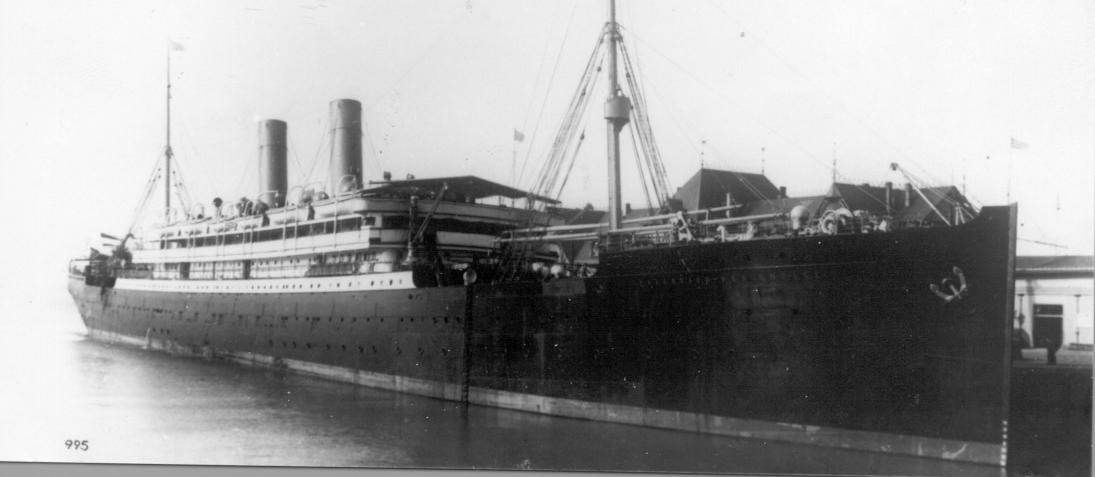
SS Friedrich der Grosse
Norddeutscher Lloyd · 1896 · Ship Guide
Overview
SS Friedrich der Grosse was a large Norddeutscher Lloyd passenger and mail steamer built by AG Vulcan at Stettin and launched in 1896. She was the first completed member of the company’s so-called Barbarossa class, a group of twin-screw intermediate liners intended for dependable long-distance work rather than record-breaking speed.
Her career connected several major fields of migration and imperial transport. She opened with service to Australia, later worked between Bremen and New York, and also sailed from Mediterranean ports to the United States. During the First World War she was interned and then seized by the United States, becoming the troop transport USS Huron. After the war she returned to civilian service and was finally renamed City of Honolulu, under which name she burned at sea and was sunk in 1922.
This page treats Friedrich der Grosse as the 1896 Norddeutscher Lloyd liner later known as USS/SS Huron and SS City of Honolulu. Her German name is also written Friedrich der Große; both spellings may appear in historical sources.
Key Facts
Tonnage and length figures vary slightly among registers and later compilations. Such differences usually reflect measurement practice, alteration, or whether registered or overall length is being reported.
Design & Construction Context
Friedrich der Grosse was designed as a large, steady intermediate liner rather than a high-speed express ship. Her twin screws and quadruple-expansion machinery gave her practical reliability for long routes, while her passenger and cargo capacity suited Norddeutscher Lloyd’s expanding global network.
At completion she was among the largest German merchant ships yet built. Her appearance—with two funnels, two masts, a long hull, and substantial superstructure—anticipated the more imposing German liners of the early twentieth century, but her moderate speed marked her as a working route vessel rather than a Blue Riband contender.
Australian and Atlantic Service
The ship’s maiden voyage departed Bremen for Australia in November 1896, placing her within Norddeutscher Lloyd’s imperial mail and passenger network to the southern hemisphere. She was subsequently shifted between Australian and North Atlantic assignments, demonstrating the flexibility expected of the Barbarossa-class ships.
On the Atlantic she appeared on Bremen–Southampton–New York schedules and, during parts of her career, on services connecting Italian ports with New York. Passenger lists and sailing notices from these routes preserve evidence of cabin travelers, emigrants, crew, and the practical movement of people through the company’s international system.
Migration Evidence
Friedrich der Grosse is especially well represented in passenger-list research. Surviving manifests and souvenir passenger lists document voyages from Bremen and Southampton to New York, while photographs of steerage passengers provide rare visual evidence of ordinary emigrant life aboard a German liner before the First World War.
Researchers should record the sailing date, route, commander, and class of passage whenever possible. The ship’s route changes mean that an undated item cannot safely be assigned to either her Australian or Atlantic service without additional evidence.
Military and Imperial Context
In 1900 the ship formed the backdrop for Kaiser Wilhelm II’s address to German troops departing for China during the Boxer Rebellion. The event is often cited because of the emperor’s inflammatory language, but the ship’s historical role should be described precisely: she served as a transport setting within a wider military deployment, not as a warship.
This episode also shows how major liners could become public stages for state ceremony and imperial politics. Photographs or printed references connected with the event should be interpreted within that specific dated context rather than generalized as representative of the ship’s entire civilian career.
Internment and USS Huron
When war began in Europe in 1914, Friedrich der Grosse took refuge in New York and was interned. After the United States entered the war in April 1917, she was seized, repaired after deliberate machinery damage by her German crew, and commissioned into American service. She was renamed USS Huron in September 1917.
As a U.S. Navy troop transport, Huron carried more than 20,000 troops to Europe and later returned both healthy and wounded servicemen to the United States. Her transport career is a distinct documentary phase, and artifacts from it should be cataloged under the American name while preserving the connection to the former German liner.
Postwar Service and Final Loss
Decommissioned in 1919, the ship passed to the United States Shipping Board and operated as SS Huron on South American routes. In 1922 she was assigned to the Los Angeles Steamship Company and renamed SS City of Honolulu for service between California and Hawaii.
On October 12, 1922, fire broke out during her first voyage under the new name. Passengers and crew abandoned the ship in an orderly evacuation, and no lives were lost. The burned-out hulk could not be safely recovered and was sunk by gunfire five days later. The loss ended a career that had crossed German imperial, American naval, South American, and Pacific passenger service.
Collecting Profile
Surviving material may include Norddeutscher Lloyd postcards, passenger lists, menus, sailing schedules, immigration manifests, photographs, and printed ephemera. Documents from her American phase may identify her as USS or SS Huron, while Pacific-service material may use City of Honolulu without mentioning her German origin.
Name changes make provenance especially important. A menu or photograph should be dated and matched to the vessel’s configuration and operator. Generic North German Lloyd material, or an item connected with another ship named for Frederick the Great, should not be attributed to this vessel without direct evidence.
USS Huron and the American Trooplift
After the United States entered the First World War, the interned German liner was seized in 1917 and renamed USS Huron. Conversion transformed a commercial passenger ship into a high-capacity troop transport. U.S. Navy engineering records credit Huron with eight wartime transport voyages carrying 20,771 troops to Europe.
That service places the former emigrant liner inside one of the largest logistical movements of the war. Her prewar ability to carry large numbers of passengers and substantial cargo made her particularly valuable once the United States urgently needed transatlantic troop capacity.
City of Honolulu and the 1922 Fire
After postwar service as Huron, the ship returned to civilian employment and in 1922 became SS City of Honolulu. On 12 October 1922 a serious fire broke out while she was at sea. Passengers and crew abandoned ship without loss of life.
The burned-out liner remained afloat for several days and was ultimately sunk by gunfire on 17 October. Her final episode is therefore best understood as two events: fire and abandonment on 12 October, followed by deliberate sinking after salvage was judged impractical.
Why Friedrich der Grosse Matters
Her career joins four distinct maritime systems in one hull: German imperial mail service, mass migration, American wartime troop transport, and postwar U.S. commercial service. The changes of name and flag are not side notes; they are central to understanding how useful passenger tonnage was repeatedly repurposed during an era of war and corporate reorganization.
Interpretive Notes
Friedrich der Grosse demonstrates how an ocean liner could serve several historical systems over one lifetime: migration, colonial mail service, military transport, postwar reconstruction, and regional passenger travel. Her importance lies less in luxury or speed than in the breadth of those assignments.
The ship’s successive identities also reward hull-based research. Following her from Friedrich der Grosse to Huron and City of Honolulu reveals a continuous material history that would be fragmented if each name were studied separately.
Evidence-first ship guideSources (Selected)
This list is intentionally conservative.
- Ocean Liner Curator — Sources (master bibliography)
- Norway Heritage — S/S Friedrich der Grosse, Norddeutscher Lloyd
- GG Archives — SS Friedrich der Grosse archival collection
- GG Archives — Passenger lists, 1902–1910
- Library of Congress — Steerage passengers aboard Friedrich der Grosse
- NavSource Naval History — USS Huron (ID-1408)
- The National Archives — Passenger lists research guide
- U.S. Naval History and Heritage Command — wartime transport statistics for USS Huron