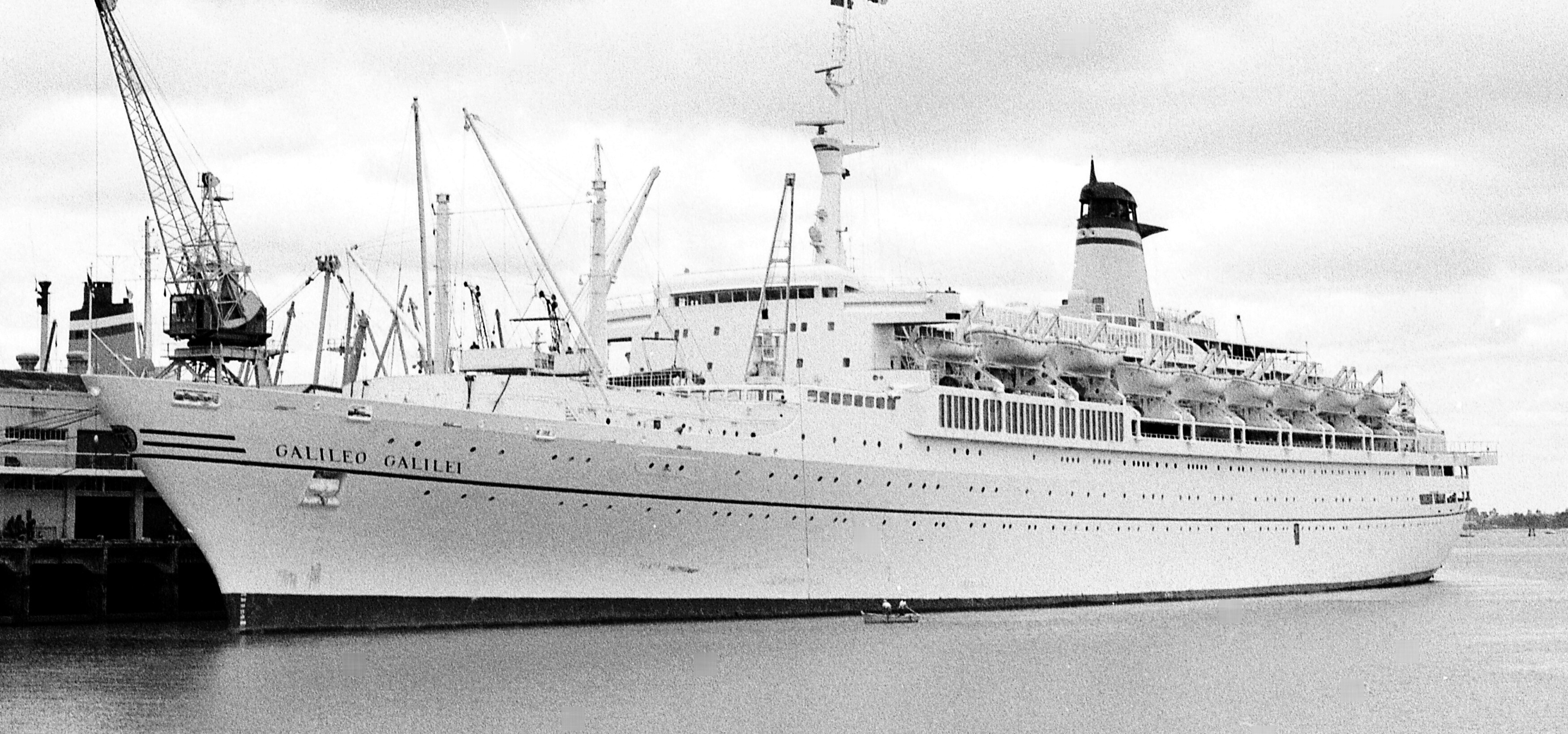
SS Galileo Galilei (1963)
Lloyd Triestino · entered service 1963 · Ship Guide
Overview
SS Galileo Galilei was one of the last large passenger liners purpose-built for the European migrant trade to Australia. Completed in 1963 for Lloyd Triestino, she and sister Guglielmo Marconi replaced the company's smaller postwar Australia-route ships and represented a final major investment in scheduled sea travel just as jet aviation was transforming the market.
Her career later traced the industry's broader transition from liner service to cruising. After leaving the Australia route in the late 1970s, she was rebuilt for cruise work and later sailed as Galileo, Meridian, and Sun Vista. She was lost to fire in the Strait of Malacca in 1999.
Key Facts
Built for the Australia Migrant Trade
By the beginning of the 1960s, Lloyd Triestino's postwar Australia-route ships were no longer sufficient for the scale and expectations of the migrant market. The company ordered Galileo Galilei and Guglielmo Marconi as larger, faster replacements designed specifically for the long Genoa–Australia service.
Museums Victoria describes the sisters as the last passenger ships purpose-built for the Australian immigrant trade. Their arrival therefore marked both a high point and an ending: they were sophisticated new liners entering a transport market that air travel was already beginning to erode.
Design for Long-Distance Travel
The ship's arrangement reflected the economics of migration service. Tourist Class overwhelmingly dominated her capacity, while First Class remained comparatively small. That balance allowed Lloyd Triestino to carry large numbers of emigrants while still providing the public rooms, deck spaces, and visual polish expected of a modern Italian liner.
One of the sisters' most distinctive features was a telescopic funnel top. It could be raised at sea to improve smoke dispersal and lowered in port to preserve the intended appearance of the ship's profile. The design became a memorable visual signature of the class.
Genoa to Sydney
Galileo Galilei was delivered on 23 March 1963 and began her first Australia voyage from Genoa on 22 April. Museums Victoria notes that the new ship reduced the Italy–Australia journey from roughly four weeks to about three on her maiden voyage.
Her sister Guglielmo Marconi joined the route later that year. Together they formed Lloyd Triestino's premier Australia service and became familiar ships to a generation of migrants arriving in Australian ports during the 1960s and 1970s.
Migration and Memory
The importance of Galileo Galilei is especially visible in Australian migration collections. Passenger recollections, brochures, accommodation plans, and arrival records survive in museums and family archives, often preserving the ship as part of a larger story of permanent relocation rather than tourism.
This distinguishes her historical role from prestige North Atlantic liners. For many passengers, the voyage was not a round trip or vacation but a one-way transition into a new life in Australia.
Changing Routes
The original service normally used the Suez route, but the operating pattern changed over time. Political disruption, canal closures, and evolving commercial conditions led to voyages by the Cape of Good Hope and, on some return passages, through the Panama Canal.
These route variations illustrate how global passenger shipping had to adapt to geopolitical events as well as to competition from aviation. A liner designed around one long-established corridor increasingly needed operational flexibility simply to remain viable.
The End of Scheduled Liner Service
By the mid-1970s, the combination of jet travel, rising fuel costs, and declining migrant traffic was undermining the economics of the Australia run. Galileo Galilei was withdrawn from regular liner service in 1977.
The ship was too modern to be immediately discarded, but the market for which she had been designed had largely disappeared. Her next phase therefore required a substantial shift from transportation to leisure cruising.
From Liner to Cruise Ship
After reconstruction, the former Australia liner returned to service as a cruise ship. She later passed to Chandris and became Galileo, then underwent another major modernization before entering service as Meridian for the newly developed Celebrity Cruises brand.
The changes were extensive enough that her later cruise identities should not be treated as unchanged continuations of the 1963 ship. Passenger capacity, interiors, operating pattern, and commercial positioning all evolved substantially.
Sun Vista and Loss
After leaving Celebrity service, the ship was renamed Sun Vista. In May 1999 a serious fire broke out while she was in the Strait of Malacca. Passengers and crew were evacuated, but the fire could not be controlled and the vessel ultimately sank.
Her loss ended a career of more than three decades that had crossed several distinct eras of passenger shipping: assisted migration, traditional liner service, early mass-market cruising, and the rise of modern cruise brands.
Why Galileo Galilei Matters
Galileo Galilei matters because she captures the paradox of the late liner age. She was among the most modern ships ever purpose-built for European migration to Australia, yet she entered service just as that transportation system was approaching obsolescence.
Her long second life also demonstrates that the transition from liner to cruise ship was not simply a change of itinerary. It required repeated rebuilding, rebranding, and reinterpretation of a ship originally designed for a very different social purpose.
Collecting Profile
Surviving material includes Lloyd Triestino brochures, accommodation plans, menus, postcards, passenger lists, tickets, sailing schedules, photographs, and migration documents. Australian museum collections preserve particularly valuable examples connected directly to passengers and voyages.
Later material should be cataloged by operating identity: Galileo Galilei, Galileo, Meridian, and Sun Vista represent distinct commercial phases even though they refer to the same underlying vessel.
Interpretive Notes
Delivery and maiden-voyage dates describe different milestones: the ship was delivered in March 1963 and began her first Australia voyage the following month.
Published tonnage figures differ slightly: sources commonly give values around 27,888–27,907 GRT as built. Rounded figures are used here rather than implying false precision.
The later cruise ship was substantially altered: continuity of hull identity does not mean that the ship retained her original 1963 passenger arrangement throughout her career.
Evidence-first ship guide