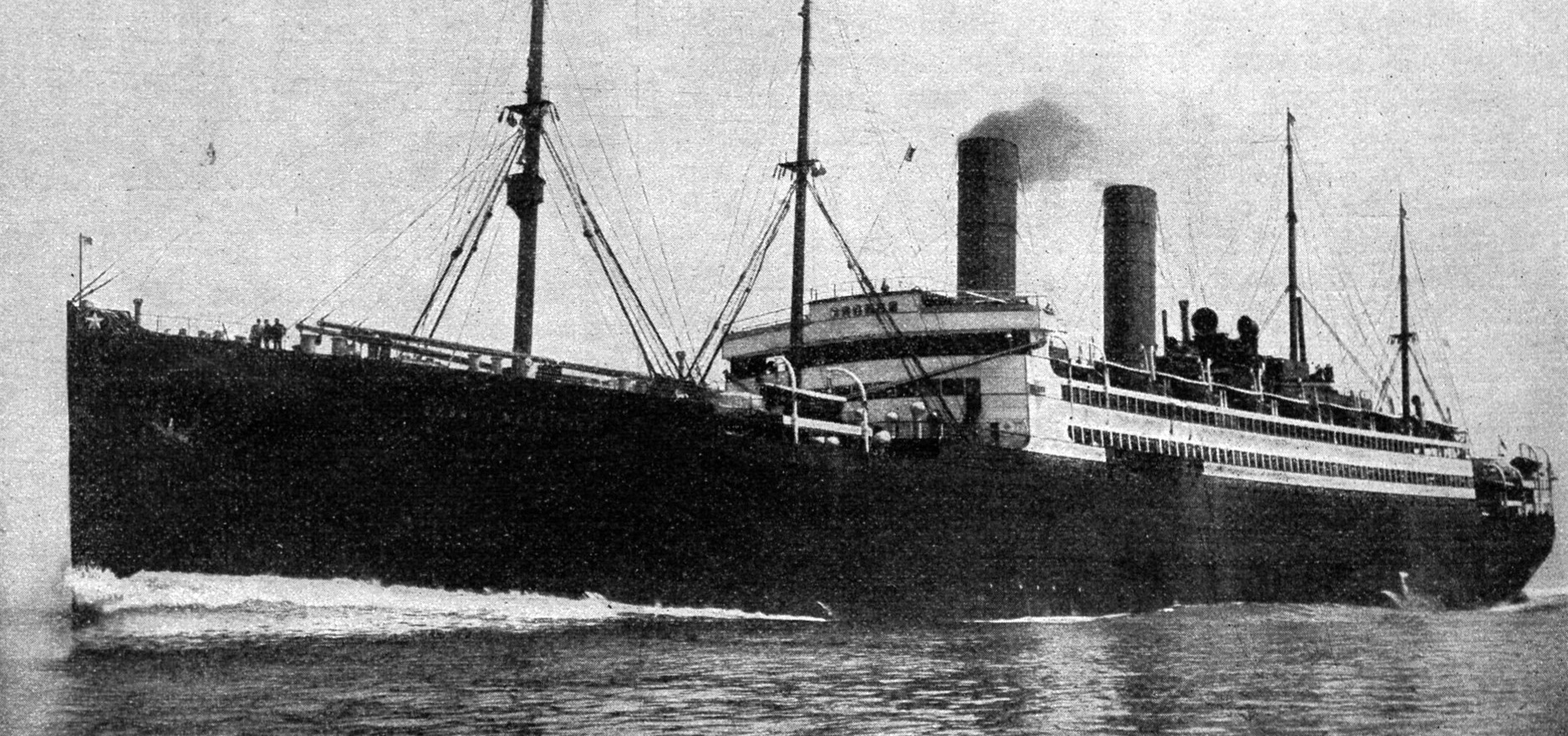
SS George Washington
Norddeutscher Lloyd · launched 1908 · Ship Guide
Overview
SS George Washington was one of Norddeutscher Lloyd's largest prewar liners and represented a different philosophy from the company's earlier four-funnel express ships. Built by AG Vulcan at Stettin and launched on 10 November 1908, she emphasized scale, passenger capacity, and comfort rather than an attempt to reclaim the North Atlantic speed record.
Her American afterlife was longer than her German commercial career. Trapped in neutral New York after war began in 1914, she was seized by the United States in 1917, converted into a major troop transport, carried President Woodrow Wilson to Europe for the Paris Peace Conference, returned to civilian Atlantic service, and was brought back into government use during the Second World War. The same ship remained in service history for more than four decades.
Key Facts
A Different Kind of German Flagship
At 25,570 gross tons, George Washington was far larger than the first generation of NDL express liners, but she was not designed around a record-breaking speed program. Her roughly 18-knot service profile reflected the growing commercial importance of spacious accommodation and large carrying capacity alongside speed.
That makes her a useful counterpoint to Kaiser Wilhelm der Grosse and the four-funnel express ships. By the late 1900s, prestige could be expressed through size, comfort, and scale as much as through headline crossing times.
1914–1917: Refuge in New York
When the First World War began, George Washington sought refuge in New York, then a neutral port, and remained there during American neutrality. Naval History and Heritage Command records that the United States took her over on 6 April 1917 and moved her to the New York Navy Yard for conversion into a transport.
The ship retained her name in American service, which can obscure provenance. A document headed George Washington may represent NDL passenger service, U.S. Navy transport work, later civilian American service, or U.S. Army operation. Date and institutional markings are therefore essential.
USS George Washington
The vessel was commissioned on 6 September 1917. Her first troop-carrying voyage began on 4 December, and during the next two years she completed eighteen round trips in support of the American Expeditionary Forces. U.S. Navy engineering history lists her troop capacity at about 6,000, making her one of the most valuable large transports obtained from the interned German fleet.
The transport's wartime story also intersects with the 1918 influenza pandemic. A contemporary account by Vice Admiral Albert Gleaves described a September 1918 voyage in which hundreds of influenza cases developed after sailing, forcing troop spaces to be converted into hospital areas. The episode provides a human and medical dimension often absent from technical ship summaries.
President Wilson and the Peace Conference
On 4 December 1918 George Washington departed for Europe carrying President Woodrow Wilson and the American delegation to the Paris Peace Conference. The voyage placed a former German liner at the center of the diplomatic aftermath of the war for which she had been seized.
Wilson's association with the ship is well documented, but collecting claims should still be phrased precisely. An artifact from George Washington is not automatically connected to the presidential party; a dated voyage, imprint, passenger context, or contemporary description is needed before making that narrower attribution.
Interwar Service
The Navy decommissioned the ship on 28 November 1919 after extensive troop and special-passenger work. She passed to the United States Shipping Board. After reconditioning, she returned to transatlantic passenger service in American hands, including operation associated with United States Lines.
Interwar material is therefore particularly rich: brochures, menus, passenger lists, sailing schedules, baggage labels, postcards, and promotional literature document the effort to recast a German-built liner as part of an American commercial fleet.
Second World War Reuse
The U.S. Government reacquired the aging ship in 1941 and briefly commissioned her as USS Catlin (AP-19). NHHC records that her coal-burning machinery could not provide the speed considered necessary against submarine threats, and she was decommissioned in September 1941.
After further government-directed employment, the vessel was converted to oil firing and operated as an Army transport, including wartime voyages to Casablanca, Australia, and the Pacific. She remained in service until 1947. Fire damaged the laid-up ship at Baltimore on 16 January 1951, and she was sold for scrap the following month.
Interpretive Notes
George Washington is a particularly strong lifecycle subject because the name stayed largely constant while the ship's meaning changed repeatedly. German liner, American Navy transport, presidential ship, civilian U.S.-flag liner, and Army transport are all legitimate identities, but they belong to different periods and evidence systems.
Her history also illustrates a larger pattern visible across Batch 15: the First World War did not merely interrupt German passenger service. It permanently redistributed major German-built liners into new national fleets and military systems, producing long afterlives that can only be understood by following provenance across flags and operators.
Evidence-first ship guideSources (Selected)
- Ocean Liner Curator — Sources (master bibliography)
- Norway-Heritage — S/S George Washington
- Naval History and Heritage Command — USS George Washington (Id. No. 3018)
- U.S. Navy — History of the Bureau of Engineering During WWI
- NHHC — Vice Admiral Albert Gleaves on the 1918 influenza outbreak aboard George Washington